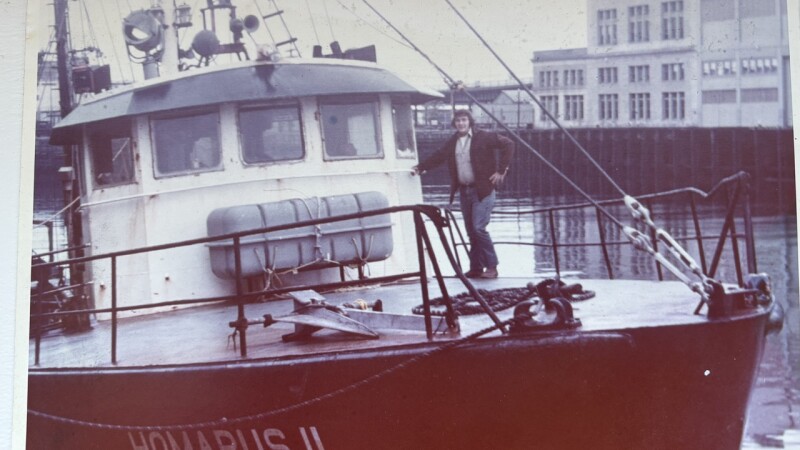
It was February of 1975, snowing and blowing 25 knots on the southern edge of Nantucket Shoals. Jim LeBoeuf, captain of the 50’ wooden offshore lobster boat Horizon, was slowly jogging upwind as his four-man crew hauled and stacked the 90 lb. Anderson lobster traps five high, in preparation for bringing them in for the season. It had been a cold trip, so cold that they slept fully clothed inside their sleeping bags. Nantucket Shoals is shallow water with curling breakers in virtually every direction, breaking waves on shallow bars separated by deeper water between. The resulting seas were best described as unpredictable.
These were dangerous conditions. Up in the wheelhouse, LeBoeuf kept watching ahead and behind to keep the boat and crew safe. At one point, he looked back to see Billy Garnos’ arm reaching up from the cold water he’d fallen into. LeBoeuf threw the boat in neutral, then kicked the stern around as the other crew members ran to the rail and fished Billy out.
At the time, they were running the boat out of Wychmere Harbor on the south side of Cape Cod to be closer to their gear. When they came into Wychmere Harbor that night, they found a frozen harbor. Alternately running the boat up on the ice, then backing away, they slowly cut a path through the loose ice and reached the wharf.
Everyone was exhausted, physically and emotionally, but the boat’s owner insisted that all the traps be offloaded, even though it was after midnight and the snow was coming down hard. The heavy traps couldn’t be stacked on the wharf, but had to be carried another 50 yards to the edge of the parking lot. It was a miserable night, but in retrospect, unloading the gear was the right decision because the heavy falling snow would have added weight to a boat already top-heavy with stacked traps.
Sadly, Billy Garnos lost his life 3 years later, when the F/V Fairwind, a 55’ steel lobster boat that he was captaining, was caught in a serious November nor’easter and overcome by hurricane-strength winds and massive, steep seas. David Berry, another Marbleheader, was also lost on the Fairwind that day. Both men had started their offshore fishing careers with LeBoeuf on the Horizon.
Although participants in New England’s nascent offshore lobster fishery during the 1960’s and 1970’s made very good money, they also took big risks, fishing 120 miles from port during the fall and winter when the weather was unpredictable. In retrospect, it is clear the boats were too small to survive the fast-moving storms that were a reality offshore, at that time of year.
It took a few more years, but gradually LeBoeuf came to realize that when offshore lobstering in 50’ boats, it just was a matter of time before the weather would be too big and the boat too small.
Coming up on the water
Both of his parents served in the Coast Guard, so it was natural that Jim and his brother Tom were drawn to Marblehead harbor, the boats, and the men who called Marblehead their home port. In the 1800s, Marblehead’s fishing fleet had more schooners than Gloucester, but after the storm of 1846, which caused the loss of 10 vessels and 65 men, Marblehead never regained its prominence.
When LeBoeuf was growing up in the 50’s and early 1960’s, the section of Marblehead’s harbor known as Little Harbor was home to a number of small boat fishermen, including lobstermen, tub trawlers, and fish trappers, as noted in Hugh Bishop’s book, “Marblehead’s First Harbor”.
“I could easily walk to Little Harbor from my house in old town Marblehead”, says Jim. “Back then you could cut through people’s backyards to reach the fish shacks that most guys had on the beach close to Graves Yacht Yard. We kids would hang around with the older guys, hoping they’d hire us to bait some tub trawls during winter, or let us lend them a hand hauling the mackerel trap on Tinker’s Island or Cat Island”.
At 12, LeBoeuf was hauling a few lobster traps from the punt his dad had rebuilt for him. By the time he was a teenager, he made weekend trips during the winter on Hugh Bishop’s tub trawler, helped haul Watson Curtis’ mackerel trap during the summer, and hauled a string of lobster gear from his skiff.
In 1963, he graduated from high school and joined the Navy even though he was only 17. He was honorably discharged at 21, though not before he served 6 months in the “fire zone” off Vietnam on the destroyer DD-778 Massey in the role of a gun fire electronics man.
The Massey was hauled out at the Chelsea Navy Yard in Boston around the time LeBoeuf was discharged. There he found work as a civilian working for the Navy, working on the same gunfire electronic systems he’d been trained on, but the work wasn’t satisfying.
Finding one’s place in the world during your 20s is something many of us do. After leaving the navy yard, LeBoeuf’s affinity with mathematics landed him a job with Hertz, then Blue Cross Blue Shield medical insurance, but he couldn’t stay away from the water.
Finding his way offshore
He landed a job on the F/V Red Diamond, an early offshore lobster boat that had formerly been a redfish dragger for the O’Donnell Usen company. It had a big air-start diesel that had to be stopped, then restarted to shift from forward to reverse. They used huge 4’x6’ metal traps shackled onto 5/8” wire cable between stops and often landed 50-100 lb. of big (5 lb. & up) lobsters from each trap. One afternoon, when coming into the hurricane wall and gate of New Bedford harbor, they shut the engine down to prepare for reverse gear, but the engine wouldn’t start again. LeBoeuf was serving as 1st mate and raced to manhandle the anchor windlass, dropping the big anchor, spilling the heavy chain out of the locker, then coming up tight, dragging a bit and fetching up only 100’ from the big SeaFreeze pair trawler tied to the dock.
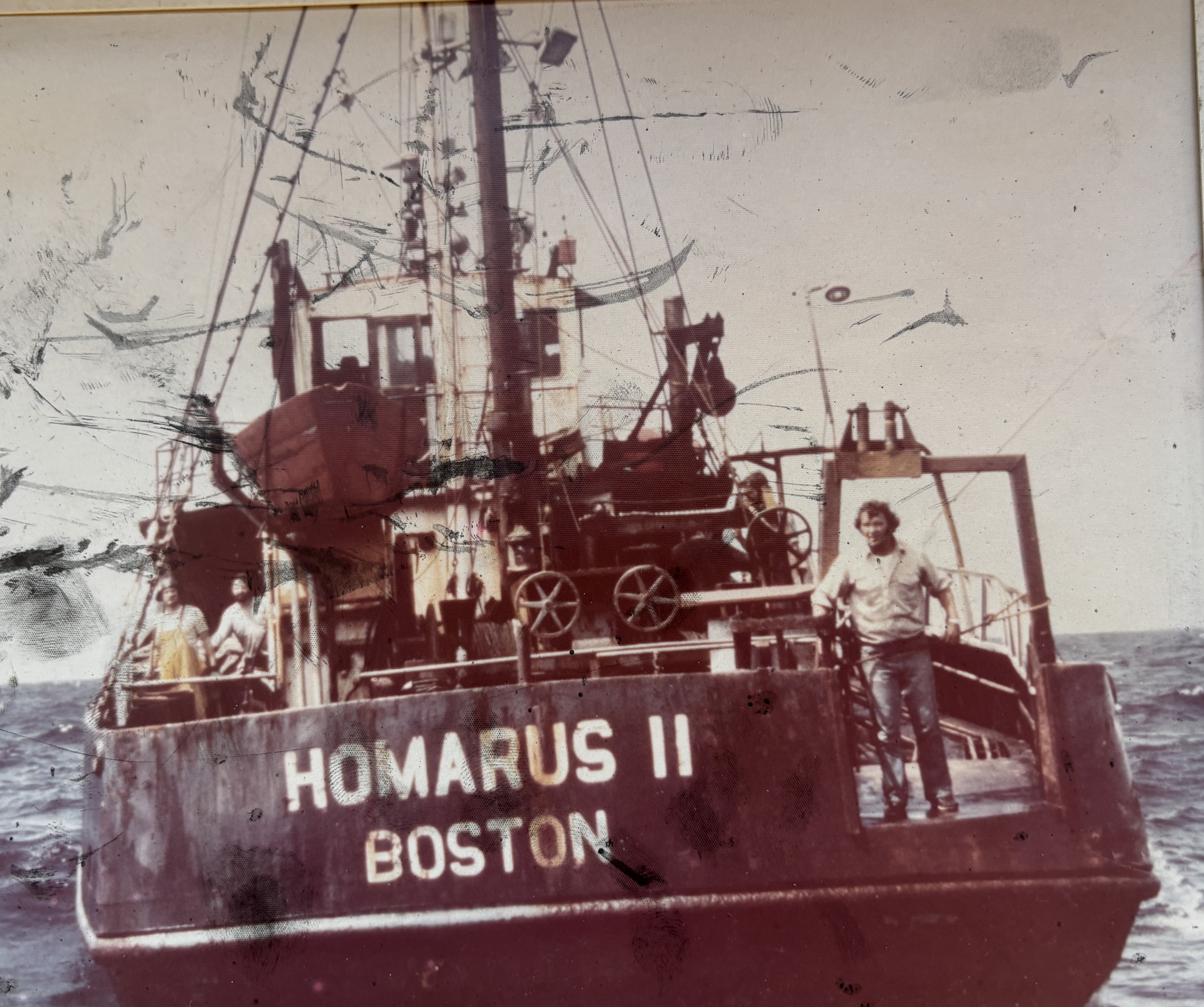
Deep Deep Ocean Products, the owners of the F/V Red Diamond, built a new boat (the F/V Homarus II), and LeBoeuf was asked to take over as captain when the original captain couldn’t take command. The Homarus II fished out of both Gloucester and Boston, depending on the time of year, and LeBoeuf commanded it for two years.
A decade in the wheelhouse
In 1973, LeBoeuf signed on to run the F/V Western Ocean with Western Ocean Resources, which operated several offshore lobster boats. Western Ocean also built big 4’ wire traps, which were now fished on a rope groundline rather than wire cable.
In 1974, LeBoeuf left Western Ocean to captain the 50’ wooden F/V Sea Dog, now renamed the Horizon, an offshore lobster boat owned by the Bartletts, a successful and entrepreneurial lobstering family from Beverly, MA. Interestingly, the Sea Dog was originally built and owned by Watson Curtis from Marblehead, who used it to tend his mackerel traps, the same traps LeBoeuf had helped haul as a teenager. LeBoeuf’s crew were Marblehead men, Tom LeBoeuf, David Berry, and Billy Garnos.
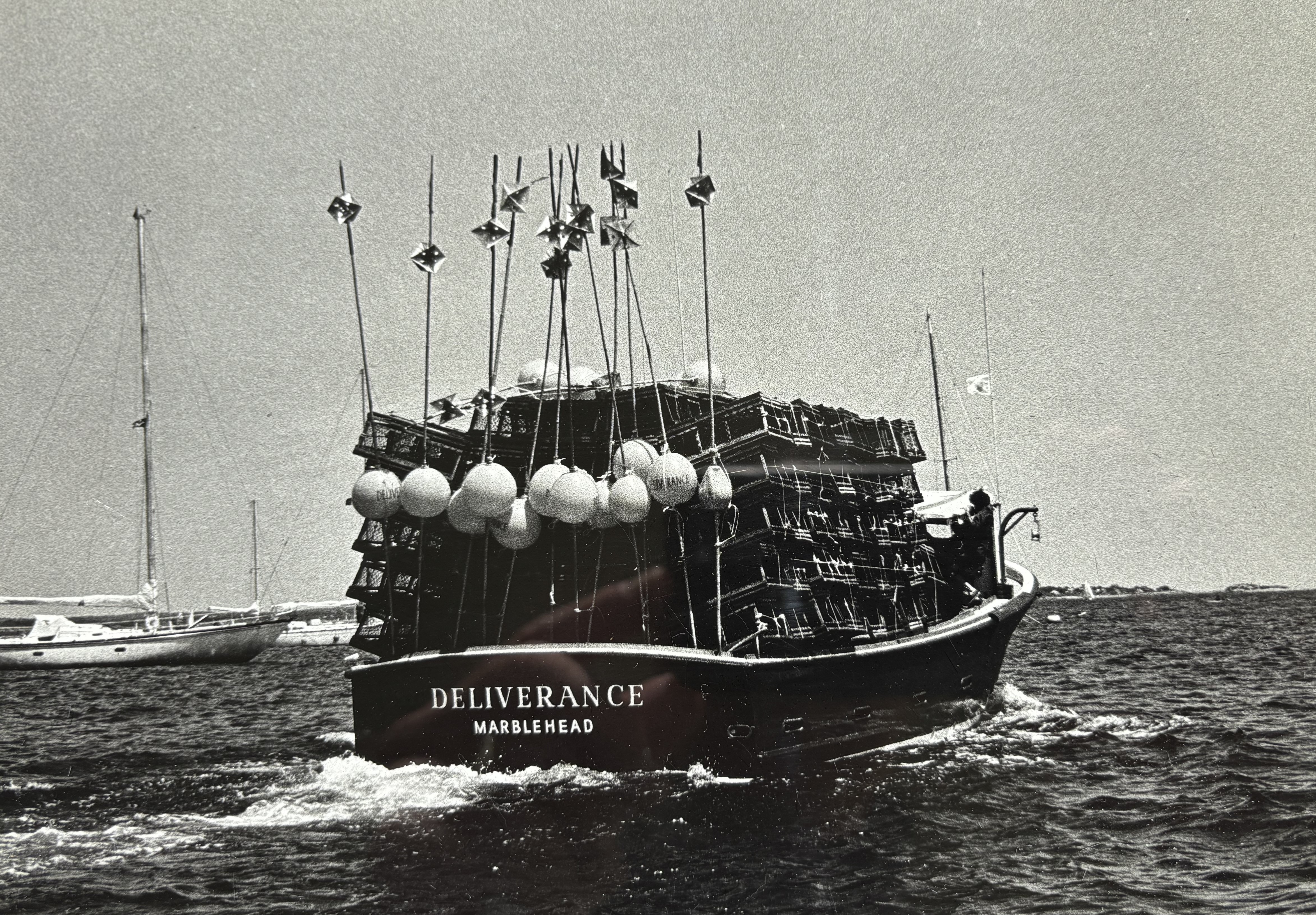
A few years later, Bob Brown, the hard-driving Marblehead line trawler and offshore lobsterman who would later own the Andrea Gail of the “Perfect Storm” fame, bought the Horizon from the Bartlett family, and LeBoeuf ran the boat for Brown. Brown was a tough man to work for, and an opportunity to run a 55’ Bruno lobster boat built specifically for the offshore fishery by Dick Bruno and Jim Gibson led LeBoeuf to the wheelhouse of the F/V Deliverance. For the next four years, including being at sea during the blizzard of 1978, LeBoeuf ran the Deliverance and made some wintertime tub trawling trips to the eastern edge of Georges Bank with Brown.
Ten years of fishing offshore in a 50’ boat, with its grueling schedule, the frequent near-death close calls, the cold, and the rough weather, will wear the toughest man down. In 1979, LeBoeuf was ready to call it quits and leave the wheelhouse and deck behind.
Trading the wheelhouse for the waterfront
This is where LeBoeuf’s story really gets interesting. How does a guy who has worked on the deck of a boat since he was a teenager reinvent himself and earn a decent living on shore?
What gives a guy, like LeBoeuf, the audacious idea that he can parlay his fishing industry experience into what has proved to be a remarkable and financially successful career on land, in the seafood business?
He decided he wanted to work in the seafood industry and began networking to find opportunities. He explored working for a seafood supplies company named Brailsford Associates, which sold Norplast totes and other items, but the dollars per transaction were modest, and he soon realized it would be hard to gain financial traction in this type of business.
Ferreting out employment opportunities, whether on land or the water, is an exercise in doing your homework and presenting yourself professionally. LeBoeuf would study what business a company was engaged in, who their customers were, and what products they sold. Then he’d decide how he might be able to help them and follow through by approaching them in a personal and professional manner that underlined that he was credible and responsible.
If an employment opportunity proved to be a dead end, LeBoeuf would ask for advice on other business owners who might be interested in his skills. A conversation with Mike Mineo at Mass Coastal in Gloucester led LeBoeuf to Jim Carlson and Ralphie Ventola, who were one of the exclusive importers of Norwegian cod and haddock fillets at the time. Carlson and Ventola didn’t have an opportunity for LeBoeuf to sell their Norwegian product, but they were in the midst of opening a new company, Mass Bay Fish, to trade seafood from other countries to their customer base, and they hired LeBoeuf on.
Carlson handed LeBoeuf a handbook which included a list of the companies who were members of the National Fisheries Institute, the seafood industry’s trade association, and said, “have at it”.
Finding opportunity in volume
How different is the thought process for deciding to commit half your lobster gear to a 20-mile section of the continental shelf and “having a nose” for finding the best matches for frozen cod fillets and large-volume purchasers who could use that product?
LeBoeuf’s affinity with math led him to understand that it is hard to make a living from a small, unstable supply of seafood and/or customers that buy just a few cases each of a variety of items. He realized he needed to find large-volume seafood producers and large-volume users of that seafood.
In the 1980’s, much of the frozen seafood imported into the U.S. came by reefer vessel, whether from Norway, Japan, Iceland, or even Canada. “I was standing on the wharf at the Quincy Market Cold Storage in Gloucester, watching a reefer vessel from Japan offload Mitsubishi brand Alaska Pollock fillet blocks,” says LeBoeuf. “They were offloading pallet after pallet of these blocks, which were being purchased by Gorton’s for their fish stick business. It didn’t occur to me immediately, but I soon realized this was the business I wanted to be in: big-volume production and big-volume consumption.” LeBoeuf was to enter the fish fillet block business, the raw material used by large U.S. companies such as Mrs. Paul’s, Gorton’s, Van de Kamp, etc., to produce a variety of retail and foodservice seafood items.
Fishing instincts, a new business
Other seafood companies began to notice the volume of the business LeBoeuf was doing, and he was hired by National Fish and Seafood in Gloucester to build their commodity block and fillet business. U.S. and Russian boats caught Alaska pollock and processed it into frozen, headed, and gutted fish, then shipped it to Korea for filleting and production of frozen fillet blocks because of Korea’s low labor costs. Those blocks were then shipped to the U.S. to provide the raw material for the “price sensitive” breaded fish stick and portions business.
LeBoeuf was well versed in boats and fishing. The companies that produced fillet blocks could relate to LeBoeuf and vice versa. In the mid-1980’s, the Alaska king crab fishery blossomed, and one of the preferred baits was East Coast herring. LeBoeuf had experience using literally millions of pounds of bait early in his career, and he stepped in to help Alaskan crab companies source Atlantic herring.
In the late 1980s, Jim was generating a significant amount of revenue at National Fish and Seafood and left to form his own company, Northern Ocean, which was largely backed by the owner of National Fish and Seafood.
Fishing experience, maximizing the bottom line
By the end of the 1980’s, U.S. boats were landing all of the Alaska pollock quota, and joint ventures with foreign fishing companies had been phased out. LeBoeuf was invited by the owner of a U.S. catcher processor boat, some 300' long, to make a trip, with the idea that he would begin marketing some of the boat’s fillet production. At the time, it was common for U.S. boats to have a Japanese fishing master onboard, directing where and how to fish. LeBoeuf discovered that the fishing master was incentivized on volume. As a result, the boat was landing tows of up to 150 tons, which resulted in inconsistent quality for a variety of reasons. It was a false economy, as customers rejected fillet blocks due to poor quality, which significantly impacted the boat’s profitability. LeBoeuf successfully pushed for smaller tows of 80 tons, which provided a steady stream of fish into the boat’s processing plant and reduced the percentage of bruised and old fish getting into the mix.
Jim’s career is a great example of how leveraging the skills needed to be a good fisherman can help you reinvent yourself in a way that provides the income and lifestyle you are looking for. Scale matters, and finding a rapidly changing industry helps, too. As our best coaches and teachers have told us, we are much more capable than we give ourselves credit for.
Thirty-five years later, LeBoeuf still has his hand in the business. He no longer captains any boats, but has a nice big farm in northern Maine, where the deer are encouraged to grow large and wily.