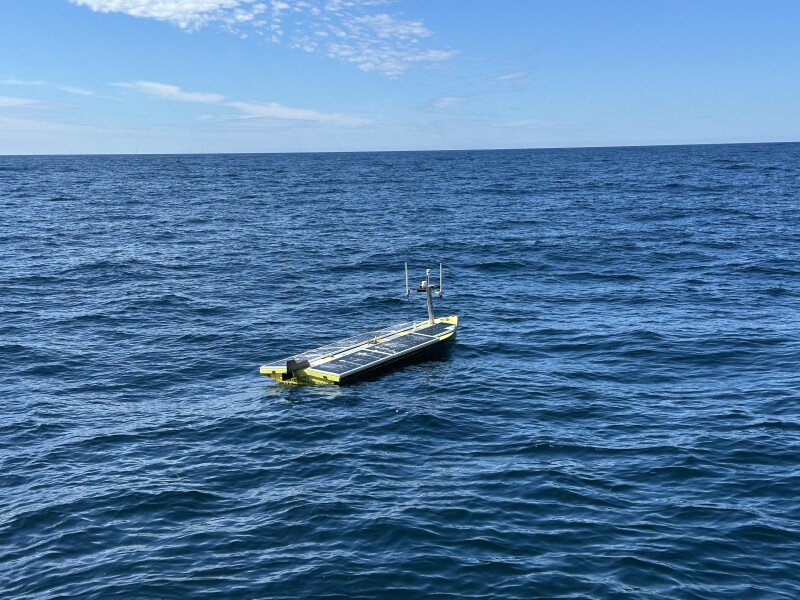
When a bright-yellow autonomous research vessel disappeared in the Gulf of Maine this month, the researchers behind it suddenly had a problem that couldn’t be solved from behind a computer screen.
They needed people on the water.
Commercial fishermen, marine businesses, researchers, and the Coast Guard quickly joined the search for the 15-foot SeaTrac, keeping an eye out as the vessel drifted offshore after researchers lost communication with it – the first time this has happened with these vessels.
What followed showed researchers at the Woods Hole Oceanographic Institution (WHOI) and NERACOOS just how quickly the working waterfront could mobilize around a piece of equipment many fishermen may not have known much about before it went missing.
“That’s a big part of the story – the way the community came together to help,” said Brenda Darroch, marketing communications manager for NERACOOS. “Everybody was invested in finding this.”
For Michael Brosnahan, a researcher at WHOI who studies harmful algal blooms or HABs, the response was especially meaningful. The SeaTrac is part of a developing network intended to give researchers earlier warning of HABs moving through the Gulf of Maine – including blooms capable of affecting shellfish, fish, and other marine life.
“We’re super appreciative of the response we got from people on the water. “This is a huge asset for us, and we’re trying to continue to build the data collected by these vessels.”
A search spreads throughout the waterfront
Researchers lost contact with the SeaTrac while it was being moved from its station off Jonesport, Maine, toward waters affected by a significant Karenia mikimotoi bloom. This specific kind of bloom causes severe mortality rates in shellfish and bivalves such as softshell clams, oysters, and other filter feeders.
The vessel had been operating roughly 10 miles offshore, where researchers have intentionally positioned it outside most lobster gear to limit its impact on fishermen. The team was moving it west to collect information on the bloom when it was parked overnight.
What happened next still remains uncertain.
Researchers believe there may have been an interaction with another vessel, but Brosnahan stressed that they don't know what caused the problem. The SeaTrac has several redundant communication and monitoring systems, but researchers lost contact with the vessel shortly after noticing unusual behavior.
A series of nor'easters complicated the search. Researchers traveled to Jonesport and went offshore with Alonzo Alley of Jonesport Shipyard in hopes the vessel might still be holding its assigned position despite the communication failure.
It wasn't.
The Coast Guard had been contacted within hours of the loss, while NERACOOS helped get information about the missing vessel out to the fishing community. Researchers eventually offered a $5,000 reward for information leading to its recovery.
Then the search took on a life of its own.
Information about the missing SeaTrac circulated online, fishermen kept watch offshore, and marine businesses offered assistance. Researchers also worked with companies willing to head offshore to retrieve the vessel if it could be located.
The breakthrough ultimately came from the SeaTrac itself.
Researchers believe the vessel flipped over at some point while adrift. It is designed to right itself, but that process can take time. After it came upright, its solar panels were exposed to sunlight again and eventually generated enough power for one of the vessel's basic communication systems to reconnect.
Less than a day after the reward was advertised, Brosnahan's phone started lighting up.
The little yellow boat was back online.
Fishermen were watching too
By then, however, the fishing community was already looking for it.
Researchers arranged for the vessel to be retrieved, with a boat heading offshore from Provincetown, Massachusetts. Around the same time, Brosnahan received an email from the wife of a fisherman who had spotted the SeaTrac roughly 40 miles offshore.
Her husband could see the missing vessel.
The fisherman continued reporting what he saw as the recovery boat approached. At one point, he could see the tow boat about 10 miles away.
For Brosnahan, the sighting was proof that even if the SeaTrac had not managed to restore communications, the broader search effort had a good chance of finding it.
“It was just really great to have people willing to keep their eyes peeled and report back to us,” he said.
The vessel was in a low-power, disabled state when it was located and recovered.
The experience also reinforced the importance of relationships between researchers and the people who spend their lives working offshore. The SeaTrac is only about 15 feet long, rides low in the water, and essentially resembles a floating solar panel. Researchers coordinate with NERACOOS and the Coast Guard on Notices to Mariners when the vessel is deployed, and it broadcasts an AIS signal and carries lights. However, as all know who spend the majority of their time on the water, things can still be easy to miss out there.
Why the little yellow boat matters
The recovery means researchers haven't lost an important piece of a larger effort to understand changing harmful algal blooms in the Gulf of Maine.
For roughly eight years, Brosnahan's team has been developing a regional sensor network to detect harmful algae. While the Gulf has a long history with the bloom, Alexandrium, which causes paralytic shellfish poisoning, researchers are seeing other harmful species emerge as waters warm, including species that can kill fish and other marine life.
That includes Karenia mikimotoi, which produced an unusually intense bloom along the Maine coast beginning around Labor Day.
Researchers operate shore-based monitoring stations in Maine, New Hampshire, and Massachusetts, but offshore detection is particularly important because large blooms can develop offshore before affecting coastal waters. The SeaTrac gives researchers a relatively flexible way to monitor those areas.
Using GPS, the autonomous vessel can hold position offshore without the expense of a traditional ocean mooring and large service vessel. Its automated microscope photographs phytoplankton cells, while data are sent back to shore via satellite connection, and artificial intelligence helps identify potentially harmful species. Results can reach researchers' monitoring system within about an hour of sampling.
The boats can also be moved as conditions change. Earlier this year, one was sent from the Isles of Shoals to Georges Bank after paralytic shellfish toxins appeared in hard-shell clams there for the first time in about a decade. Another had been stationed off Jonesport to watch for blooms researchers believe may originate in Canadian waters. Detecting a bloom developing near Nova Scotia could provide up to six weeks of warning before it reaches the Maine coast.
Building an early-warning system
For fishermen, that warning could make a difference.
During this fall's Karenia bloom, Brosnahan said some concentrations reported in Casco Bay reached roughly 50 million cells per liter. The species can occur below the surface and has been associated with low-oxygen conditions, creating potentially damaging conditions for marine life. Researchers heard reports of impacts to worms, clams, and other organisms on Maine mudflats.
The goal of the National HAB Observing Network in the Northeast is to provide better information about where blooms are developing, where they may be headed, and what fishermen and coastal communities could face next. The vessels are deployed seasonally based on bloom patterns, with someone on call whenever they are offshore.
The loss will also give researchers a chance to reassess the system. Brosnahan said the team plans to look at what can be improved to reduce the chances of another vessel disappearing.
But the experience also showed the value of having more eyes on the water.
If another little yellow boat ever needs help offshore, more fishermen now know what they're looking at — and why it's there.