

From hybrid propulsion systems taking shape in Alaska to quiet shifts in how fishermen think about fuel, weight, and efficiency, the next phase of the low-carbon fishing fleet isn’t defined by a single solution. It’s a mix of incremental gains– alternative diesels, hybrid systems, and even how a boat sits in the water.
Across the industry, one thing is becoming clear: the path forward isn’t one-size-fits-all. It’s tied to how each vessel works, where it fishes, and what it burns to get there.
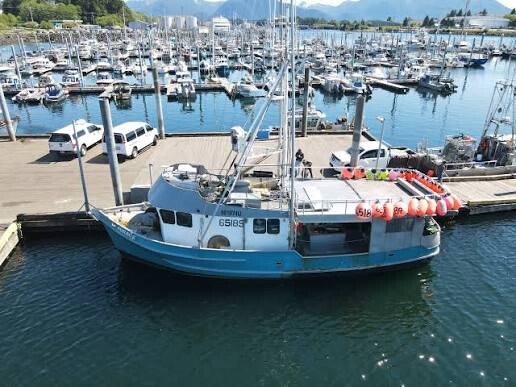
In Sitka, Alaska, that future is already tied up to the dock. The 50-foot Mirage, owned by fisherman Jeff Turner, is one of the first U.S. commercial fishing vessels outfitted with a hybrid diesel-electric propulsion system– a project backed by the U.S. Department of Energy and supported by the Alaska Longline-Fishermen’s Association (ALFA).
For Turner, the benefits showed up right away, and not just at the fuel tank.
“The noise pollution is something I really notice,” Turner shared during the vessel christening event reported by KCAW. “A quiet boat is fatigue-free. I mean, you’re talking in a normal voice. You don’t have to yell across the deck.”
That reduction in noise– something echoed by fishermen across the fleet– has become one of the most immediate and tangible benefits of hybrid systems. In a previous article on National Fisherman, Maine lobsterman Christian LaMontagne pointed to the same advantage, noting that reduced engine noise would be “such a quality-of-life increase.”
But behind the comfort factor is a more measurable gain: fuel savings.
According to another National Fisherman article by Paul Molyneaux, energy consultant Chandler Kemp estimates the Mirage could see “roughly…20 percent fuel savings and reduced wear and tear on the main engine.” While that number varies depending on how a boat operates, it reinforces what researchers are finding– hybrid systems can cut fuel use, especially in fisheries with long idle times or variable power demands.
However, the technology isn’t plug-and-play. “The vessel’s operating profile will determine what makes the most sense,” Kemp said, emphasizing that differences between day boats and week-long trips can significantly impact efficiency.
Alternative fuels: promise with trade-offs
While hybrid systems are gaining traction, they’re only one piece of the equation. The broader conversation around decarbonization is increasingly focused on what fuels boats will burn in the decades ahead.
Alternative fuels– from biodiesel to hydrogen– offer pathways to reduce emissions, but each comes with trade-offs. Biofuels are among the most immediately accessible. They can often be used with existing engines, making them one of the more practical near-term options. But they’re not without challenges, including concerns over fuel stability and long-term engine impacts.
Other options, like liquefied natural gas (LNG) and methanol, offer lower emissions but require significant changes to onboard storage and safety systems. Hydrogen and ammonia, often cited as long-term solutions, remain limited by infrastructure and vessel design constraints– particularly for smaller commercial boats.
As the American Bureau of Shipping safety advisory notes, “the lower energy density of most alternative fuels impacts fuel storage, vessel design, and operational range,” forcing fishermen and designers to weigh trade-offs between range, safety, and efficiency.
Kemp sees the future as a combination of systems rather than a single fuel switch. “What I think could happen…is that we could see hydrogen fuel cells being used for propulsion and a battery incorporated into the system to augment the fuel cell,” he told Molyneaux.
Challenges on shore
Even as new systems emerge, one of the biggest challenges isn’t on the boat– it’s on shore. “There isn’t anybody in this country yet making these systems,” said Linda Behnken, executive director of ALFA, in KCAW reporting. “There is an electric outboard maker that we want to use on a mariculture boat. But there isn’t anybody certifying marine-certified batteries in this country yet, or building these systems.”
That lack of domestic manufacturing and certification is compounded by logical hurdles. Transporting batteries, for example, has already become an issue in Alaska, where shipping restrictions have tightened due to fire risk.
“The whole discussion about how you move an electric vehicle to Alaska…we can’t put them on these container ships anymore because of the danger of fire,” said Sen. Lisa Murkowski. “So we’re going to have to figure this one out pretty darn quick.”
And for ports without access to high-capacity electrical infrastructure, the challenges are even more basic. As LaMontagne said, access to charging power varies widely from port to port, limited by where hybrid electrical systems can realistically operate.
Efficiency starts with the hull
While much of the conversation around the low carbon fleet focuses on engines and fuel, another piece of the puzzle is gaining attention: how efficiently a vessel moves through the water in the first place.
Vessel lift and displacement– essentially how much of the boat sits in the water and how much resistance it creates– can have a direct impact on fuel consumption. A heavier boat, or one that pushes more water, requires more power to move. That translates directly into higher fuel burn, regardless of what fuel is used.
This is where incremental changes can make a difference. Adjustments to hull design, weight distribution, and even gear storage can reduce drag and improve efficiency without requiring a full propulsion overhaul. For the low-carbon fleet, those gains matter.
Fishermen-led research conducted through the Fishery Friendly Climate Action Campaign emphasized that reducing emissions isn’t just about switching fuels– it’s about reducing energy demand across the board. That can include everything from propulsion systems to auxiliary loads and hull efficiency.
Hybrid systems, alternative fuels, and renewable add-ons like solar or wind all benefit from a more efficient platform. The less energy a vessel needs, the easier it becomes to integrate lower-carbon solutions.
A working waterfront approach to change
For many fishermen, the transition to a lower-carbon fleet isn’t about chasing trends–it’s about staying competitive and keeping operations sustainable in the long run. “I want to take advantage of the system. I want to see what it can do,” Turner said of the hybrid setup on the Mirage. “And I want the next person, and the next person, to learn from it…what’s it gonna be in five years, ten years.”
Real-world experience continues to shape how new technologies are tested and adopted across the fleet. From hybrid diesel-electric systems to alternative fuels and smarter vessel design, the future of commercial fishing is being worked out on deck, trip by trip.