




As pressure mounts to decarbonize the maritime sector, U.S. commercial fishermen are navigating the most transformative shifts in the fleet’s history. According to the Energy Transition for the U.S. Commercial Fishing Industry: Technical and Operational Advisory, released by the American Bureau of Shipping (ABS) in partnership with the U.S. Coast Guard and CDC’s National Institute for Occupational Safety and Health (NIOSH), the path toward low-carbon fishing will require major changes in vessel design, infrastructure, and safety protocols.
According to the advisory report, “The U.S. commercial fishing vessel industry is a vital component of the American blue economy,” supporting 700,000 jobs and generating $55 billion in annual sales. Yet nearly all of that fleet still runs on diesel.
Electrification on the horizon
The ABS advisory identifies electrification as one of the most promising technologies for cutting emissions, lowering fuel costs, and reducing maintenance demands. Countries like Norway and Denmark are already deploying hybrid and full-electric systems across fishing fleets from 30 to 280-foot vessels. For the U.S., the challenge will be scaling those systems across diverse vessel types from Maine lobster boats to Gulf shrimpers and investing in the infrastructure to support these changes and upgrades.
In Maine, lobsterman Christian LaMontagne is among the growing number of fishermen eyeing that future. “Especially because a lot of my day lobstering, I’m just sitting in idle, bouncing between strings,” LaMontagne told National Fisherman in a previous interview. “It would be such a quality-of-life increase to have reduced noise.”
The ABS report also highlights the noise reduction benefit for better crew conditions and marine ecosystem health as a key advantage of hybrid-electric propulsion. Beyond comfort, reduced noise also lessens underwater acoustic pollution, also an increasingly important factor in sustainable fisheries.
Power & Practicality
In Alaska, fishermen and researchers are taking a multi-pronged approach. “Solar seems promising for the seafood processing sector,” Linda Behnken, executive director of Alaska Longline Fishermen’s Association (ALFA), told National Fisherman. “But I am not aware of workable technology for our small-scale commercial fishing boats at this time.”
Behnken’s group is collaborating with the Department of Energy’s Vehicle Technology Office and engineers at Kempy Energetics to test hybrid diesel-electric propulsion systems that could eventually pair with solar or wind power. “The next feasible step is a hybrid diesel-electric system,” she shared, which is a concept strongly supported by the ABS advisory’s recommendation that hybridization be prioritized for nearshore and medium-sized vessels where charging access is realistic.
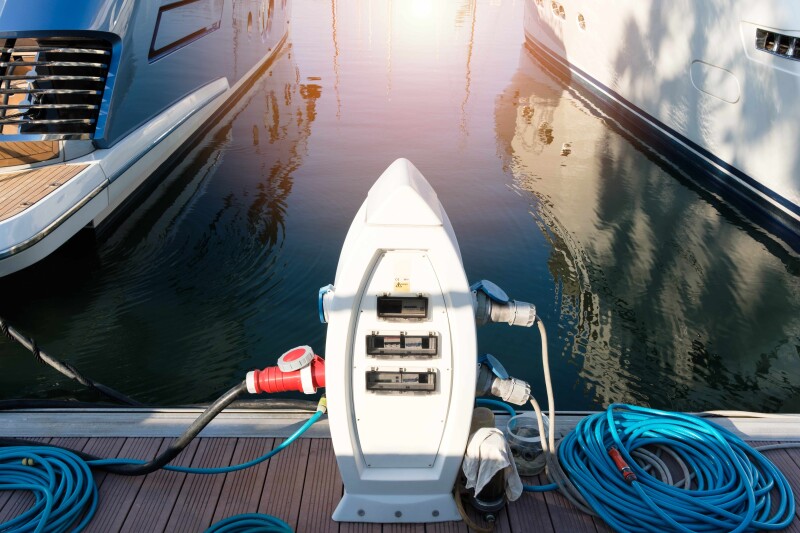
However, as LaMontagne pointed out, infrastructure remains a limiting factor. “In Portland, we’re incredibly lucky,” he said. “They already have triple-phase electric for superyachts, and that’s exactly what you’d use to charge an electric boat. But once you head Downeast (Maine), it’s another story.”
The advisory report also points out this gap, calling for “parallel investment in vessel upgrades and waterfront infrastructure.” Without accessible power at the dock, the most efficient systems will remain out of reach for small ports and remote communities.
Weighing alternative fuels
While electrification captures much of the spotlight, the ABS report explores a wide range of fuel options, including liquefied natural gas (LNG), methanol, biodiesel, hydrogen, and ammonia, each with distinct challenges and advantages.
Biofuels, derived from renewable organic materials, are “readily available and mature for commercial fishing” but require further development to mitigate corrosion and clogging issues. LNG and methanol are both lower-emission options that demand specialized storage systems and safety protocols. Hydrogen and ammonia, two zero-carbon fuels often hailed as long-term solutions, still face “infrastructure and design limitations, particularly for smaller vessels.
Even the best-designed systems come with trade-offs. The report warns that “the lower energy density of most alternative fuels impacts fuel storage, vessel design, and operational range, requiring careful engineering to maintain vessel stability and safety.
Safety & training
Adopting new fuels also introduces new risks from cryogenic burns with LNG to toxic vapor exposure to methanol or ammonia. “Ensuring crew safety through proper design, training, and emergency preparedness is essential,” the ABS report stated.
Recommendations include enhanced firefighting systems, real-time vapor detection, and specialized drills simulating leaks or battery fires. The report also calls for new regulations tailored to alternative fuels, noting that existing U.S. Coast Guard and EPA rules “lack specific provisions for fuels like ammonia, hydrogen, methanol, and lithium-ion batteries.”
For fishermen like LaMontagne, the transition couldn’t happen overnight, but the introduction of these new propulsion methods is becoming more common. “Being younger, switching to a new system is potentially more rewarding,” he said. “I’ve got more years to capitalize on it.”
That mindset —pragmatic, year-forward-thinking —is exactly what the ABS envisions for the industry’s next phase. “The commercial fishing industry can safely embrace alternative fuels and modern energy systems by updating regulatory frameworks, bolstering emergency preparedness, and prioritizing specialized crew training,” the report stated.
Across the country, fishermen and innovators are proving that cleaner power doesn’t have to mean compromise. From wind-assisted vessels to first-generation hybrid boats, the fleet’s energy future may look very different, but it’s still grounded in the same independence that has always defined the way of life that makes up America’s working waterfronts.
.jpg.small.400x400.jpg)
