

When Christian LaMontagne talks about the future of fishing, he’s not dreaming of bigger engines or faster runs offshore. He’s thinking torque. Silence. Clean power. And most of all, options.
LaMontagne runs a 34-foot Wayne Beal called Guillemot, a commercial boat from Long Island, Maine, rigged for lobstering in the warmer months and winter scalloping, both under state licenses. His setup is old-school dependable, a Caterpillar 3116 diesel, 300 horsepower, all mechanical, no computer system in sight. “It’s like the old reliable,” he said. “Super maintainable, super simple.”
However, simplicity has its costs. LaMontagne’s fuel usage is relatively modest, around 25 gallons per day during scallop season, less for lobstering. Yet fuel still eats up about 15% of his expenses. “It hasn’t been a huge concern for me because I really try to make it better,” he explained. “But if we can have reliable energy, there are a lot of things that come with that.”
That’s where the conversation of diesel-electric hybrid engines came in.
The right fit for inshore work
LaMontagne sees hybrid propulsion not just as a climate solution, but as a practical upgrade for boats like his. “Especially because a lot of my day lobstering, I’m just sitting in idle, bouncing between strings,” he said. “It would be such a quality-of-life increase to have reduced noise.”
It’s not just about comfort, it’s about capability. “I didn’t know anything about diesel engines or mechanical stuff on a boat until about three years ago,” he said. “Now I’m doing oil changes, replacing valves. I’ve learned a lot. There’s no part of me that doubts I could learn to maintain an electric system, too.”
For LaMontagne and others like him, the limitations of battery weight and range aren’t deal-breakers. “We’re day boats,” he said. “We’re not running overnight trips. We could trickle charge overnight and be ready to go in the morning.” With fishing methods that already operate at low speeds and close to shore, the diesel-electric hybrid has real appeal.
Trust, testing, and tech support
Still, the path to adoption won’t be instant. One of the Policy Pathways to a Low Carbon Fishing Fleet reports, published by the Fishery Friendly Climate Action Campaign, captures a consistent message from fishermen nationwide: new technologies must be proven before they’re embraced.
Fishermen interviewed for the report stressed the importance of real-world demonstrations, financial support, and full-service backup. As one Oregon fisherman put it, “I don’t mind going first, as long as when I sign on the dotted line, there’s technical support, [so] if you went first, you’re not just stuck with a pile of shit.”
Many individuals from the report also echoed LaMontagne’s own openness, as long as the rollout comes with risk protection.
“I’d be totally into running it,” he said. “Just to get some comfort with electric systems. I’d even consider trying to rig up a 25-foot electric skiff just to see how it works.”
The report also emphasized the need to involve fishermen from the beginning, something LaMontagne also supports. “People in this industry are smart. They’ll adapt. I’ve seen the fleet evolve quickly before. This idea that we can’t change is a myth,” he said.
The infrastructure gap
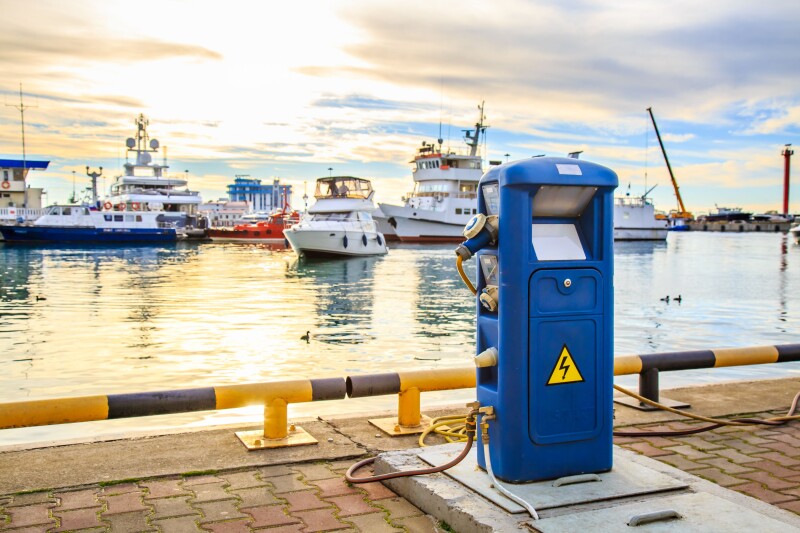
Even the most motivated fishermen can’t adopt a new propulsion system if the local dock doesn’t have the power to support it. “In Portland, we’re incredibly lucky,” LaMontagne said. “They already have triple-phase electric for superyachts, and that’s exactly what you’d use to charge an electric boat.”
But once you head Downeast, it’s another story. “It might be decades before some of those communities see that kind of infrastructure,” he said. “Places like Long Island might never get it. Who knows?”
This disparity in shore power access is a key concern in the Policy Pathways report, which calls for parallel investment in vessel upgrades and waterfront infrastructure. It’s not just about building better boats; it’s about making sure every port is ready to support them.
Affordability matters
Fishermen don’t avoid these systems because they don’t want them- they avoid them because they can’t afford them.”
Even with enthusiasm and optimism around new technology, the upfront cost of a diesel-electric system could stop most small-boat operators in their tracks. That’s why strong state and federal incentives are key. Programs like the EPA’s Diesel Emissions Reduction Act (DERA) and the USDA’s Rural Energy for America Program (REAP) are starting points, but not guaranteed, and more tailored support is needed.
As one Massachusetts lobsterman told researchers, “You can’t really half-put an electric engine in and see what happens. It’s either all the way or nothing. Unless it isn’t going to cost them a penny, no one’s going to jump.”
LaMontagne agrees that the right incentives could make a huge difference. “Once you start throwing money at it, people might get interested,” he said. “People might realize this could be a good change.”
Younger voices, bigger impact
LaMontagne represents a generational shift in the fleet. He's open to innovation, grounded in practicality, and not afraid to experiment. “Being younger, switching to a new system is potentially more rewarding,” he said. “I’ve got more years to capitalize on it.”
But he also sees the complexity. “You can’t ignore the emotional connection people have with their boats,” he added. “It’s an extension of you. Changing the engine is a big deal.”
Still, LaMontagne is convinced that diesel-electric is coming, whether in the form of a quiet skiff for puttering around the island or a fully tricked-out workhorse. “It’s already happening in some regions. And I wouldn’t mind being part of that change.”
Find more on Talking Shop on a Low Carbon Fleet here.