

Scientists have documented a much broader spawning distribution for Atlantic bluefin tuna than previously recognized, according to new research published in Progress in Oceanography.
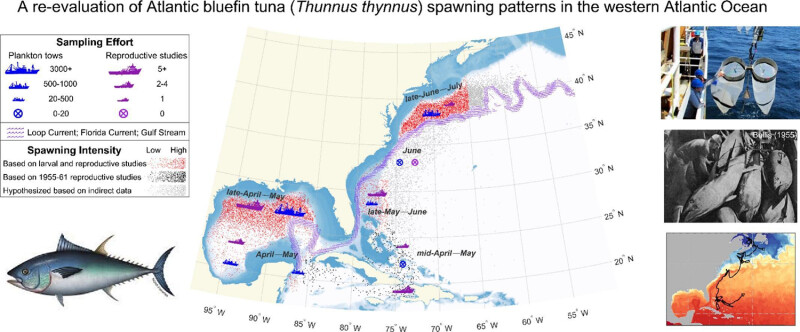
The NOAA Fisheries study, which analyzed more than 35,000 plankton tows and examined nearly 5,000 individual tuna larvae from 1955 through 2021, found that bluefin tuna spawn in a nearly continuous area from the Northwest Caribbean to the Slope Sea off the Northeast U.S. continental shelf.
In addition to the known spawning ground in the Gulf of Mexico, bluefin spawn in the Northwest Caribbean Sea, north of the Bahamas, the Blake Plateau, off the Carolinas shoreward of the Florida Current, and the western Slope Sea.
The northern Gulf of Mexico in late spring and the western Slope Sea in early summer produce the most larvae, according to the study. The results suggest bluefin spawn in a continuous area during a prolonged spawning season that starts in April in the southernmost areas and ends in early August in the Slope Sea.
"Previous larval studies outside the Gulf of America were often based on a single year of sampling," said Dave Richardson, a research fish biologist and lead author of the study. "When we compiled data from many surveys, the consistency was remarkable. When you sample the same area at the same time of year, you consistently find bluefin larvae. This confirmed the pattern we've seen in recent years has been going on for a long time. For example, bluefin larvae have been collected from the 1970s through the 2000s in both the Yucatan Channel in the south and the Slope Sea in the north."
Bluefin tuna have historically been managed as two stocks — one that spawns in the Mediterranean Sea (eastern) and the other that spawns in the Gulf of Mexico (western). Recent larval and reproductive sampling added the Slope Sea to the list of known spawning grounds. Previous research suggests the populations may mix in the Slope Sea.
Mapping all bluefin spawning grounds is critical to provide a more realistic picture of the population structure and show the extent to which there are unique groups of fish that primarily interbreed with one another, according to the researchers.
Scientists analyzed larval and reproductive data from research surveys, museum and archive samples dating back to 1972, and cruise reports, published data, paper records, and field notes dating back to the 1950s.
The Southeast Area Monitoring and Assessment Program, a state-federal program that collects fishery-independent data in the southeast United States, contributed the most bluefin larvae to the analysis. Since 1982, the program has been consistently sampling the northern Gulf of Mexico during the peak spawning times of April and May.
Museum and archived samples were critical to the analysis. Scientists measured larval bluefin tuna abundance in previously unsorted plankton samples collected from 1982 through 2021 and reanalyzed museum collection samples dating back to 1972. Many bluefin larvae were "hiding in plain sight" — not identified at the time because larval fish guides stated that bluefin larvae were only found in the Gulf.
"Larval fish look nothing like their adult selves. Fins, pigment, even mouth and eyes develop over the first few days or weeks after hatching," said Katey Marancik, a research fishery biologist and co-author. "We need to rule everything else out to confidently identify the species. This takes skill and experience. It comes down to minute details under a microscope, like specific and unique pigment patterns, that change as the larva develops. We did this several thousand times."
The study mapped 42 years of sea surface temperatures and looked for changes in suitable areas and times for bluefin spawning. Between 1982 and 2023, spawning areas reached ideal spawning temperatures earlier in the year due to warming ocean temperatures. The Slope Sea in particular is warming faster than other spawning grounds. However, there is little indication that the location of bluefin spawning has changed over the time series.
"Our findings re-affirm that bluefin tuna spawning is related to biology and habitat qualities, rather than arbitrary geographic boundaries," said Christina Hernandez, co-author and assistant professor of biological sciences at Old Dominion University. "Like most tuna species, they spawn when their internal cues for spawning, including their gonads and energetic stores, match up with external habitat cues, including water temperature. Because of this, they may be more resilient to environmental change than if they only spawned in one area, for example, the Gulf."
Documenting where and when bluefin tuna spawn is critical to understanding their population structure, which is necessary to effectively manage the species, according to the researchers. Bluefin tuna are highly valued by both recreational and commercial fishermen. The species has a history of stock depletion from the 1970s to the early 2000s, but recent population trends have been positive.
"These new data tell us where bluefin tuna are spawning and when, which gives us an idea of where they are migrating and how much they are contributing to future generations," said Trika Gerard, co-author and deputy director at the Southeast Fisheries Science Center. "This, combined with information about genetics and population structure, helps managers decide the most appropriate way to sustainably fish for this prized species."
While the study broadens the known spawning grounds for bluefin tuna, scientists noted that sampling over the years has been uneven. Scientists are particularly interested in sampling the Northwest Sargasso Sea — south of the Gulf Stream and east of the Florida Current — for bluefin larvae. Bluefin tuna adults occur there in June when temperatures are suitable for spawning, but none of the more than 35,000 plankton tows analyzed came from that area.
"We are keeping our eyes open for opportunities to sample in June in the northwest Sargasso Sea, a few hundred miles east of the Carolinas," Richardson said. "The plankton tows we use to collect bluefin larvae are quick, typically taking only 10–15 minutes. The challenge and expense is getting to these areas of the open ocean. 'Piggybacking' on existing research surveys can be a cost effective way to sample and ultimately answer longstanding questions about bluefin population structure."