

Plenty of pot and trap fishermen on all coasts have been storm-bound at the dock, knowing that their bait bags are empty and their gear isn't fishing. If a big V-notched female lobster is in the trap, she's very likely eating all the keepers and will have to be thrown back, along with a bunch of empty shells. If it's early in Dungeness season, with powerful Pacific waves crashing on the bars off many ports, the crabs will be crawling past unbaited traps with little interest.
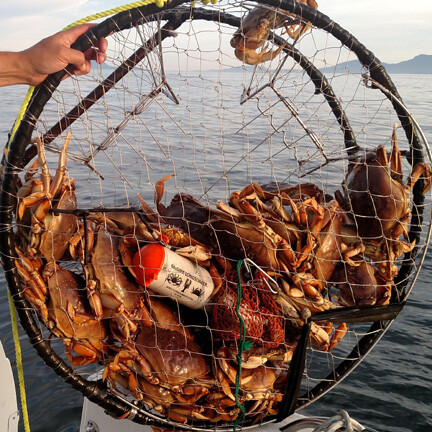
Russ Mullins of Longsoaker Fishing Systems in Bellingham, Wash., looked at this problem and had an idea: the Longsoaker timed-release bait container. "It holds the bait and keeps it dry until the galvanic timer corrodes away. Then it opens, and you've got fresh bait in your trap without ever having to leave the dock." The patented galvanic timer mechanism causes the Longsoaker to open somewhere between 12 hours and five days, according to the Longsoaker website, but Mullins notes that most fishermen target a fresh bait release near the middle of the expected soak, often one to three days. "Usually, it opens sometime after the second day if the fisherman hauls the pot on the fourth day."
While Mullins launched his product 12 years ago, he notes that it is really catching on. "We have about 12,000 of them out there now," he says. "And they're proving themselves. The guys using them are catching 25 to 45 percent more crab."
One of the primary advantages, Mullins points out, is that when the weather is bad, traps and pots can be rebaited without running a boat offshore. Even at $25 per unit, that can save fishermen money, especially with diesel approaching $5 per gallon. "Some guys even double them up so that you have one set for two days and another for three," says Mullins.
Another advantage of the Longsoaker, Mullins notes, is that all the scent from the bait is released on the bottom where the crabs are, rather than dispersing through the water column as a freshly baited pot sinks.
Although he is based in Bellingham and is primarily focused on the Dungeness crab fishery, Mullins has expanded to Alaska and the East Coast. "I sell to the crabbers and pot cod fishermen in Alaska," he says. "And I have 40 to 50 guys between Nova Scotia and Massachusetts using it. If guys want the Longsoaker, I can get it to them, but I don't have the data on lobsters that I do on crab."
Mullins notes that using the Longsoaker adds another step to the baiting process, so it needs to pay off in higher catches. "When the skipper tells me that the crew wants to use it, you know that means you're catching a lot more."