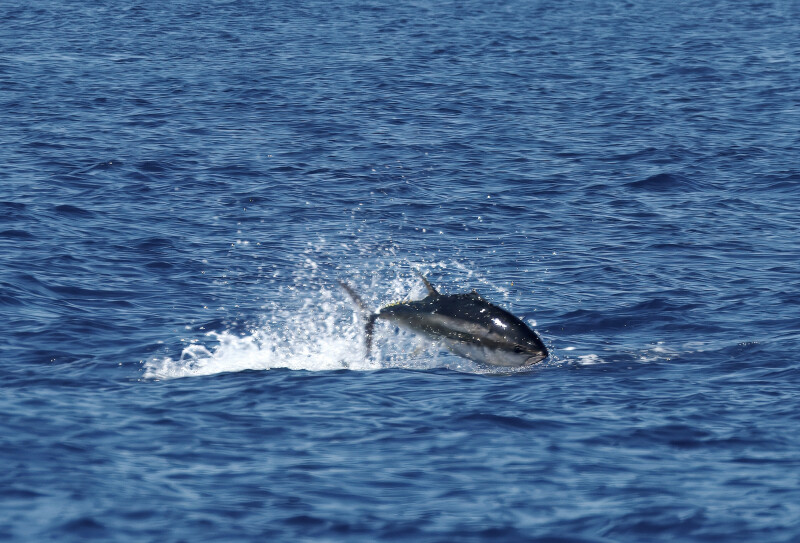
A sweeping three-decade study has confirmed that conservation measures in the western Atlantic have turned U.S. and Canadian waters into a critical refuge for Atlantic bluefin tuna — including fish that originate in the heavily fished eastern Atlantic and Mediterranean.
The findings, published in the Proceedings of the National Academy of Sciences, are based on electronic tagging data from 1,720 bluefin tuna tagged between 1996 and 2025, combined with catch records going back to 1950. The international research team was led by Dr. Barbara Block of Stanford University and included scientists from NOAA Fisheries, Acadia University, the University of Hawaiʻi, the Swedish University of Agricultural Sciences, the Institute of Marine Research in Norway, the Marine Institute in Ireland, and the Barcelona Zoo Foundation in Spain.
A TALE OF TWO FISHERIES
The catch data paint a stark picture of unequal fishing pressure across the Atlantic. Of total bluefin landings since 1950, the Mediterranean Sea alone accounted for 55 percent, while the entire western Atlantic—all waters west of the 45°W management line—accounted for just 11 percent. That disparity has widened in recent decades: the Mediterranean now represents 72 percent of Atlantic-wide bluefin catches.
Fishing pressure in the Mediterranean intensified sharply through the 1990s and 2000s, driven in part by the rise of capture-based aquaculture targeting more mature fish. Catches peaked at 60,000 metric tons in 2007—nearly double the scientific recommendations at the time. Historically, Mediterranean purse seine fisheries targeted juvenile fish aged one and two, removing them before they could grow large enough to migrate into the open Atlantic. In 2010, following widespread concern about the stock's status, the International Commission for the Conservation of Atlantic Tunas (ICCAT) implemented significant quota cuts and binding conservation measures.
The western Atlantic has operated under a very different management regime. For more than 45 years, western catches have adhered to binding total allowable catch limits — typically a tenth of the eastern quota — and have included strong conservation measures such as prohibitions on targeted fishing in the Gulf of Mexico, renamed by the Trump administration as the Gulf of America.
TAGS FOLLOW THE FISH
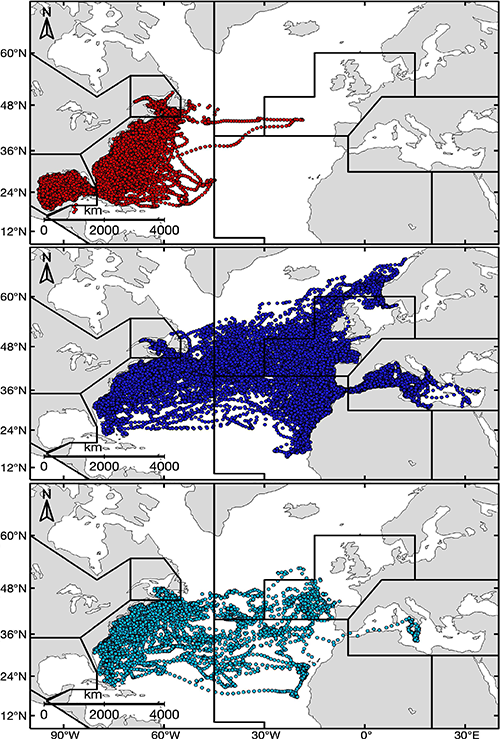
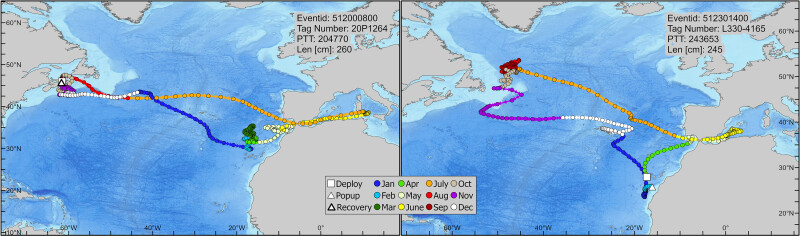
Electronic tag data confirmed what scientists had long suspected: bluefin tuna make extensive trans-Atlantic migrations, predominantly moving from east to west. Many fish originating in the eastern Atlantic and Mediterranean travel to U.S. and Canadian waters to feed and grow, often remaining in the west for several years before returning to spawn. Adult fish tagged in American and Canadian waters were found to migrate back to the Mediterranean to spawn, then return the following year to forage along the U.S. East Coast. Western-origin fish, by contrast, tended to remain west of the 45°W management boundary.
The westward pull is likely driven by food. Bluefin are believed to be following prey species—Atlantic mackerel, Atlantic herring, and menhaden—that are abundant in North American waters.
The data also revealed that eastern-origin fish experienced significantly lower fishing mortality when in the western and North Atlantic compared to when they were in the east. The western Atlantic, in effect, offered them a safe harbor from the intense harvest pressure of Mediterranean fisheries.
AN INTERNATIONAL RECOVERY STORY
Block summarized the findings plainly: "Our research demonstrates that lower fishing mortality in the West and North Atlantic has provided a refuge for eastern-origin Atlantic bluefin tuna, and highlights the importance of Atlantic waters to bolster the bluefin tuna population as a whole."
John Walter, deputy director of science and council services at the NOAA Southeast Fisheries Science Center and a co-author of the study, called the outcome "an international success story—we have thriving fisheries throughout the Atlantic and a return of the fish to many areas where they had not been observed in many years. The key to this rebound may be surprisingly simple—allow a fish restricted to spawn in a narrow environmental niche but evolved to seek productivity anywhere in the ocean, to do just that."
The recovery has been noticed by those on the water. Anglers along the U.S. East Coast have reported catching more and larger bluefin than at any point in the past 30 years—anecdotal evidence that tracks with the science. ICCAT has since adopted a higher total allowable catch for the western stock in recognition of the recovery, and NOAA Fisheries is working on rulemaking to implement the corresponding U.S. quota increase in 2026.
MANAGEMENT IMPLICATIONS
Eugenio Piñeiro Soler, NOAA's Assistant Administrator of Fisheries, emphasized the study's value for international management: "Management of this internationally shared resource requires high-quality scientific information — and this work provides one example of that. This research addresses one of the primary sources of uncertainty surrounding the amount of mixing and movement occurring between these two stocks. This is a critical piece of information needed to inform sustainable yield advice."
Researchers cautioned that questions remain. Whether current total allowable catch levels can be sustained against a rapidly changing ocean and growing global demand for bluefin is not yet known. The study was funded by the U.S. Bluefin Tuna Research Program, grants to the Block lab at Stanford University, and The Ocean Foundation's Tag-A-Giant Fund.
Atlantic bluefin tuna are managed as two separate stocks by ICCAT, divided at the 45°W meridian, with the western stock harvested by the United States, Mexico, Japan, and Canada.