
All around the U.S. coasts, shipyards report difficulty in finding skilled workers, even when the pay rates are over $35 an hour. But We Work the Waterways (WWW) is making headway in attracting young people to the marine trades, and while the program has focused on the shipping industry and inland waterways, organizers have been invited to bring it to the 2026 Pacific Marine Expo.
“We’re a non-profit and always looking for support,” says Nikki Fondren, director of marketing and outreach at WWW. According to Fondren, the WWW project began under the umbrella of another organization, but has been operational as a stand-alone organization for a year and a half. “We’ve done a few different programs, but our flagship is our Maritime Interaction Day, where marine professionals interact with students and talk about career opportunities in the marine industry. We’ve done them all over the country now,” says Fondren. “Milwaukee, Pittsburgh; Paducah, Kentucky, and here on the Gulf Coast. We had a Maritime Interaction Day at the International Workboat Day in New Orleans last December, and that was a great success. We had 250 kids, and 50 supporters.”
WWW uses a model that leverages local marine-related businesses, volunteers, and outreach to local schools. “We want to make students aware of the opportunities in marine trades so we ask the high schools to pick mostly juniors and seniors who might have an interest in marine trades. For the Maritime Interaction Days, we reach out to local businesses that can help us financially and with volunteers.”
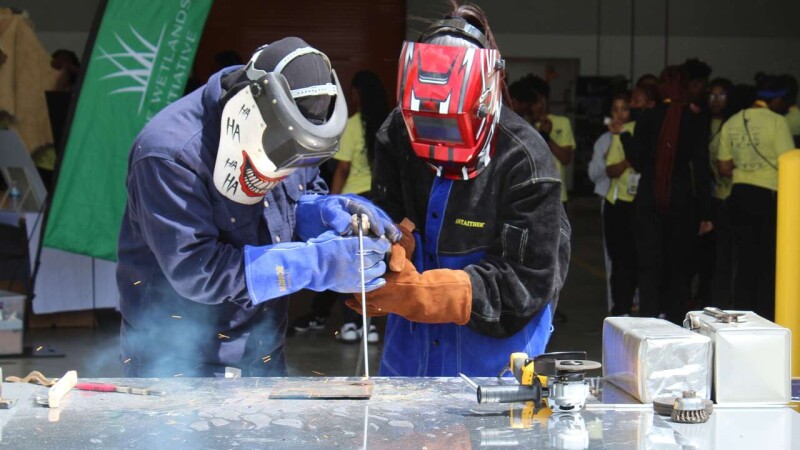
As Fondren describes it, a Maritime Interaction Day starts with a panel of business leaders who talk about opportunities. “But the real fun starts with the activity stations we set up with the businesses. At one station, kids might have a chance to do a man overboard drill where they pull a dummy from the water; they might practice line throwing, or do a welding demonstration welding crackers together with squeeze cheese; although we have done some real demonstrations where kids at least get to put on the welding helmets.”
Students who attend all wear a “We Work the Waterways” T-shirt with the names of all the sponsors on the back and receive a badge with a maritime QR code with links to all the opportunities. “They get to keep the T-shirt,” says Fondren, noting that the badge with the QR code allows them to continue exploring their options after the event.
“This will be our first event on the Pacific Coast,” says Fondren. “So far, we have 85 kids signed up and a half dozen sponsors with activity stations, and that list is growing.”
Fondren notes that many of the skills that WWW focuses on, like welding and diesel mechanics, are transferable between most marine industries. “Hopefully, we can find some traction in the commercial fishing industry,” she says.