

Enforcement officers have finished their deployment with Operation North Pacific Guard, the annual multinational patrol that polices illegal, unreported, and unregulated fishing in international waters of the North Pacific.
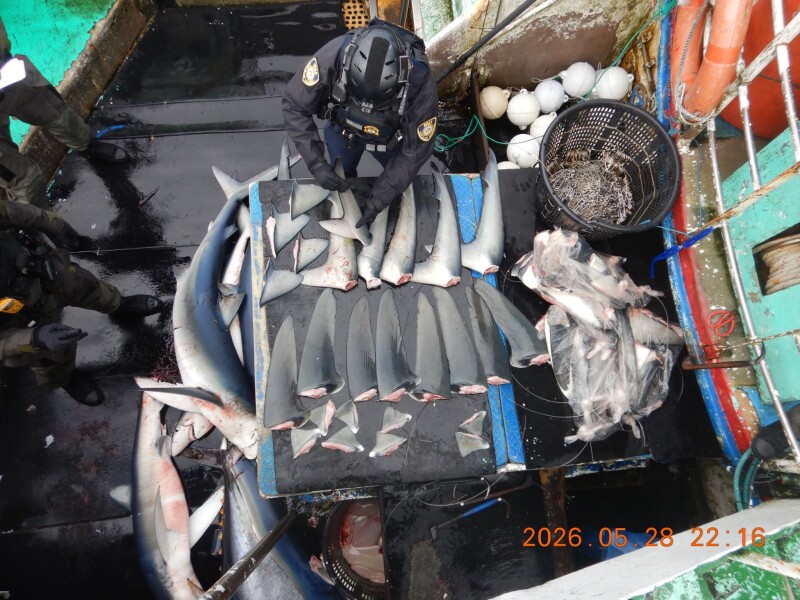
Officers from NOAA's Office of Law Enforcement patrolled more than 8,000 nautical miles aboard the Canadian Coast Guard ship Sir Wilfrid Laurier, sailing with fishery officers from Fisheries and Oceans Canada (DFO), the Canadian Coast Guard, the Royal Canadian Mounted Police, the U.S. Coast Guard and the Fisheries Agency of Japan. Working under authorities granted by international law, the crew conducted dozens of boardings and inspections of foreign fishing vessels and documented violations of conservation and management measures including shark finning, possession of endangered species and failure to accurately report catch, according to NOAA.
Suspected violations were referred confidentially to the flag states of the vessels involved and to the relevant regional fisheries management organizations for investigation. Under RFMO procedures, flag states handle the investigations and any penalties; sanctions can be reviewed by the RFMOs and, for the most serious cases, can include a complete ban on fishing.
"The dedication of our officers ensures that sustainable fishing practices are upheld on a global scale," said Benjamin Cheeseman, assistant director of NOAA's Office of Law Enforcement, Alaska Division. "Their work on the high seas directly protects the integrity of the oceans and the livelihoods of honest fishermen back home."
NOAA did not release a violation count. DFO, which led the shipboard patrol, said in its own Aug. 6 announcement that the integrated crew aboard the Sir Wilfrid Laurier monitored several hundred fishing vessels, conducted 30 high-seas inspections and interacted with more than 500 crew members over roughly two months, turning up 52 potential violations. Those included shark finning and the use of prohibited gear to take sharks, misreporting of catch, bycatch and discards — including prohibited species — and multiple failures to use seabird protection measures while setting gear.
DFO put the Sir Wilfrid Laurier's total track at more than 23,000 kilometers, or roughly 12,400 nautical miles, over the full two-month patrol. NOAA did not specify how much of that its officers were aboard for.
"Protecting fish stocks does not stop at our borders," said Joanne Thompson, Canada's Minister of Fisheries. "This work protects our investments under the Pacific Salmon Strategy Initiative to restore wild Pacific salmon and the ecosystems they depend on."
The Pacific Salmon Strategy Initiative funds the operation on the Canadian side. It received $412.9 million over five years under Canada's national nature strategy. Nineteen DFO fishery officers took part this year, five of them on air surveillance out of Japan. Canadian officers have participated since 2019.
Canada also led daily aerial patrols out of Hokkaido, monitoring fishing activity in the Northwest Pacific with enforcement staff from the Fisheries Agency of Japan and the Korea Coast Guard aboard. Those flights surveyed 344 fishing vessels and flagged 21 additional potential violations tied to shark finning, illegal killing of dolphins, pollution and vessel marking requirements, according to DFO.
The patrol also deepened enforcement ties with Japan. For the second year, the Fisheries Agency of Japan placed a fishery officer aboard the Canadian vessel, and for the first time a Canadian fishery officer rode Japan's high seas patrol vessel as a ship rider, joining the FAJ inspection team on vessel inspections. Officials from both countries exchanged operational findings and coordinated joint monitoring and inspection work under three memoranda of cooperation on maritime security signed by Prime Minister Mark Carney and Prime Minister Takaichi Sanae in March.
Crew members also assisted in the rescue of three Canadians from a distressed sailing vessel during the patrol.
NOAA framed the deployment as direct support for the "Restoring American Seafood Competitiveness" executive order, arguing that keeping illegally harvested product out of the supply chain protects U.S. markets from unfair trade practices.
President Trump signed the order on April 17, 2025, directing the Commerce Department, the U.S. Trade Representative, and the regional fishery management councils to address seafood trade practices, reduce regulatory burdens on domestic fisheries and develop a comprehensive seafood trade strategy. Its text cites imports accounting for nearly 90% of seafood on U.S. shelves and a seafood trade deficit exceeding $20 billion. The order also directs USTR to examine the trade practices of major seafood-producing nations, including IUU fishing and forced labor in the supply chain, and to consider responses up to and including action under Section 301 of the Trade Act of 1974.
Operation North Pacific Guard grew out of Operation Driftnet, launched to enforce the United Nations moratorium on large-scale pelagic driftnet fishing adopted under General Assembly Resolution 46/215 in 1991. The operation has since expanded to target all forms of IUU fishing across the North Pacific, covering the convention areas of the North Pacific Fisheries Commission, the North Pacific Anadromous Fish Commission and the Western and Central Pacific Fisheries Commission — organizations that manage squid, tuna and salmon stocks, among others. More than 1,300 vessels are registered to fish the North Pacific high seas.
Beyond documenting violations, the patrols have exposed gaps in the rulebook itself. DFO said Canada has used the findings to push new binding measures through the RFMOs in recent years, including a shark finning ban and rules on salmon retention, pollution and catch reporting. Officers on this year's patrol also collected water samples and environmental data for analysis in Canada and Japan, including work on salmon migration range and microplastic levels.
.jpeg.small.400x400.jpg)