
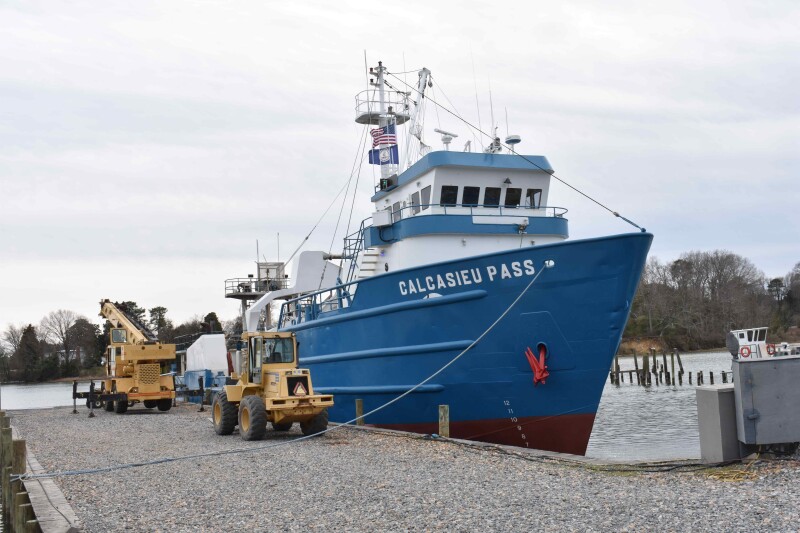
The recent sinking of the Calcasieu Pass in Delaware waters in the Atlantic Ocean to make a reef perhaps speaks more to the changing times of Virginia’s menhaden fishery than to an end of life grave for an old fishing vessel.
The former 180’ menhaden carry-away boat Calcasieu Pass was donated by Ocean Harvesters of Reedville, Va., to Coleen Marine for the Delaware Department of Natural Resources and Environmental Control (DNREC).
The boat was sunk in August on Delaware’s Del-Jersey-Land reef about 26 miles off Indian River Inlet in the ocean. The vessel will provide new habitat for reef-associated fish and marine life while creating opportunities for anglers and divers.
Ocean Harvesters’ fleet is composed of six large menhaden steamers and four carry-away boats. A carry-away boat is a dedicated transport vessel used to carry menhaden back to the processing plant, allowing fishing vessels to continue to fish longer in active fishing zones.
The Calcasieu Pass was taken out of service after the 2023 fishing season and donated in 2024. “We sold the vessel at a one dollar transaction fee, essentially donating the vessel as a reef,” says Monty Deihl, chief executive officer of Ocean Harvesters in an email. “We were able to take it out of service because we started using more contractor fishing services from Kellum Maritime LLC.”
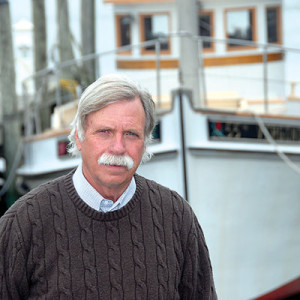
Jimmy Kellum, 64, of Kellum Maritime LLC in White Stone, Va., is an independent “snapper” menhaden fishermen who has purse seined for 45 years in the Chesapeake Bay’s bait fishery. Menhaden are sold for bait to commercial blue crab and eel pot fishermen, to recreational sports-fishermen, and to a growing number of recreational crab potters. Virginia’s waterfront shoreline housing industry has been booming of late. Most every house has a dock and on most every dock are crab pots.
The Virginia Marine Resource Commission (VMRC) allows two crab pots without a license for personal use and offers a five-pot recreational license for $36 with a terrapin excluder device or $46 without. Some recreational crab potters report paying as much as $2 for one menhaden fish to bait a pot.
For generations, the bay's menhaden bait business has been served by a fleet of small purse net boats referred to as "snapper rigs”. The origin of the word "snapper" as it relates to smaller menhaden fish boats has been lost to time. Some watermen, however, think it may have come from a size comparison of a snapper bluefish to a snapper menhaden vessel. Snapper blues are smaller than a fully mature bluefish and snapper menhaden boats historically have been smaller than larger steamers used in the bay’s reduction fishery.
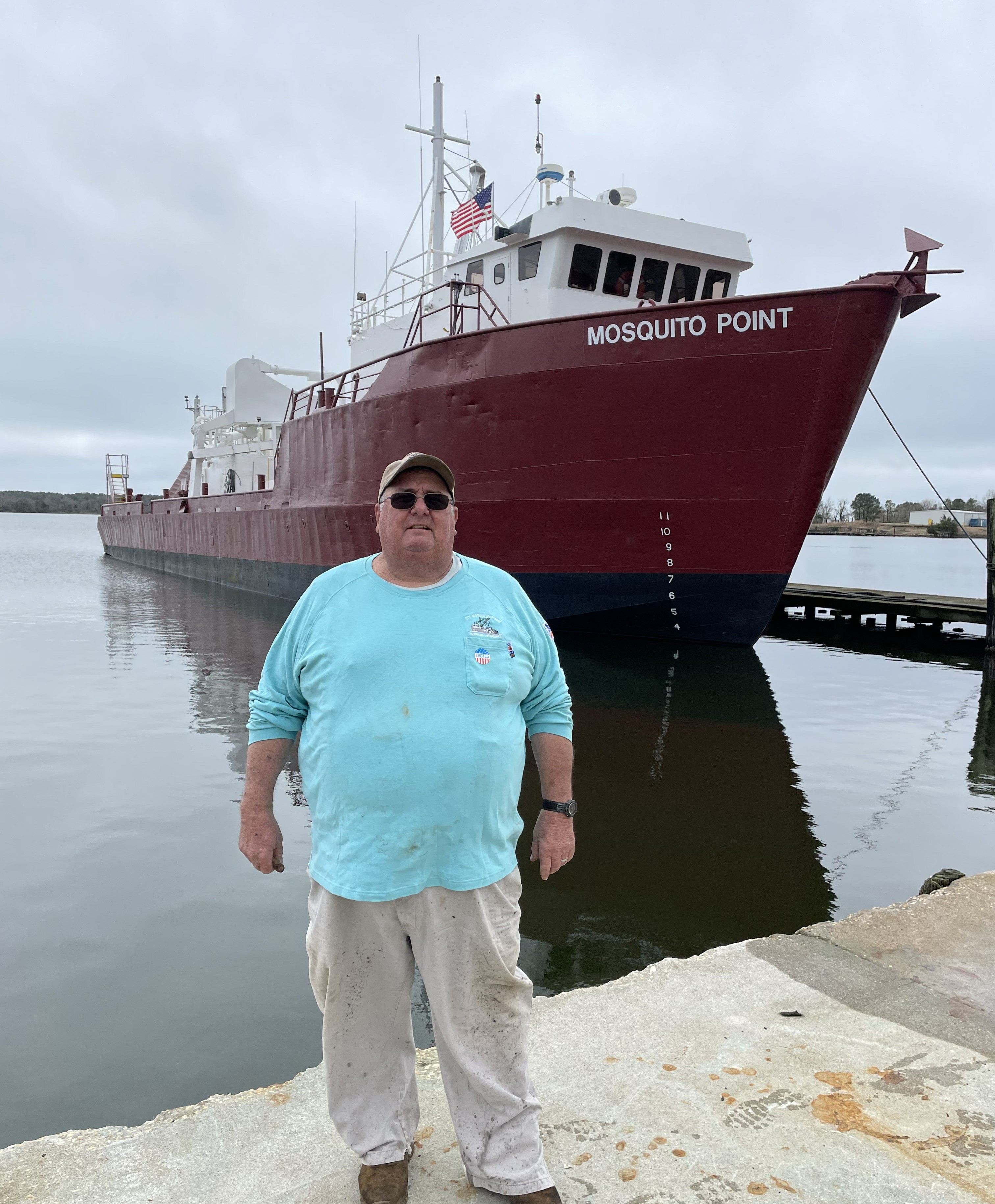
The snapper fleet was once fairly large in numbers but has now shrunk down to just two large vessels. Kellum owns one. He bought the 147’ x 34’ x 8’ GP Anna in 2015 and renamed her Mosquito Point. He had been operating two smaller vessels named Carters Creek and Indian Creek, but wanted to expand his fishing efforts into the Atlantic Ocean, resulting in the purchase of the larger Mosquito Point.
“We had begun to experience tighter quotas and a smaller labor force available to pull from. It was getting hard for us to find crews to work the two boats,” said Kellum.
“So, when the Calcasieu Pass lost an engine and needed another $4 to $5 million in repairs and upgrades, Monty and I talked about working together,” said Kellum. “I had the Mosquito Point that was close in size to the Calcasieu Pass - able to carry 804,000 pounds of fish back to the processing plant and could be worked in the ocean - so we partnered and it has worked out for both of us.”
The sinking of the Calcasieu Pass appears to have worked out for both parties. “We have donated numerous vessels this way over the past 15 years, and it seems that New Jersey and Delaware end up with quite a few of them and they have very active reefing programs,” says Deihl.
“Our part in this is that by donating the vessel rather than selling it to some other potential user, or for scrap steel, we feel we are helping the vessel give back to the environment and it seems a fitting end for these vessels,” says Deihl. “It has also provided work for Jimmy and his boat without us having to add another boat to our fleet.”
The Mosquito Point is not just being used as a carry-away boat. Since Kellum holds a portion of Virginia’s snapper menhaden bait quota, he is able to fill that quota from Ocean Harvesters’ nets. “Now I know at the start of the season that I will fill my quota and have work through the season as a carry-away vessel,” says Kellum.
Since Kellum has gone to work for Ocean Harvesters, he says there is now only one snapper menhaden vessel catching its own fish in Virginia waters. The 175’ x 38’ x 6.5’ F. Ray Rogers, owned by Reedville Bait Co. of Reedville, is the last one working the bay.
“Throughout the bay region, the bait fishery supports a large recreational saltwater sport-fishing business and commercial crab pot fishery,” says Kellum. “I am not sure where bait fish are going to come from if all the fisheries supplying those businesses go away.”