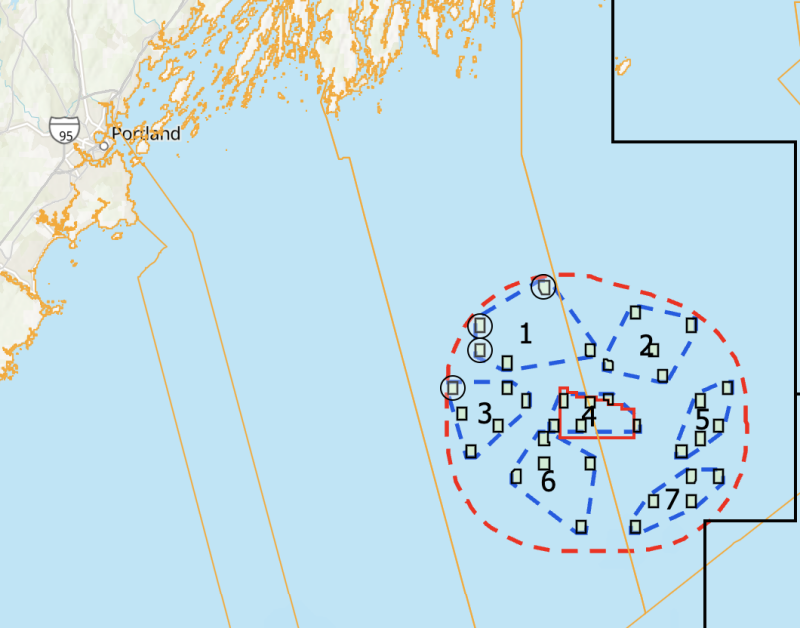
The Maine Department of Marine Resources (DMR) is planning a winter bottom trawl survey around the state’s long-planned offshore wind energy research project, aiming to understand how floating wind turbines may affect the ocean ecosystem and commercial fishing.
After major offshore wind proposals succumbed to opposition from the Trump administration, the modest Maine Research Array Wind Energy Area – a lease area of almost 15,000 acres in the Gulf of Maine – remains in limbo, since a potential developer bowed out in March 2026 over that uncertainty about federal policy.
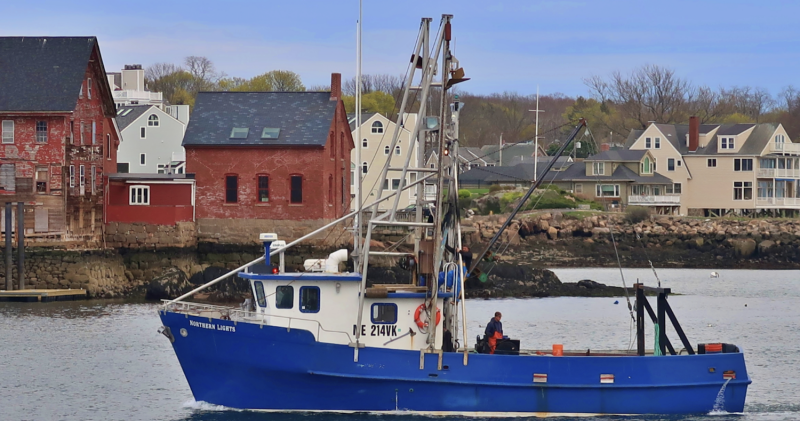
The 55-foot dragger Northern Lights is scheduled to set out from Portland to work from around Jan. 11 through Feb. 28, with 37 sampling tows over nine days. The time frame is weather-dependent and could extend into March, according to an agency statement.
The sampling will help researchers examining fish and invertebrate populations “to establish baseline data that they will then compare with findings collected during the construction and operation” of a floating turbine array, according to the DMR.
There’s no plan to ask fishermen to move their gear during the survey, but the DMR could send out notices if officials see gear “is set to interfere with research operations,” the agency says.
Related surveys to sample plankton and larval lobster in the wind research area are planned between Jan. 1 and March 31. The DMR is partnering with the Bigelow Laboratory for Ocean Sciences on the surveys, scheduled for two days per month aboard the R/V Maine.
The State of Maine obtained the federal Bureau of Ocean Energy Management lease Aug. 19, 2024 – just five months before President Trump’s second inauguration, his declaration of an “energy emergency” and prohibition of new federal wind power leases.
As originally proposed by the administration of Gov. Janet Mills, the Maine research lease, located 28 nautical miles offshore Maine on the U.S. Outer Continental Shelf, could allow for the deployment of up to 12 floating offshore wind turbines.
State planners envisioned an operational array capable of generating up to 144 megawatts, and a purpose-built port and construction base at Sears Island in Penobscot Bay.
The port plan drew opposition from local groups and in October 2024 lost out on an application for a $456 million grant from the U.S. Department of Transportation. The already ill-starred wind energy program soon ran up against the second Trump administration’s broad offensive against renewable energy.
The state’s designated operator, Pine Tree Offshore Wind, LLC, cited “recent shifts in the energy landscape that have in particular caused uncertainty in the offshore wind industry,” in a March 28, 2025 filing with the Maine Public Utilities Commission, effectively freezing the proposal.