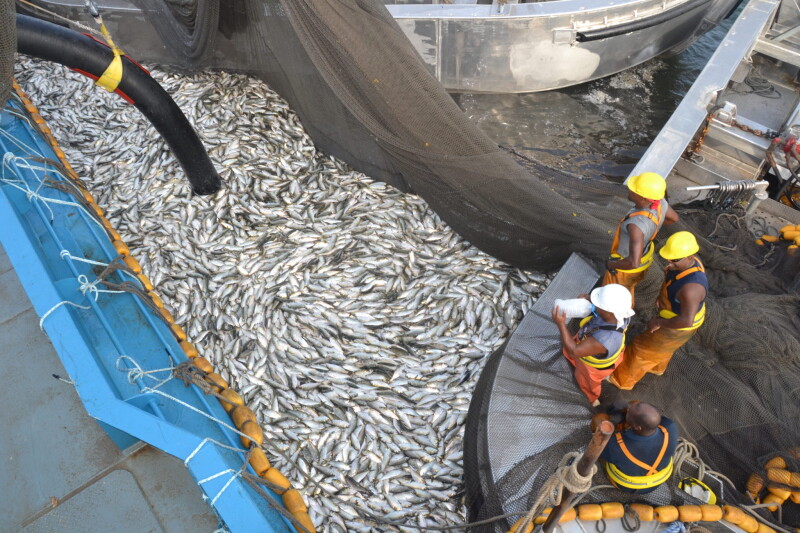
Lower Atlantic menhaden landings in 2025 have raised new concerns among conservation groups about the health of the forage fish population, but commercial fishing representatives say unusually rough weather may have contributed to the shortfall and are urging fisheries managers to wait for additional scientific research before imposing further restrictions.
In a Nov. 8 release, the American Small Pelagics Network (ASPN) challenged claims that the fishery's failure to reach its 2025 catch limit indicates declining menhaden abundance. The organization pointed to an analysis of National Weather Service warnings and NOAA buoy records showing significantly rougher conditions along the Mid-Atlantic coast during the latter part of the fishing season.
According to ASPN, days under gale-or-stronger warnings from August through December 2025 averaged 53 percent above the preceding 10-year average across 11 coastal forecast zones stretching from the Virginia-North Carolina border to the western New York Bight. Hours under those warnings increased 63 percent, while days with small craft advisories or stronger warnings were 20 percent above average.
The organization said the timing was particularly important because those months coincide with the seasonal southward migration of menhaden, when commercial fishermen depend on workable conditions to reach migrating schools.
An examination of NOAA buoy records also found that wave heights reached at least three feet more frequently in 2025 than during the previous decade at Cape Henry, Virginia; Barnegat, New Jersey; and the entrance to New York Harbor.
ASPN argues that these conditions limited fishing opportunities for both the bait and reduction sectors and should be considered when evaluating the industry's lower landings. The findings, however, do not establish how much of the catch shortfall resulted from weather rather than changes in fish abundance or distribution.
The release comes after the Chesapeake Bay Foundation and the Forage Fish Campaign pointed to the unfilled 2025 catch limit as a warning sign about menhaden availability. Conservation advocates have called for stronger protections for the species, which provides an important food source for striped bass, osprey, and other marine predators.
Industry backs additional research
In a separate Nov. 6 statement, Ocean Harvesters welcomed comments from Derek Aday, director and dean of William & Mary's Virginia Institute of Marine Science (VIMS), emphasizing the importance of additional research before making management decisions affecting the Chesapeake Bay.
Aday, writing in the Richmond Times-Dispatch, described research supported by Virginia's newly approved budget that will examine menhaden abundance, their availability to predators and commercial fishing patterns within the Bay.
"The Chesapeake Bay is too important to manage by assumption," Aday wrote.
Monty Deihl, CEO of Ocean Harvesters, said the research could help fisheries managers better understand the relationship between commercial harvest and the Bay's ecosystem.
"Dr. Aday has put the focus exactly where it belongs: on rigorous, independent science that can give decision-makers the information they need," Deihl said.
Ocean Harvesters also pointed to ongoing research supported by the Science Center for Marine Fisheries, involving scientists from VIMS, the University of Maryland Center for Environmental Science and NOAA, as another source of information for future management decisions.
The company maintains that these studies should be completed before additional restrictions are adopted.
Management decisions ahead
The Atlantic States Marine Fisheries Commission (ASMFC) is considering changes to the Chesapeake Bay reduction fishery cap through Draft Addendum II, including options to reduce the existing 51,000-metric-ton cap by as much as 50 percent and distribute harvest more evenly throughout the season.
The commission also reduced the coastwide Atlantic menhaden total allowable catch by 20 percent for 2026. Its latest stock assessment found that Atlantic menhaden are not overfished and that overfishing is not occurring, although concerns remain about the species' availability to predators within the Chesapeake Bay.
As National Fisherman previously reported, commercial fishermen from Maine and Virginia have urged managers to maintain existing coastwide quotas, warning that additional reductions could affect lobster bait supplies, processing jobs and fishing communities.
UFCW Local 400, which represents Virginia menhaden fishermen, has also called for additional research before further Bay restrictions are implemented.
With managers weighing future harvest limits, the latest industry statements highlight the competing interpretations of declining landings and the broader question of whether existing scientific information is sufficient to justify additional restrictions.