

.jpg.medium.800x800.jpg)
Ray Wadsworth, a longtime figure in Alaska fisheries, is turning 80 in 2026, but age isn’t slowing him down much, if at all. Wadsworth has brought a few innovations to the fishing industry, such as his pin bone machine. “In the early 2000s I spent 6.6 million dollars inventing a machine that would fillet a salmon and remove all the bones, including the pin bones, but with a fresh fish that hadn’t gone into rigor mortis yet.”
Wadsworth took the machine to Chignik down on the Alaska Peninsula and got it set up to process live fish. “I had a floating processor called the New West, and we had live pens alongside for the fish,” he explains. “We had a few boats with oxygenators in their holds to keep the fish alive, and they’d put the fish in our pens. Then we’d take them out of the water, bleed them, run them through the machine, vacuum pack them, and freeze them before they ever went into rigor mortis. This was the freshest fish in the world, but the processors were still canning, so it never caught on. I lost everything.”
But Ray Wadsworth is one of those people who doesn’t quit, one of those people who can lose everything and then get back on top again. “I went back to what I do best,” he says. “Designing and building boats and catching fish.” Since then, Wadsworth has built and sold several boats now operating in the salmon fishery, mostly tenders and seiners, and he is still inventing. His latest creation is an amphibious skiff that he initially thought could be useful in the set net fishery. “It’s 30 feet by 10 feet,” says Wadsworth. “And it has tracks that fold down so it can crawl up the beach about as fast as you can walk.”
After building the boat at his shop in Oakley, Idaho, Wadsworth trailered it up to Alaska and took it across to Seldovia, on Kachemak Bay. “We slept in it on the way up,” he says. “It’s got bunks and a little galley.”
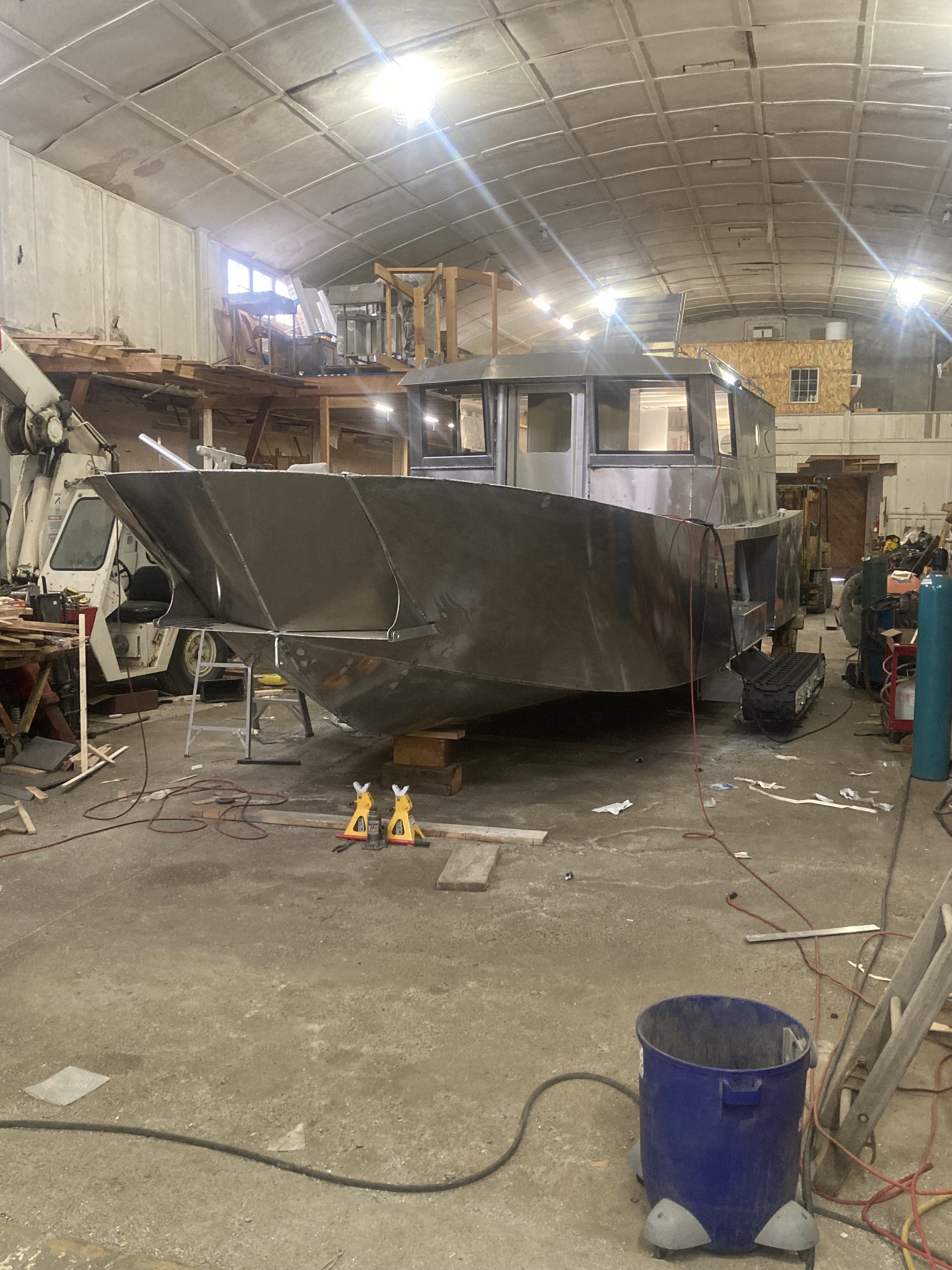
Powered by a Cummins 8.9-liter engine driving a Chinese-built AWT JT342 jet, Wadsworth reports getting the boat up to 30 knots. “It only draws a foot,” he says.
When the boat approaches the beach, Wadsworth lowers the tracks from the sides and engages the hydraulic motor that drives them. “It was a lot harder to build than I had imagined,” he says. “The tracks are a rubber material like snowmobile tracks, and getting the rams and drives for them figured out took a long time. It’s got a ramp in the front that goes down, and that took some engineering.”
According to Wadsworth, he wanted a sharp bow like a regular boat, but getting the ramp to work with that proved to be more of a challenge than he bargained for. “I have all the CAD drawings for it. If somebody wanted one, I would build it with a flat bow, not as pretty but a lot easier.”
For now, Wadsworth’s latest invention, the amphibious skiff that he designed like set netters, is sitting on his land in Seldovia. “I don’t know if there’s any interest,” he says. “It could also be good for anyone who has to deal with big tides.”