
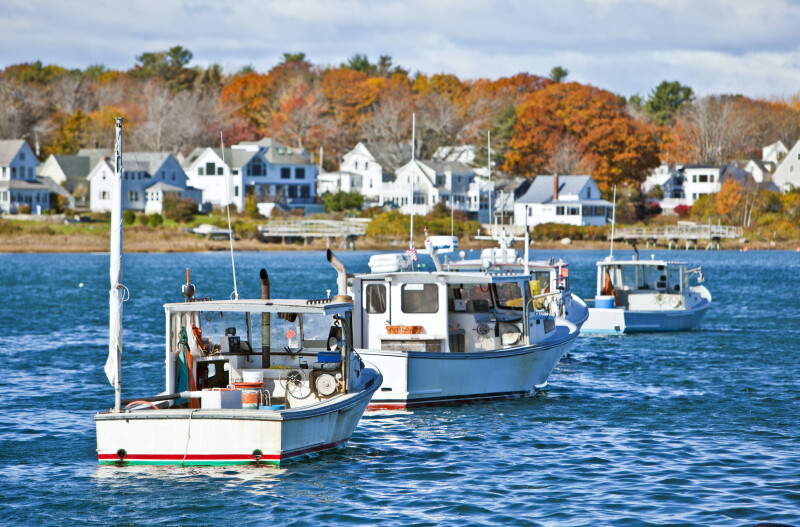
A bill that would extend the current pause on new North Atlantic right whale regulations affecting the lobster fishery until 2035 is headed to the full U.S. House after winning approval from the House Natural Resources Committee.
According to Maine Public, the committee voted to advance H.R. 9436, the Northeast Lobstermen Protection Act, legislation introduced by Rep. Jared Golden, D-Maine, and Rep. Mike Lawler, R-N.Y. The bill would extend the existing moratorium on certain new right whale regulations, including potential fishery closures, from its current 2028 expiration to 2035.
The committee approved the measure in a bipartisan 22-13 vote on July 15.
Golden said the extension is needed because delays in the federal rulemaking process and ongoing scientific research have left regulators without the information necessary to craft effective, science-based measures.
"In 2022, Congress enacted this regulatory pause and funded new efforts to gather information to support a data-driven process establishing rules that made sense for both the fishermen and the whales," Golden said in a statement. "But today the rulemaking process is behind schedule for reasons that have nothing to do with Maine fishermen."
Speaking before the House Natural Resources Committee, Golden said additional time would help ensure any future regulations balance whale conservation with the needs of the commercial fishing industry.
"We need more time to make sure that any new measures we ask lobstermen to take will strike a very careful balance between protecting marine life and protecting the livelihoods of fishermen themselves," Golden said.
The moratorium was originally enacted by Congress in 2022 with bipartisan support from Maine's congressional delegation and Gov. Janet Mills. Earlier this year, President Donald Trump also expressed support for extending the pause, according to Golden's office.
Golden's office said layoffs at NOAA and other federal disruptions have delayed the Atlantic Large Whale Take Reduction Team's rulemaking process. At the same time, the Maine Department of Marine Resources (DMR) has argued that additional time is needed to incorporate ongoing research into future management decisions.
"We are still gathering various types of data, and we anticipate that several of these data streams will not be able to be incorporated into decision-support tools due to the compressed timeline for rulemaking," DMR Commissioner Carl Wilson wrote in a letter supporting the bill. "An extension of the pause would ensure that there is time to incorporate this information, and that rulemaking is based on the best available science."
The proposal has drawn support from numerous commercial fishing organizations, including the Maine Lobstermen's Association, Maine Lobster Advisory Council, Maine Lobstering Union Local 207, New England Fishermen's Stewardship Association, New Hampshire Commercial Fisherman's Association and the Massachusetts Lobstermen's Association.
John Drouin, vice president of the New England Fishermen's Stewardship Association, said the legislation would allow regulators to develop management measures using more complete scientific information while maintaining existing protections.
Not everyone supports the delay.
According to Maine Public, Gib Brogan, campaign director for the conservation group Oceana, argued during committee testimony that existing protections are insufficient to recover the critically endangered North Atlantic right whale, whose population is estimated at roughly 400 animals.
"All of the available evidence shows that the protections that are in place right now are not enough to support the recovery of North Atlantic right whales," Brogan said. He added that the current regulatory timeline already provides ample opportunity for public input and debate and urged lawmakers not to postpone additional protections.
The extension would provide the Northeast commercial lobster fleet with continued regulatory stability while federal agencies complete ongoing research and rulemaking. Industry organizations backing the bill say the additional time will help ensure any future right whale regulations are based on the best available science, rather than an accelerated timeline, reducing the risk of new restrictions that could disrupt one of the state's most valuable fisheries.