There are many manufacturers of marine toilets, but one of the oldest and best-known manufacturers is Raritan Engineering Company, in Millville, New Jersey.
“I go to a few shows,” says Kim Carrell, Chief Operating Officer (COO) at Raritan. “The thing is people don’t like to talk about it.”
But what to eat, where to sleep, and where to poop have been basic considerations of humans since the days of living in caves, and they remain important, especially in the tight quarters of boats. “I have seen our marine toilets on a lot of the Wicked Tuna boats,” says Carrell. “I haven’t talked to anyone on the big commercial boats, but most buy through our distributors. Our biggest sellers are the Atlantes and the Marine Elegance models.”
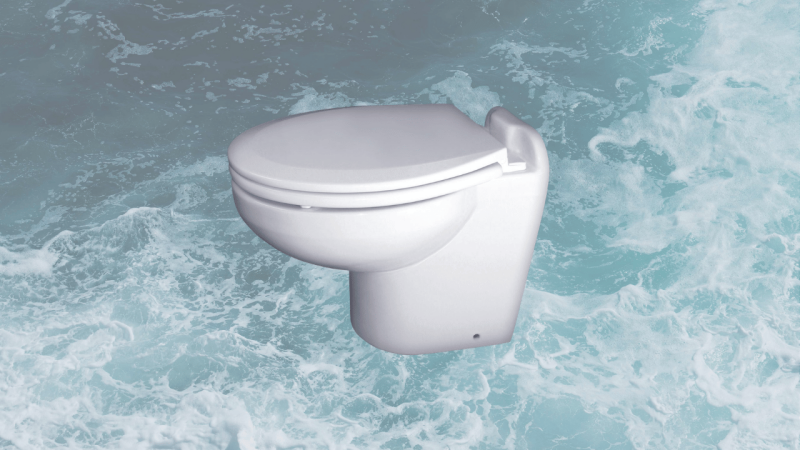
Both models are macerator toilets, Carrell explains. They basically send the contents of the toilet through something like a garbage disposal. The macerator is able to efficiently move waste down the line and either into a holding tank or overboard, depending on the regulations in effect. “For boats under 65 feet, you have to have a Type I Marine Sanitation Device (MSD) and a holding tank inside three miles,” says Carrell. “Outside three miles, you can discharge overboard. The Type I devices are not permitted in areas designated as a federal no-discharge zone.”
Having begun in 1958, Raritan Engineering is the oldest company manufacturing marine toilets for 68 years. “Our first macerating toilet was the Crown Head model, which we introduced in 1965,” says Carrell. “Then about 25 years later the vacuum toilets became very popular, but we didn’t go down that road; we stayed with the macerator.”
According to Carrell, the macerator is simpler in its operation and does not depend on maintaining a vacuum to move the poop along. “We believe our toilets do a better job of clearing the lines so you don’t have waste sitting in there. Especially our latest model, the Atlantes Freedom, the design of the macerator creates a vacuum-type action in the bowl. The ability to create a vacuum-type action in the bowl means a more efficient flush with less water.”
Carrell notes that waste stuck in the lines can lead to odor permeation and a bad smell in a boat’s head. “We sell quality hoses, with a ten-year warranty, which eliminates that problem, but if someone has an odor problem, we tell them to take a hot rag and wipe the hose. If the odor transfers to the rag, it’s permeating through the hose.”
Raritan’s electric toilets offer a few unique features. They offer the SeaFresh system, allowing the user to switch between raw or onboard water flushing options. They also offer a Smart Toilet Control that reduces the amperage draw and uses just over a pint of water. A regular flush uses about three pints,” she says. “If you use fresh water from a tank, the pump draws 18amps at 12 volts. When using raw water, the pump draws about 22 amps.” Carrell points out that the average flush with a Raritan system lasts about 10 seconds, and while a vacuum flush may draw less amperage, it typically runs for about 45 seconds. “Ours may be more efficient in the long run,” she says.
One thing Carrell warns about when using saltwater is the potential for another kind of odor. “When you use saltwater and then leave the boat, the organisms in the saltwater that is left around the rim all die and rot. So that first flush when you come back to the boat after a couple of weeks can knock you over.”
While the Atlantes and Elegance models are well known and popular, Carrell notes that the company continues to upgrade. “Our newest macerator is easy to disconnect and reinstall a spare,” she says. “That way, if someone tries to flush something they shouldn’t and plugs the toilet, you can swap them out, and you’re back in business.
After 68 years, Raritan Engineering continues to solve the “where to poop” question on commercial and recreational vessels in the U.S. and elsewhere.