


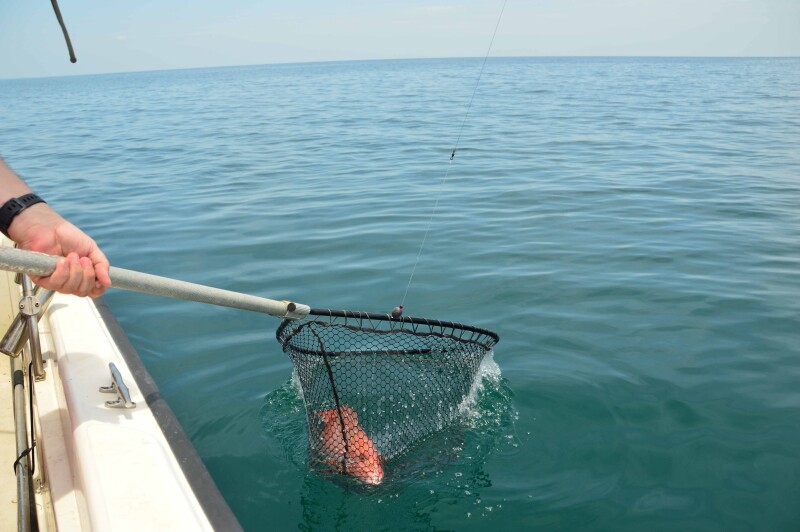
Six commercial fishing businesses and fishermen from Florida and North Carolina have filed a federal lawsuit challenging exempted fishing permits that authorize a 14-day recreational red snapper season in South Atlantic federal waters.
The lawsuit, Ariel Seafoods of Florida, Inc. v. Lutnick, was filed Oct. 5 in the U.S. District Court for the District of Columbia against the National Marine Fisheries Service (NMFS) and Commerce Secretary Howard Lutnick. The plaintiffs are asking the court to declare three permits issued Sept. 21 to Florida, Georgia, and South Carolina illegal.
The permits authorize recreational red snapper harvest in federal waters off the three states from Oct. 9 through Oct. 22, with the possibility of a second season in December. NMFS has separately established a three-day federal season, Oct. 9-11, for anglers not participating under a state permit.
At the center of the dispute is how additional red snapper harvest is being allocated between the recreational and commercial sectors.
Under the federal fishery management plan, red snapper landings are divided roughly 72 percent recreational and 28 percent commercial. According to the release announcing the lawsuit, 2026 recreational landings had been set at 21,726 fish, while commercial landings were set at 11,213 fish.
The exempted fishing permits increase the recreational harvest level to 112,787 fish while leaving the commercial harvest level unchanged. The plaintiffs contend the change effectively alters the fishery's allocation without going through the South Atlantic Fishery Management Council process.
The lawsuit raises three claims under the Magnuson-Stevens Fishery Conservation and Management Act and the Administrative Procedure Act. The plaintiffs argue that NMFS changed the allocation of the fishery without properly addressing that change, altered the mechanism used to calculate the red snapper catch limit outside the fishery management plan, and relied on assumptions that could increase the risk of overharvest.
The release states that NMFS set the harvest level at the overfishing limit rather than the lower annual catch limit and acknowledged that the approach would increase the risk of overfishing. The plaintiffs also challenge assumptions used to estimate recreational dead discards and how those discards were accounted for when determining available harvest.
A new benchmark stock assessment for South Atlantic red snapper, SEDAR 90, is underway and scheduled for peer review in December 2026.
This is the second lawsuit this year challenging exempted fishing permits for the South Atlantic red snapper fishery. In May, NMFS issued permits to Florida, Georgia, South Carolina, and North Carolina authorizing recreational seasons of up to 62 days.
On May 21, U.S. District Judge Rudolph Contreras granted a preliminary injunction in Southeastern Fisheries Association v. Lutnick. According to the release, the court found that the permits were required to comply with the Magnuson-Stevens Act, that NMFS failed to respond to public comments about the catch limit, and that it violated its regulations by approving applications that did not specify expected harvest.
NMFS withdrew those permits in June, and the states reapplied in July. Slash Creek Waterworks, one of the plaintiffs in the earlier case, is also among the plaintiffs in the new lawsuit.