Confirmed large whale entanglements in U.S. waters declined in 2025, though the total remained slightly above the long-term average, according to a new report from NOAA Fisheries.
NOAA documented 76 confirmed large whale entanglements nationwide in 2025, down from 95 in 2024. The total was slightly higher than the annual average of 72.7 confirmed cases recorded between 2007 and 2024.
Of the 76 whales, 70 were alive when their entanglements were documented, while six were dead when initially reported. Each case represents an individual whale rather than multiple sightings of the same animal.
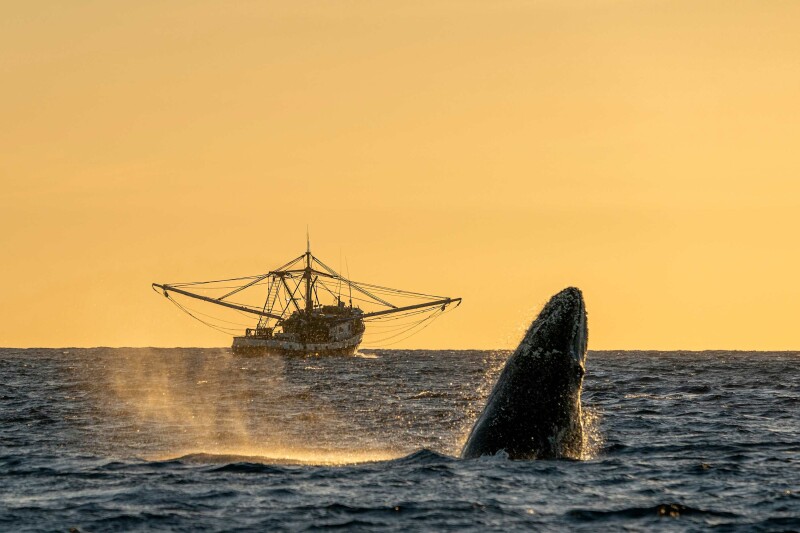
Humpback whales accounted for the overwhelming majority of cases, with 65 confirmed entanglements. NOAA also documented four gray whales, two fin whales, one minke whale, one North Atlantic right whale, and one sperm whale. Two cases involved whales whose species could not be determined. Humpbacks have accounted for more than 71 percent of all confirmed large whale entanglements since 2007.
The Pacific accounted for much of the activity in 2025. Entanglements were first reported and confirmed off 11 states, with nearly 79 percent of confirmed live-whale reports occurring off California, Alaska, Hawaii, and Washington. California accounted for 27.6 percent, followed by Alaska at 23.7 percent, Hawaii at 15.8 percent, and Washington at 11.8 percent.
For fishermen, one of the report's notable findings is how often the source of an entanglement could, and could not, be identified.
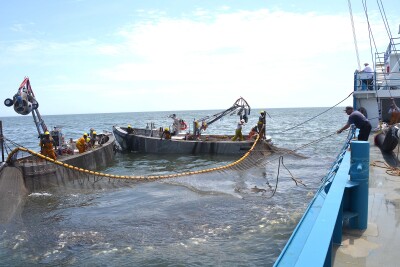
NOAA said approximately 46 percent, or 35 of the 76 cases, were verified as involving commercial or recreational fishing gear. The other 41 involved line that could not be directly attributed to a particular fishery or other source. NOAA noted that because fishing is a common source of line in the marine environment, some unidentified cases were likely related to fishing activities, but the agency did not assign them to a specific source.
The report's gear breakdown included 20 cases involving line and buoys, 20 involving unidentified line, 16 involving net, and 13 involving trap gear. Smaller numbers involved monofilament, longline, hook-and-line gear, a fish aggregating device, and a mooring system.
Response teams mounted efforts for at least 33 whales initially reported alive and free-swimming, resulting in the full or partial disentanglement of 13 animals. Another 16 whales were documented releasing themselves from their entanglements. In 36 cases, responders could not mount a response because of factors including the whale's remote location, weather, or reports received too late in the day. Those whales were presumed to remain entangled.
NOAA uses the annual entanglement data to evaluate the effects on individual whales and populations and to inform management measures aimed at reducing entanglement risks while supporting marine industries.
The agency also emphasized that the location where an entangled whale is observed does not necessarily indicate where it encountered the gear, as whales can travel long distances while entangled.
.jpg.small.400x400.jpg)