
.jpeg.medium.800x800.jpg)
It’s September on the Arctic coast of Alaska, and the whaling crews of Utqiagvik (Barrow), Alaska, have been busy.
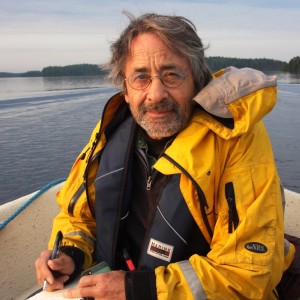
“The weather has gotten bad, so I finally have a little time,” says Martin Edwardsen, co-captain of Harry Brower Jr.’s crew. “It’s the Little Kupaaq crew,” he says.
Edwardsen also serves as executive director of the Alaska Eskimo Whaling Commission (AEWC), formed in 1977 to regulate subsistence whaling for 11 Inupiaq villages under the auspices of the International Whaling Commission (IWC). “So far we have gotten five bowhead whales this year,” says Edwardsen. “We got one in the spring season, and we have gotten four so far this fall season.”
The Little Kupaaq crew harpooned a big bowhead about 28 miles offshore on September 9. “They weigh about a ton per foot,” says Edwardsen. “The one our crew got was 55 feet. It took about four hours to get it to our butchering station.”
Unlike the harpoon cannons used on industrial whaling boats that operate in defiance of the IWC, the Inupiaq whalers throw their harpoons by hand. “We call our harpoon a darting gun,” says Edwardsen. “It has a trigger that, when it hits the whale, shoots a penthrite bomb into the whale’s vital organs; the bomb has a trigger that lights a fuse inside it, so it explodes inside the whale.” Edwardsen adds that the darting gun also includes a toggle harpoon head that embeds in the whales and separates from the shaft. “That has a line on it, and we attach an A3 or A5 float to that so we can follow the whale.”
Once the whale dies, Edwardsen explains, they have to tie up the front flippers to keep it from spinning when being towed. “Then we tie onto the tail with a heavy rope that can be anywhere from 1 ¼ to 2 inches thick. The boats we use are 20- to 28-foot skiffs with 250- or 300-horsepower outboards. Some have two motors.”
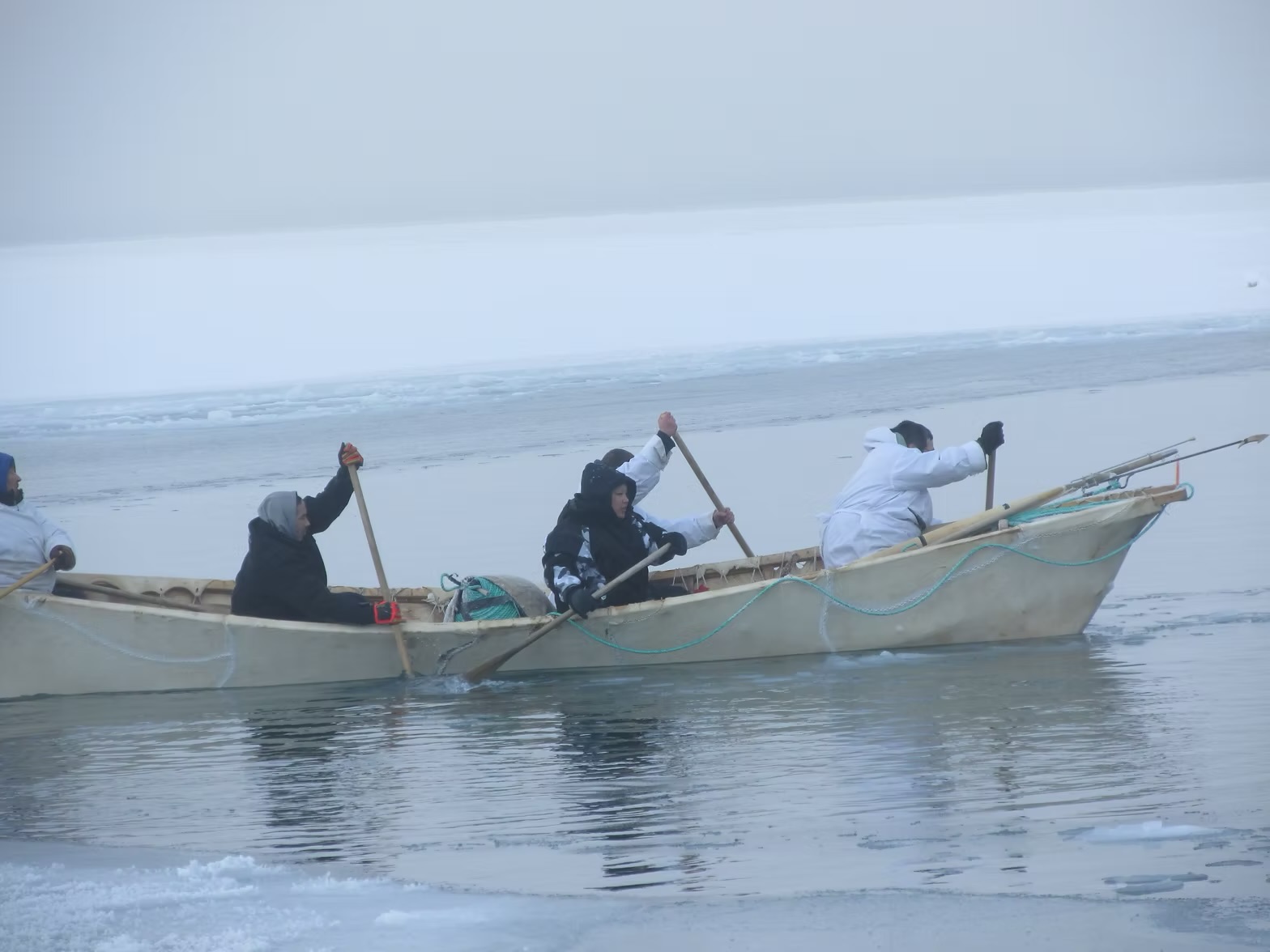
Utqiagvik has 31 registered whaling crews, and many are often out hunting at the same time. If one crew gets a whale, others come to help. “The longer the rope, the more boats can tie on to help pull,” Edwardsen says. “We had a combined 1700 horsepower on our last whale,” he says.
Once on the beach, the crews and community join in butchering the whale. “The blubber and skin, the maktak, is everybody’s favorite,” says Edwardsen. “For some families it’s their main source of food, and we use it to trade with inland communities for salmon and berries that we don’t have here.”
Edwardsen notes that the butchering is also used to train young harpooners. “We encourage them to help butcher so they can see where the whale was struck, and where the bombs exploded so that they learn where to throw.”
In his role with the AEWC, Edwardsen attends IWC meetings where he advocates for the subsistence fishery. “The crews of our village are allowed 27 strikes,” says Edwardsen. But strikes don’t always result in a harvested whale, he points out. “Sometimes the ice can take a whale before we can butcher it,” he says. “Other times a whale might sink, and then in a few days it floats again because of the gases in it’s stomach, and we go find it. But with those we only take the blubber, not the meat.”
Besides its economic importance, Edwardsen notes that the subsistence bowhead hunt is vital to his community's culture and that children go out on the boats at a young age. “I started going when I was six,” he says. “And this year we had my wife’s 8-year-old nephew in the boat.”