




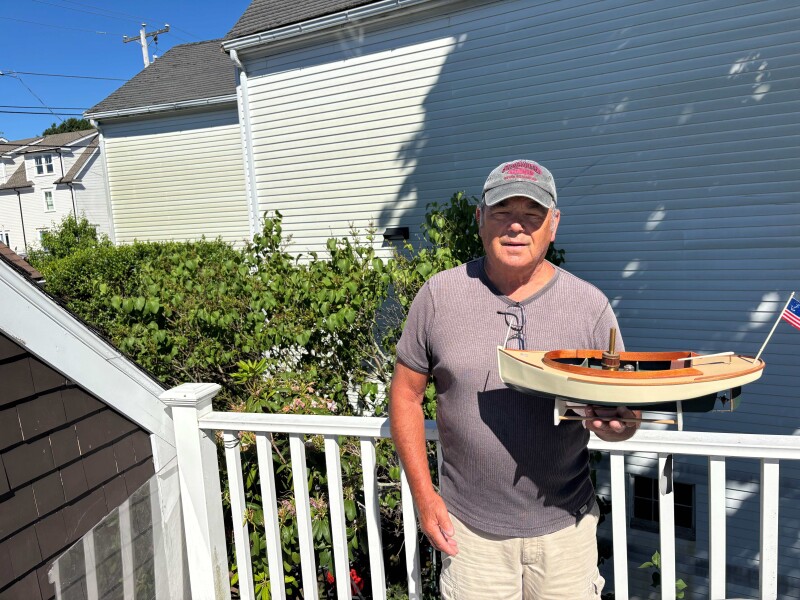
Andy Gallant was about 12 years old when he got the idea to motorize his 8-foot dinghy.
Born in 1949, Andy grew up in Essex, Mass., during a time when Dana Story's shipyard was still building wooden fishing and pleasure boats on one end of the causeway, while Nick Hemeon was turning out some of the region's finest wooden lobster boats a few hundred yards away toward Gloucester.
"I had a Briggs and Stratton air-cooled lawn mower engine, and the town dump was a good source of pulleys and shafts," Gallant recalled from his favorite living room chair.
Andy spent much of his youth as what he describes as a "wharf rat," hanging around the boat yards and exploring the Essex River in his rowboat.
Essex and Gloucester boatyards employed many local men who were skillful working with wood and metal. "I was lucky that some of the older guys, maybe, saw a bit of themselves in me and took time to help me with some of my boyhood projects," he said.
One local craftsman built a strut for Gallant's dinghy, and with help from his father, the young boat enthusiast ended up with what he remembers as the fastest 8-foot pram for miles around.
Another early mentor was family friend George Doucette, who worked at the Gloucester Marine Railways. After spotting an abandoned 12-foot Amesbury skiff that needed new garboards, Doucette brought it home and helped introduce Gallant to the process of taking apart and rebuilding a wooden boat.
"George brought it home, and I got an education in how to take apart and put a boat back together," Gallant said. "I also became the new owner of a sweet little boat that rowed much easier than the pram had."
Looking back, Gallant believes those early experiences around boats helped shape his appreciation for good design.
"When you grow up around wooden boats shaped to cut through the water easily and keep you safe, you develop an eye for a boat with nice lines," he said. "I've always liked building things, but one of the key reasons I was drawn to building boat models is that I really enjoy the look of a boat with graceful lines."
Soon after leaving the Navy in 1969, Gallant went to work at Pike's Marine in Essex. Lenny Pike serviced the town's commercial fishing fleet along with many pleasure boats. That work gave Andy a front-row seat to the daily movement and maintenance on a wide variety of fishing and pleasure boats.
"Like Story's shipyard down the street, at Pike's, we were moving boats around on cradles and rollers," he said. "Way back when, Story's had a horse for dragging heavy things, but in 1969, we had a tractor."
It was while working at Pike's Marine in 1970, that Gallant built his first ship model, a two-masted coasting schooner.
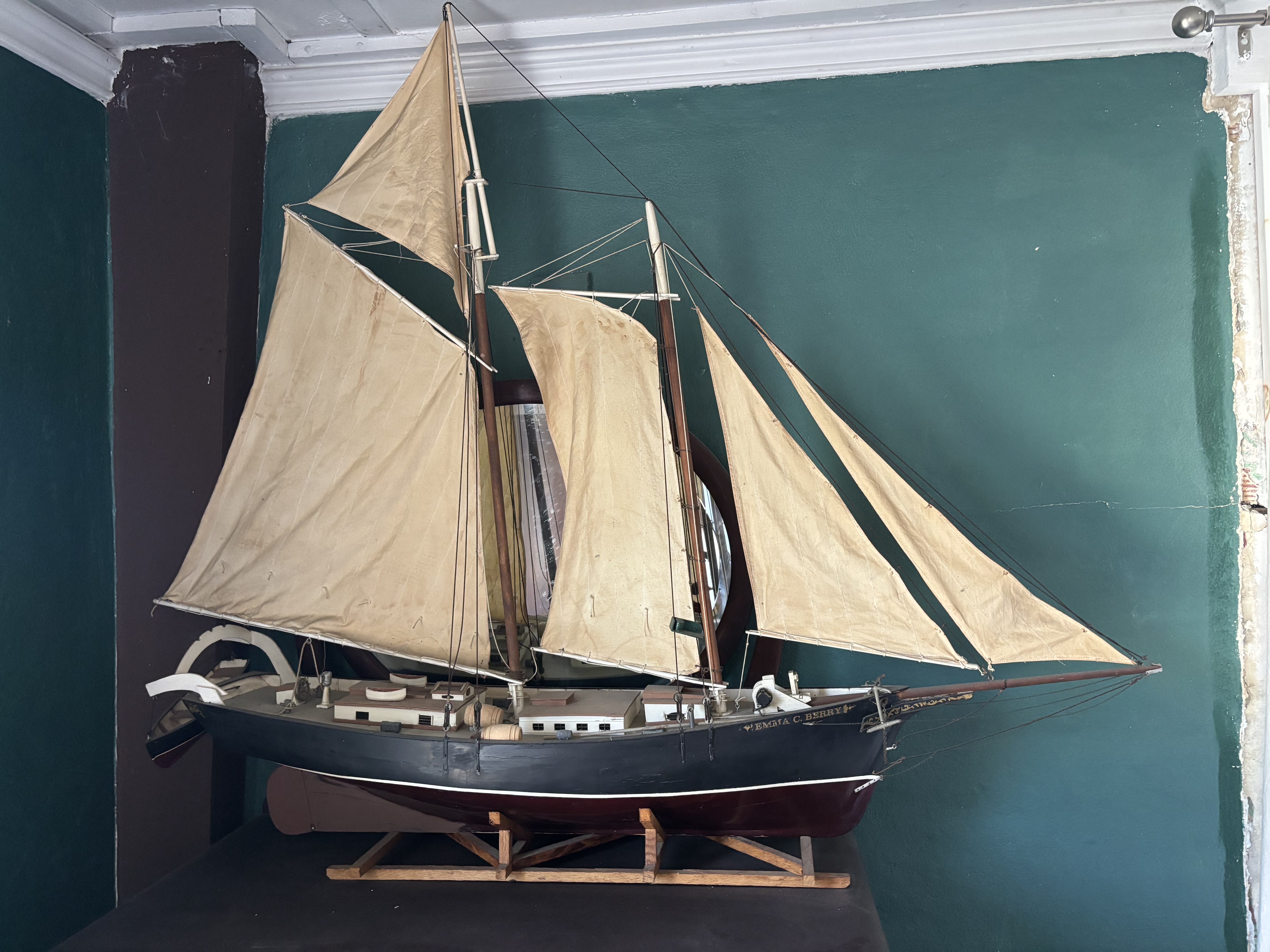
"Even though it was a kit, don't be fooled into thinking that it was like one of the little plastic warship models that you glued together with airplane glue as a kid," he said. "It was complicated."
The project introduced him to the layout and rigging of the coasting schooners that once carried lumber, stone and other cargoes up and down the East Coast. A local woman sewed the sails from dimensions Gallant provided.
"I am kind of afraid to touch those sails now, given they are 55 years old," he said.
Andy has always been more comfortable working with mechanical systems than electronics.
"I know that computers and cell phones are powerful tools, but I have always felt much more comfortable working with things I can understand like cams, levers, carburetors and drive shafts," he said.
Even at 78 years old, he continues repairing and selling small two-stroke and four-stroke outboards.
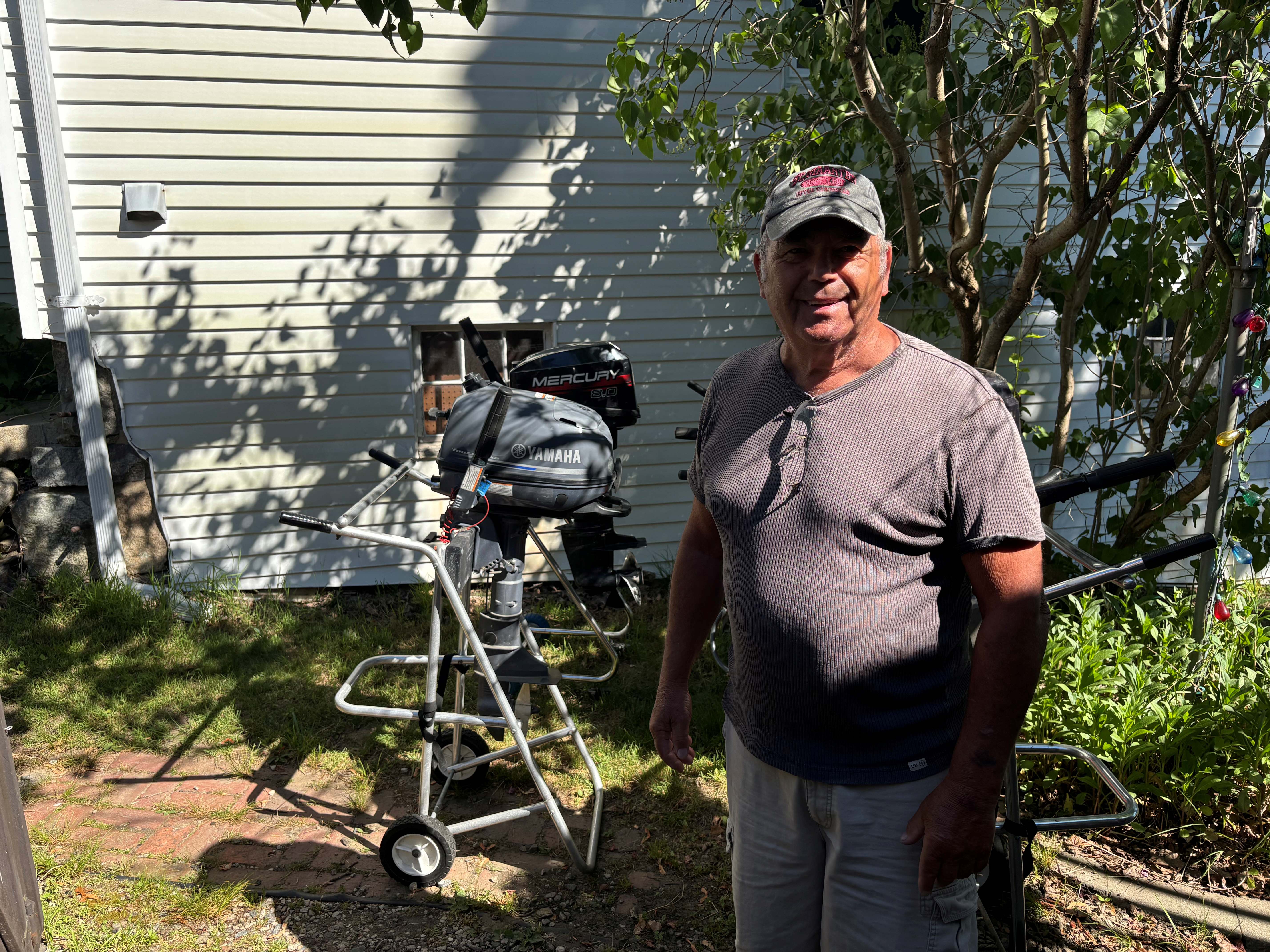
"Some people might think of these outboards as complicated, but I find them to be pretty simple and logical in design," he said.
Gallant supported his family through a career built around his mechanical skills. Most recently, he worked for several local seafood processing companies, but before that he spent roughly two decades at Varian in Gloucester, a manufacturer of electronic components for aerospace and defense applications.
Working nights at Varian gave him more time to focus on ship model building, a hobby that steadily grew into a lifelong passion.
"I'd get home from work late at night, and before I left for work the next afternoon, I'd often make progress on whichever model I was working on," Gallant said.
He found that solutions to modeling challenges often appeared unexpectedly.
"Everyone's mind works differently, but I often found that I might be totally focused on my responsibilities at work, when a solution to a ship model problem would come to me," he said. "It's like the problem-solving part of my brain was still working in the background, while I was fully engaged in repairing a machine for my employer."
Today, visitors to Gallant's 1720's home will find ship models displayed throughout nearly every room. Some were built from kits, others from scratch using plans, and a few were purchased simply because he admired the craftsmanship.
The collection includes tugboats, schooners, clam skiffs, express cruisers, lobster boats, a Chris-Craft runabout, late-1800s British assault launches and racing sailboats.
"When the federal fisheries people had the big office in Gloucester, they had four or five of my fish boat models on display for a while," Gallant said.
While Gallant has a workshop attached to the back of the house where he repairs outboards and keeps his power tools, most of his models were built on a small portable bench inside the house.
"You don't need a big shop to build ship models," he said.
Over the years, Andy has enjoyed both the model construction process and the opportunity to learn about the vessels themselves.
"I've enjoyed building all my models and learning the details of their construction," he said.
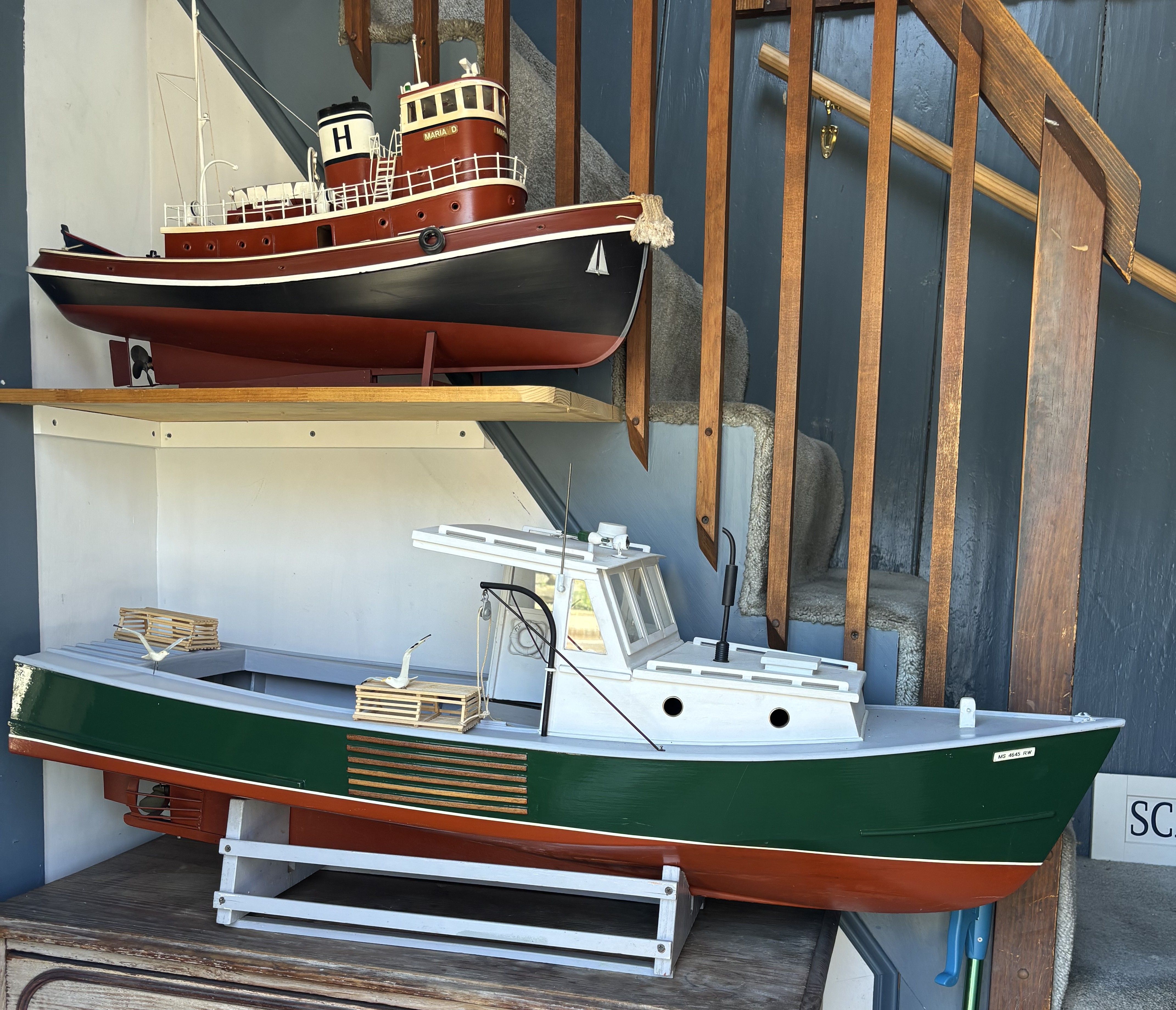
Among his favorites are a 36-inch hard-chined lobster boat displayed in the front hall, a similarly sized sardine carrier in the back room and a graceful lobster boat in the kitchen window that reminds him of Nick Hemeon's designs.
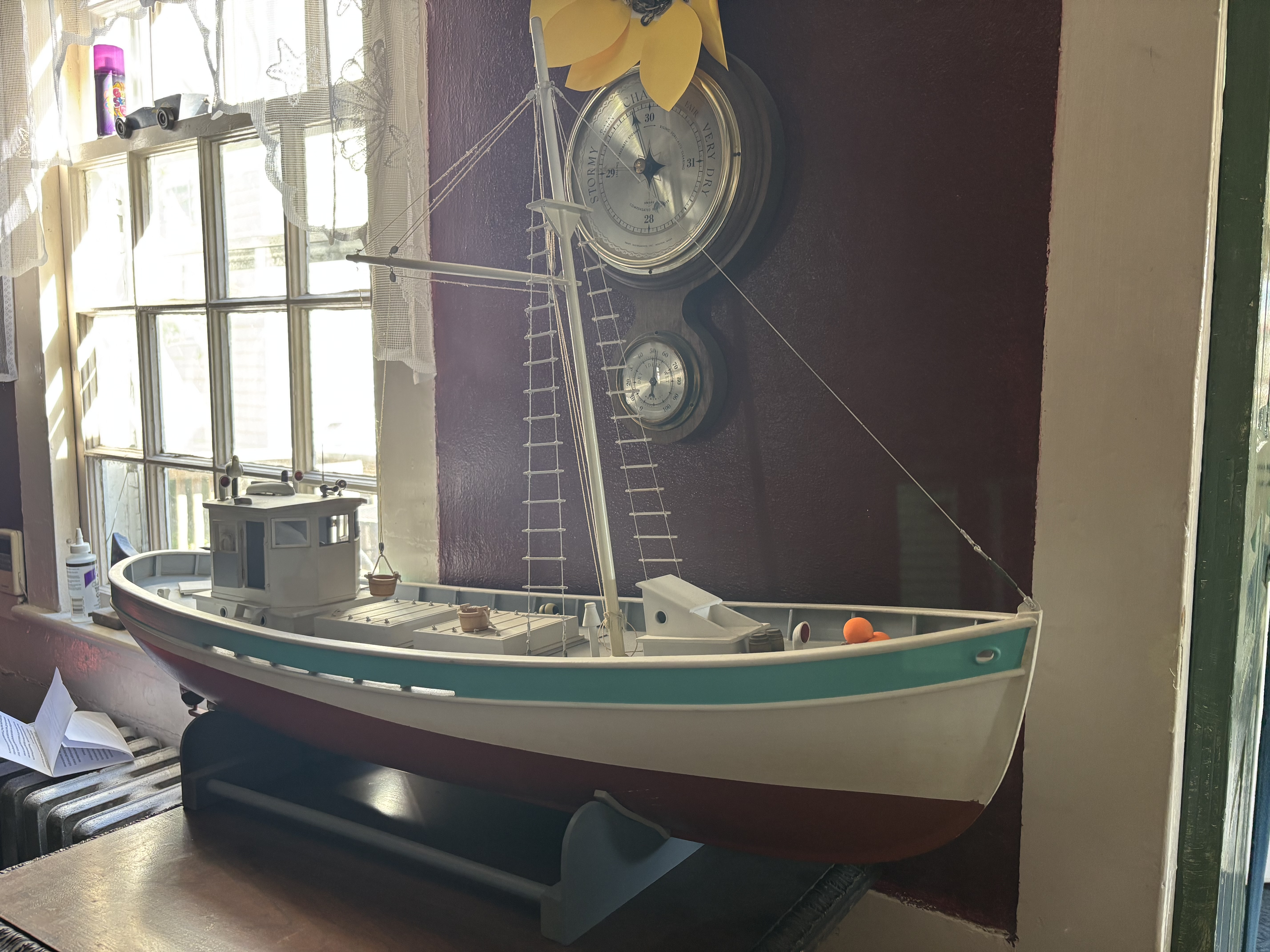
"It is hard to have a favorite, but I guess if I had to pick one model to take with me in the event of a house fire, it would be the European cruising schooner," Andy said. "It is just so graceful, and I built it from scratch."
His appreciation for boat design extends beyond miniature vessels.
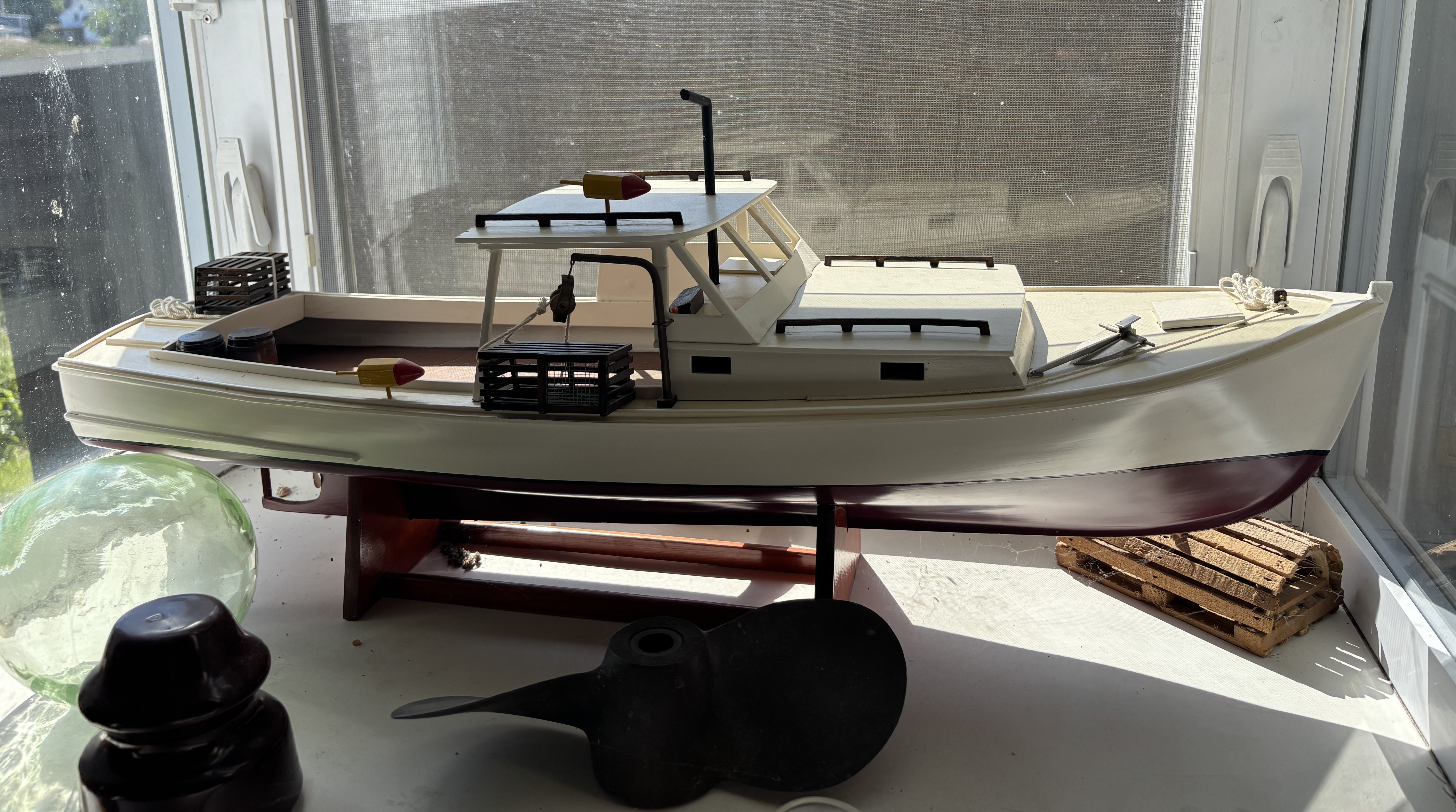
"I love the round bilge lobster boat in my kitchen window, but I am partial to hard-chined boats like the rugged, hard-chined lobster boats that Brad Story built down the street for members of Beverly's Bartlett lobstering family," he said.
That preference, may stem in part from owning a 36-foot hard-chined Harker's Island cruiser with a fantail transom for two decades. The vessel originally worked as an oyster and shrimp boat in North Carolina.
When he eventually sold the Harker's Island boat, Gallant replaced it with another hard chined boat, a 35-foot fiberglass Mainship cruiser.
"I just got back from a short, three-day cruise in the Mainship," he said.
Despite concerns that many traditional crafts are fading, Gallant does not believe ship model building is disappearing.
"Ship model building is not a dying art," he said. "There is a very large and active international community of ship model builders."
That community includes suppliers around the world who continue producing specialty woods, fittings and hardware for model builders.
"When I was heavy into building new models, I'd get my drop-cast miniature anchors and such from a company in Russia," Andy said.
What remains uncertain is the future of the collection he has spent decades assembling.
"I do wonder what is going to become of my model collection," he said.
Gallant worries that changing cultural attitudes have affected how people value handcrafted work.
"Maybe if you haven't grown up during a time when interacting with craftspeople, be they boatbuilders, cabinet makers, seamstresses or bakers, was part of your normal daily life, it is harder to appreciate the time and effort necessary to create something well-made," he said.
Sometimes, he feels that people during the first half of his life had a greater appreciation for the skills required to build his models.
Still, Gallant said the primary reason he built the models was never for recognition.
"It's true that I want to share my models with other people, but the truth is I built them for myself because I was fascinated with their design, the purpose they were originally built for and the problem-solving nature of the building process for each individual model," he said.
Andy doesn't think he can put a price tag on any of his models.
"There's no appropriate value for anything I built, as I didn't build them to sell, and the number of hours I invested in each one probably means that I would earn less than minimum wage if I were to sell them," he said.
For now, he is content to live among the collection he spent a lifetime creating.
"That said, I really enjoy seeing them every day here in the house and don't want to sell them," Gallant said. "I'd like other people to enjoy them in the future, but as of yet, I don't really know how to give them a good home when the time comes, so that they will be seen every day, like they are now."

.jpg.small.400x400.jpg)
