




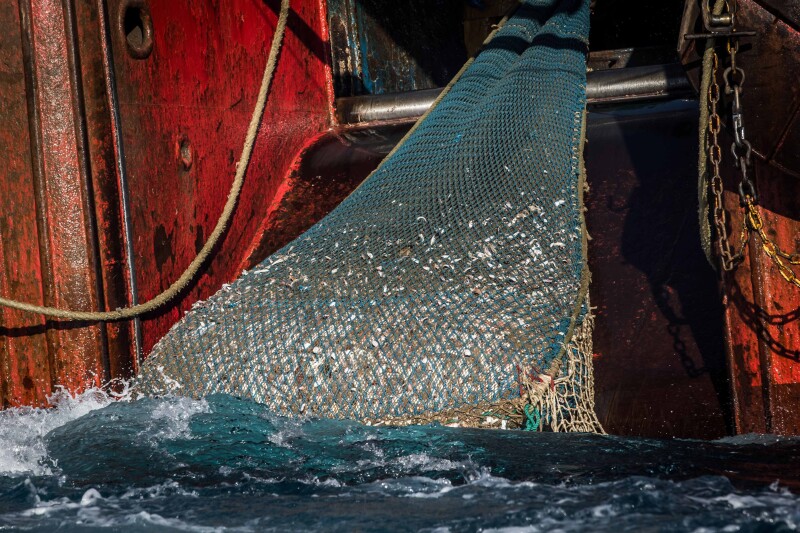
U.S. Senator Dan Sullivan (R-Alaska) has reintroduced the Bycatch Reduction Act, legislation that would expand federal efforts to reduce bycatch, limit seafloor impacts from trawl gear, improve fisheries monitoring and increase transparency in fishery management.
According to Sullivan's office, the bill builds on recommendations from the Alaska Salmon Task Force, which was created through legislation he authored and signed into law in 2022.
The proposal would establish new standards and monitoring requirements designed to keep both midwater and bottom trawl nets off the seafloor, require proven salmon excluder devices on pollock vessels, invest in salmon tagging and genetic sampling, expand ecosystem research, and create a new flume tank testing facility to evaluate fishing gear under simulated ocean conditions. The bill also would reauthorize NOAA's Bycatch Reduction Engineering Program and encourage fishermen to test new gear and technologies aimed at reducing bycatch and habitat impacts.
Several of the bill's provisions mirror concerns that have recently been raised before the North Pacific Fishery Management Council over pelagic trawl gear and its interaction with the seafloor.
In comments submitted following the council's June meeting, veteran Bering Sea and Gulf of Alaska crab fisherman Jeff Steele urged the council to adopt measurable performance standards that would verify pelagic trawl gear is operating off the bottom before allowing it to fish in areas closed to bottom trawling. Steele, a second-generation fisherman with 50 years in Alaska's crab fisheries, said the issue centers on ensuring that gear classified as pelagic truly operates in the water column rather than making contact with the seabed.
Steele argued that observer data show pollock vessels can make contact with the seafloor while fishing, despite being classified as pelagic trawlers. He also noted that Alaska, the Northeast Atlantic Fisheries Commission and the United Nations Food and Agriculture Organization all define pelagic trawl gear as operating in midwater without touching the seabed.
His comments focused heavily on habitat areas that have long been closed to bottom trawling to protect crab habitat, cold-water corals, sponges and other essential fish habitat. Steele argued those protections should also apply to pelagic trawl gear until it can be demonstrated that the gear consistently remains off the bottom.
Steele also pointed to the Bristol Bay Red King Crab Savings Area, describing it as one of Alaska's most productive crab habitats. He noted the area has received special protections dating back to the 1960s, when Congress and international agreements prohibited foreign trawling there to protect king crab, halibut and salmon. While portions of those protections were later reduced, Steele argued the remaining habitat continues to play an important role in sustaining Bristol Bay king crab stocks.
In announcing the legislation, Sullivan said the bill was developed after hearing concerns from commercial fishermen, subsistence users, sport fishermen and coastal communities across Alaska.
"I've heard from countless Alaskans—from subsistence harvesters to commercial and recreational fishermen, and from residents of coastal communities to upriver villages—who are rightfully demanding direct action to reduce bycatch and gear contact with the seafloor to better protect our fisheries," Sullivan said.
He described the proposal as "the most comprehensive bycatch legislation ever introduced in the Congress," adding that it is intended to strengthen enforcement of trawl standards, improve monitoring and reporting transparency, and support the development of new technologies to reduce bycatch and habitat disturbance.
Beyond gear requirements, the legislation would require NOAA to publish observer coverage requirements and bycatch information in plain language, expand public participation opportunities in the North Pacific Fishery Management Council process, and reconstitute the Alaska Salmon Task Force to help oversee NOAA's research priorities related to trawl gear impacts.
Steele echoed many of those themes in his comments, urging the council to close what he described as a management loophole by keeping pelagic trawl gear out of bottom-trawl closure areas until fishermen can demonstrate the gear operates entirely off the seafloor. He argued that doing so would better align management with the original purpose of those protected habitat areas and help the council meet its essential fish habitat conservation objectives.
The bill also includes provisions aimed at foreign seafood competition by prohibiting imports from countries that do not meet conservation and bycatch standards comparable to those required of U.S. fishermen.
Several Alaska fishing organizations voiced support for the legislation.
Gabriel Prout, president of the Alaska Bering Sea Crabbers, said the measure addresses "critical data gaps in Alaskan fisheries" while promoting collaboration and new technologies to better understand fishing gear impacts on the seafloor and reduce unobserved mortality of benthic species.
Michelle Stratton, executive director of the Alaska Marine Conservation Council, said the organization has long advocated for stronger accountability around bycatch, unobserved fishing mortality and seafloor contact. She said the bill's focus on research, monitoring and performance standards tied to seafloor contact represents "important steps in the right direction," while emphasizing that the work must ultimately result in "measurable, enforceable standards."
Support also came from the Kenai River Sportfishing Association, whose executive director Shannon Martin said the legislation advances reforms to reduce bycatch while strengthening protections for benthic habitat and improving transparency within the North Pacific Council process.
Linda Behnken, executive director of the Alaska Longline Fishermen's Association, said the bill reflects "meaningful action to reduce bycatch and protect seafloor habitat from bottom trawling," calling it "a bold step forward."
According to Sullivan's office, the legislation also would authorize additional funding for research infrastructure, support testing of innovative fishing gear by commercial fishermen, and require expanded studies of salmon migration, marine heatwaves, sea ice loss, ocean acidification and other ecosystem changes affecting salmon, halibut, crab and other commercially important species.
.jpg.small.400x400.jpg)
