

In the spring of 1997, when I interviewed for the senior editor position at National Fisherman, Sam Smith, the editor in chief, had me critique a couple of issues of the magazine. The cover line on one went something like this: “It’s salmon season in Bristol Bay, and it’s going to be a big one.”
I was leery. I had been 10 years working in newspapers, where certainty about things that aren’t known facts can get you into trouble. Besides, I had been a commercial fisherman for many years and had learned that predictions about fish and weather are often fanciful.
Sam pooh-poohed my concern. The Alaska Department of Fish and Game (ADF&G), he explained, used real-time fish counts to essentially meter salmon returns to ensure enough fish made it up the rivers that feed Bristol Bay. As a result, the harvest essentially consisted of surplus fish— a term Sam eschewed in favor of “acceptable biological catch.” Absent other variables — a theme we will return to later — the long-term viability of the sockeye salmon fishery was assured.
(As it turned out, sockeye run that summer was not “a big one,” and the ADF&G dialed the catch back.)
Meanwhile, on the high seas, Alaska pollock, caught mostly in the Bering Sea, has been the largest U.S. fishery by volume for more than 30 years.
These marquee fisheries have fueled the public’s long-held notion of Alaska fisheries as bastions of well-managed abundance — a notion that is not altogether misguided, especially when compared with numerous other North American fisheries.
Still, when it comes to sustaining abundance, Maine’s lobster industry doesn’t need to take a back seat. Additionally, Maine has done an exemplary job of providing for new entrants to the lobster fishery while still limiting access because there is no transferable quota to buy or lease.
As the New England groundfishery began to wane in the late 1980s, a handful raised-fo’c’sle trawlers, most of which belonged to the Rockland, Maine-based O’Hara Corp., shifted operations to the West Coast to participate in the H&G (headed and gutted) groundfishery off Alaska. Groundfish were plentiful enough that the fishery often closed when the limit on bycatch, as opposed to the groundfish quota, was reached.
The in-migration from the East Coast did not go unnoticed by Alaska hands who saw themselves as foundational in their fishery, even though in many cases they themselves had come from someplace other than the 49th state. More times than I can I count I was told how, unlike their rapacious cousins from New England, Alaska fishermen were wise stewards of the resource.
The truth is more complicated. Five years after Columbus set foot in the New World, the British explorer John Cabot (actually, an Italian named Giovanni Caboto) arrived off the Newfoundland coast in search of a northern route to Asia. Instead, he found shoals of cod so vast the crew dipped them aboard with baskets. Later accounts, no doubt apocryphal, allege that the fish were so thick the crew was unable to set the ship’s anchor.
Cabot sailed home with news of the bounty. By 1502 or 1503, fleets from Great Britain, Portugal, Spain, and France sailed west for cod. Over the course of the next nearly five centuries, the waters off North America supplied the world with an estimated 200 million tons or more of cod, according to the Northwest Atlantic Fisheries Organization.
By comparison, commercial harvesting of Alaska cod and halibut did not begin until the late 19th century. High-volume groundfishing, largely prosecuted by foreign fleets, didn’t get underway until the late 1950s, although the effort was monumental. By the time the 1976 Magnuson-Stevens Act extended the U.S. exclusive economic zone to 200 miles, foreign vessels were taking 2 million metric tons of groundfish every year from the North Pacific.
The bottom line, though, is clear; foreign fleets had plundered the waters off New England for going on 500 years; by comparison, the Bering Sea was virginal.
The 200-mile limit, though not embraced by American distant-water tuna and shrimp fishermen, saved U.S. fisheries. By the early 1970s, European and Soviet bloc vessels that had been working Georges Bank and elsewhere out of sight of land were moving into the inshore waters of the Gulf of Maine. I was working the deck of a Portland, Maine-based dragger in the fall of 1971 and remember watching Coast Guard C-130s dropping smoke bombs along the 12-mile limit as the factory ships churned along just outside the line. No seabirds followed these ships because nothing was discarded. The only thing that went overboard was a trickle of water from the factory.
There is probably no such thing as a magic wand in fisheries, but the 200-mile-limit came close. In the North Pacific, it spawned so-called joint ventures (JVs) that allowed U.S. catcher boats to transfer their catch to large foreign processors. Meanwhile, the U.S. increased its harvesting and processing capacity, and the foreign vessels were phased out.
Foreign vessels also left the waters off New England, easing the pressure on fish. And the 1970 Capital Construction Fund, known as the CCF, allowed fishing vessel owners to defer taxes on their income to replace or improve their vessels.
In the fishing business, though, you can only swipe a magic wand so many times. Although fishermen in New England and the North Pacific were poised for a golden age, it would not be a golden epoch.
To some extent, New Englanders were undone by their own success. Loran-C made navigation infinitely more precise than it had ever been. Combined with the scanning sonar, draggers could tow their nets up against hard bottom and get through narrow crevices. In many cases, high-rise four-seam nets climbed over rocky patches that would have shredded traditional two-seam nets. “A fish hasn’t got a place to hide,” one of my mentors liked to say. Meanwhile, catches were good, and the CCF encouraged nontraditional investors to get their feet wet in fisheries. With hindsight, it might have been renamed the “Overcapitalized Construction Fund.”
After a half-millennium of pounding, New England stocks were not going to recover completely overnight. “Rationalizing the fishery” became NOAA’s North Star. The chosen means to this end — catch shares — has found much more support among academics and regulators than among Yankee fishermen.
After JV fishing ended, Bering Sea pollock fishermen clashed over allocations between catcher boats and factory vessels. This was resolved by the American Fisheries Act, which, among other things, resulted in the federal buyback of about a third of the factory trawl fleet as well as the creation of cooperatives, and it resulted in the end of the fishery’s infamous “race to fish.”
Even so, the pollock fleet was in the doghouse with environmental advocates who feared it was compromising Steller’s sea lion populations through depletion of forage fish, and to an extent it remains there. Pollock fishermen today are also under a microscope over salmon bycatch and on gear interaction with the sea floor in what is supposed to be a midwater fishery.
In 1998 I made a trip on a Bering Sea pollock trawler and couldn’t help but notice the shine on the ground tackle when we hauled back. I asked the Norwegian fishing mate how this could be. “I like to bring it in for a gentle landing,” he replied, a twinkle in his eye.
Like pollock fishermen, Alaska groundfishermen for the most part are blessed with adequate stocks. But bycatch is an issue to the extent it limits fishing effort, with the harvest constrained by salmon as well as halibut bycatch. And like all fishermen in recent times, fuel prices eat away at the bottom line.
If there is a theme to fishing in the 21st century, it may be that abundance is not enough.
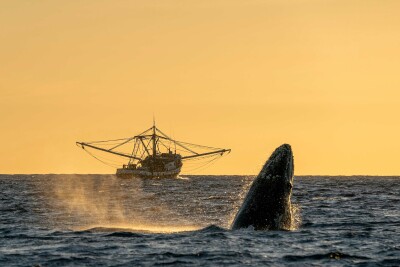
In Maine, for example, lobster stocks have declined but are still healthy. Fuel and bait prices are vastly outpacing ex-vessel price increases, and rising water temperatures are believed to adversely impact landings. Diminished North Atlantic right whale numbers hang over the industry like a sword of Damocles. The industry contends there hasn’t been a right whale mortality attributable to Maine lobstermen, but it’s getting very little traction outside coastal communities. Between area closures and ropeless gear, the envisioned protections for right whales will cost the lobster industry many millions in time and money and will usher many fishermen out of the business.
Although most salmon runs in Alaska are healthy, king and chum runs in Western Alaska are not. Rising seawater temperatures in the North Pacific are outpacing other ocean basins. And while the half-trillion-dollar Pebble Mine project, which opponents say threatens the entire Bristol Bay watershed, has been thwarted by two federal agencies, a judge is expected to issue a ruling on a challenge to the Environmental Protection Agency’s veto, which was predicated on the Clean Water Act.
Whatever she decides, it is unlikely to put the matter to rest.
Maine and Alaska have vastly different fishing histories, but with the passage of time, the challenges facing their fishermen – and fishermen throughout this country – are not so different.
Management has become more focused on potentially adverse impacts of fishing than it is on optimum yield. The creation of extensive no-fishing zones constrains fishing effort, yet research into population gains resulting from such areas has not been comprehensive. Rising seawater temperatures make climate change hard to ignore as species seem to roam northward. Abundance is always going to be an issue, but whatever we think of management, we are doing better at sustaining stocks as time goes on.
How we’ve done at sustaining fishermen is another story. Most of us probably feel we’ve not done nearly so well. There must be more to management than preventing overfishing, rebuilding depleted stocks, and protecting essential fish habitats. We can check those boxes, for the most part. The question we must answer is, what value to the United States are wild harvest fisheries and the communities they sustain?