

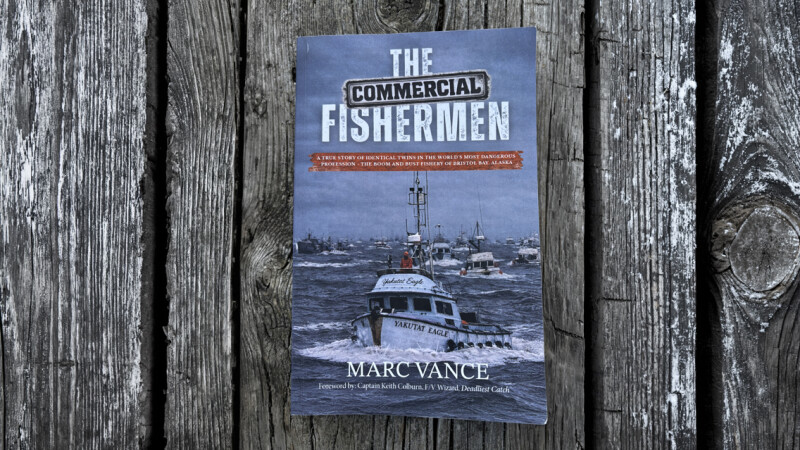
Marc Vance and his twin brother Malcom were sent to Alaska straight out of high school in 1980, mostly to keep them out of trouble it seems. While Vance’s new book The Commercial Fishermen, is chock full of details, he only hints at why he and Malcom were sent north. “Alaska, it was decided, would straighten us out,” he writes.
What Vance does share is so much information about the Bristol Bay salmon fishery that a close reading would be worthwhile for anyone fishing or planning to fish “the Bay.”
A word that appears frequently in Vance’s book is, weight. He talks about how, after their first season, the memories of Bristol Bay and the fishery carried weight compared to the off-season jobs he and his brother found; they had to go back. He talks about the bunk house they stayed in, built in the 1920s, and the weight of its history. Finally, he talks about the weight of leadership, and that’s where the story opens up.
“My brother and I leaned in toward the edge,” Vance writes. After three years working as deckhands, the Vances bought a boat, the 28-foot EPC 20, and after three years of leasing permits, they leaned in toward the edge further by buying a $165,000 permit.
Vance ran the boat and Malcom ran the deck and they pushed hard. They fought, they reconciled, and they kept going. The book follows how they met the challenges as the fishery evolved from canneries to frozen, how fish quality improved, and the way the market bounced up and down. Vance’s detailed explanations of the fishing and the gear should make The Commercial Fishermen required reading for greenhorns, and anyone who wants a clear understanding of the fishery. In particular, his description of how to hang a net is patient and instructive. He credits his brother Malcom with an ability “to read web like it was braille to a blind man.”
Besides the technology of the fishery, Vance goes into the social aspects. He talks about the friendships that grow in a temporary community, and testimonials in the first pages speak to his place in that community. But Vance was not a nice guy out on the water, and he doesn’t shy away from admitting it. He describes succumbing to a mania to catch fish that led to yelling orders. It’s not hard reading the book to realize Vance was a screamer; the kind of captain that anyone who has been in the fishing business long enough has come across. But he owns it, and deeper into the book he recognizes something that was probably more painful. Every summer, the Vance twins took their sons, Austin and Malcom Jr. to Bristol Bay with them. “We leaned on them too early,” Vance writes.
“We treated them like men before they had a chance to be teens. And I burned them out.” After forty years, when the Vance brothers decided it was time to stop, they offered the boat to the boys, both quickly responded, “no,” and Vance realized that he had burned them out.
For the Vance twins, born in a different time, their career together was one of leaning in towards the edge, facing and overcoming challenges. In the words of Captain Arab: “Forty years of privation, peril, and storm time! Forty years on the pitiless sea!” While parts of the book read like man versus fish, or man versus the market, or man versus technology, in the end it is about Marc Vance versus Marc Vance. Writing has a way of demanding truth, and in The Commercial Fisherman Marc Vance comes clean in many ways.