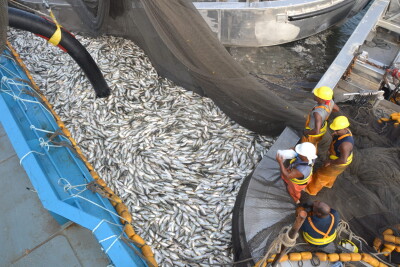
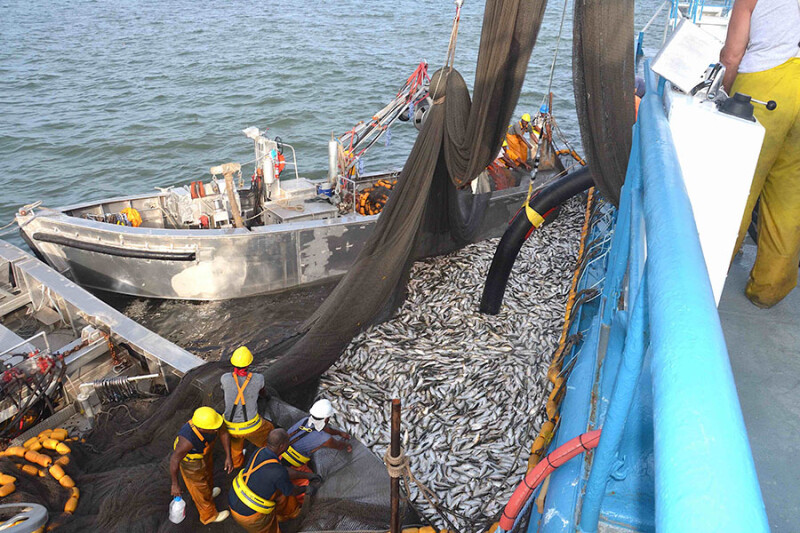
Atlantic menhaden fishermen will face additional harvest restrictions over the next two years after the Atlantic States Marine Fisheries Commission (ASMFC) approved a phased reduction in the coastwide quota, prompting industry representatives to warn of economic consequences for fishing crews, processing workers and coastal communities from Maine to Virginia.
The Atlantic Menhaden Management Board voted 11-7 on Nov. 10 in Newport, R.I., to set the coastwide quota at 170,000 metric tons in 2027 and 155,000 metric tons in 2028. The new limits represent reductions of approximately 9 percent and 17 percent, respectively, from the 2026 quota of 186,840 metric tons, which had already been reduced by 20 percent from the previous three-year quota.
The decision follows months of discussion over menhaden management, particularly in the Chesapeake Bay, where recreational fishing and environmental organizations have called for additional harvest restrictions amid concerns about the availability of menhaden as forage for striped bass, osprey, and other predators.
Commercial fishing representatives have opposed further reductions, pointing to the latest stock assessment, the economic importance of the fishery and ongoing research intended to better understand menhaden abundance in the Bay.
Maine helps broker a compromise
According to the American Small Pelagics Network (ASPN), Virginia Delegate Adele McClure initially proposed maintaining the existing coastwide quota for 2027 and 2028. The motion failed in a 7-11 vote.
Maine's Megan Ware then introduced the phased reductions that ultimately passed, seeking to balance scientific projections with the economic consequences facing New England's bait fisheries. Ware told the board that access to locally harvested menhaden had helped keep Maine lobster businesses afloat as operating costs increased.
“This is clearly a very divided issue,” Ware told the board. “I’m asking that our bait fisheries not be collateral damage at the end of the day.”
McClure, who favored maintaining the existing quota, subsequently proposed a smaller reduction and called for additional time for scientific research. Her amendment did not receive a second. The board also rejected a Massachusetts proposal for deeper successive cuts before adopting Ware's motion.
Maine and Virginia, both of which initially supported maintaining the quota, ultimately joined other delegations in voting for the compromise.
The vote comes as the ASMFC's latest stock assessment found that Atlantic menhaden are not overfished and that overfishing is not occurring. The commission manages the species using ecological reference points that account for the needs of predators that depend on menhaden. The phased reductions are intended to move the fishery closer to its ecological fishing mortality target.
Industry pushes back following vote
In a joint statement released Nov. 11, Ocean Harvesters and Omega Protein thanked commissioners for their work while expressing disappointment with the outcome and criticizing the response from several recreational fishing and environmental organizations.
“We disagree with the quota reduction, but we appreciate the commissioners who listened to fishermen, considered the consequences for our communities, and worked through a difficult process,” said Ben Landry, spokesperson for the Virginia menhaden reduction fishery. “They deserve our thanks for their time and effort.”
The companies took issue with comments made by the Theodore Roosevelt Conservation Partnership, the American Saltwater Guides Association, and the Forage Fish Campaign, among others, following the decision.
Jaclyn Lunaas, forage fish manager for the Theodore Roosevelt Conservation Partnership, told Newsday the decision was “a complete failure of management,” while the American Saltwater Guides Association described industry representatives who attended the Newport meeting as among the “least scientifically educated” people in the room.
“These representatives came to speak for fishermen, workers and communities,” Landry said. “Fishermen and workers who worry about paying bills and supporting their families deserve to have the consequences of these decisions considered.”
The Forage Fish Campaign accused the commission of protecting a foreign-owned company at the expense of American fishermen and coastal communities, pointing to Omega Protein's ownership by Canadian seafood company Cooke Inc. International Game Fish Association President Jason Schratwieser also called for an end to reduction fishing altogether.
Landry said those criticisms overlook the American fishermen, processing workers and families who depend on the Virginia fishery.
“Recreational fishing also removes large numbers of fish from the ecosystem and supports families, businesses and coastal communities,” Landry said. “Commercial fishing families deserve the same consideration.”
Fishing families face further uncertainty
For Ocean Harvesters CEO Monty Deihl, the latest quota reductions carry significant economic implications for Virginia's Northern Neck, where the menhaden industry supports hundreds of jobs.
“These cuts affect our union workers, African American and other minority fishermen, processing employees and families, as well as businesses throughout the Northern Neck,” Deihl said.
The industry has also challenged arguments that lower menhaden landings in 2025 indicate a decline in fish abundance or suggest additional quota reductions would have little economic impact. In recent weeks, industry representatives have pointed to unfavorable weather conditions that kept vessels off the water during critical portions of the 2025 season.
“If we have a good weather season next year, unlike 2025, these lower quotas will mean lost fishing opportunities and real hardship,” Deihl said. “These are the paychecks and benefits families rely on and the economic activity that supports our region.”
The decision follows months of advocacy from labor, civil rights and business organizations, including United Food and Commercial Workers Union Local 400, the Virginia State Conference NAACP and the Southern Christian Leadership Conference. The organizations have urged fisheries managers and lawmakers to consider the economic consequences of additional restrictions, particularly for African American workers, union families and rural communities where comparable employment opportunities are limited.
The economic implications extend beyond Virginia. Earlier this month, National Fisherman reported on fishermen from Maine and Virginia joining forces to oppose additional coastwide quota reductions. Maine fishermen highlighted the importance of menhaden as an affordable, locally available bait source for the lobster industry, while Virginia fishermen emphasized the jobs and communities supported by the reduction fishery.
Ocean Harvesters and Omega Protein said they remain committed to supporting recently funded research aimed at improving understanding of menhaden abundance in the Chesapeake Bay. United Food and Commercial Workers Union Local 400 has also called on lawmakers and the ASMFC to refrain from imposing additional Bay restrictions until ongoing research establishes whether they are necessary.
“We will do our best to manage through these restrictions and support our people,” Deihl said. “We look forward to completing the recently funded research and believe it will show that these severe restrictions were never necessary.”