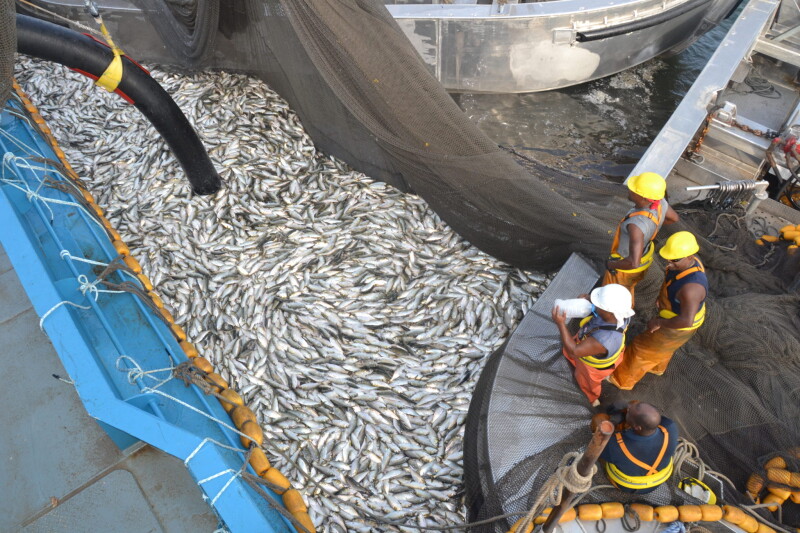
The Atlantic States Marine Fisheries Commission (ASMFC) has voted to advance Draft Addendum II to Amendment 3 of the Atlantic Menhaden Fishery Management Plan for public comment, reviving a proposal that had been delayed earlier this year as commissioners sought additional work on the document.
The Aug. 5 vote by the Atlantic Menhaden Management Board marks the next step in a management debate that has divided industry representatives, conservation organizations and fisheries managers over whether additional restrictions are needed in the Chesapeake Bay reduction fishery.
As National Fisherman previously reported, the Board voted in May to pause action on Draft Addendum II and form a work group to further refine the proposal before deciding whether to release it for public review.
The draft addendum includes several management options that would reduce the existing 51,000-metric-ton Chesapeake Bay Reduction Fishery Cap, automatically link the Bay cap to future changes in the coastwide total allowable catch, and require Virginia to divide the Bay cap into seasonal quota periods intended to spread harvest throughout the fishing season.
The Board's Aug. 5 action does not implement any of those measures. Instead, it begins the public comment process before commissioners consider whether to adopt any of the proposed management changes.
Following the vote, Ocean Harvesters, the Reedville, Va.-based company that operates the Chesapeake Bay reduction fishery, criticized the Board's decision, arguing the draft addendum advances management measures before a biological problem has been clearly established.
In a statement released after the meeting, the company said the document acknowledges there is currently insufficient scientific information to fully characterize menhaden abundance and distribution within the Chesapeake Bay or determine the influence of fishing pressure, while still proposing restrictions that could reduce harvest opportunities.
Ocean Harvesters also argued that the draft does not demonstrate that the existing Bay cap has failed or that the proposed management measures would provide measurable biological benefits.
The company cited comments made during the meeting by Virginia ASMFC Commissioner Adele McClure, who questioned whether the public comment process should move forward before additional research is completed.
"Without that complete picture, without the proper Bay-specific data, I feel like we are putting the cart before the horse instead of availing ourselves to the upcoming studies and data that could finally guide us," McClure said during the meeting, according to Ocean Harvesters' summary of the discussion.
McClure also pointed to ongoing research efforts that she said could provide managers with more complete scientific information before making future management decisions.
"We finally got that funded in Virginia at $4.5 million. We have three studies, and this could guide us in the context of good science, which is good for both the public, for union workers, and the fisheries," she said.
According to Ocean Harvesters, several research efforts are now underway to better understand Chesapeake Bay menhaden abundance, movement and ecological dynamics.
Those efforts include a collaborative research roadmap funded by the Science Center for Marine Fisheries involving scientists from the Virginia Institute of Marine Science (VIMS), the University of Maryland Center for Environmental Science and NOAA. The project is intended to identify the data and methods needed to establish what the company described as a scientifically defensible Chesapeake Bay harvest cap.
Virginia has also committed funding toward a VIMS-led Atlantic menhaden research program examining abundance, movement, predator consumption, fishing effort and localized depletion questions. In addition, recent federal appropriations approved funding for NOAA to conduct a new Chesapeake Bay menhaden survey.
Ocean Harvesters said those studies are intended to provide the Bay-specific scientific information that the draft addendum acknowledges is currently unavailable, arguing the research should help inform future management decisions.
The company said it plans to participate in the public comment process and encouraged stakeholders to review the draft addendum and consider whether the proposed management measures are supported by available scientific evidence.
The release of Draft Addendum II for public comment marks the latest chapter in an ongoing debate over Chesapeake Bay menhaden management. While stakeholders continue to disagree over how existing science should be interpreted and whether additional restrictions are warranted, the Board's latest action gives fishermen, industry members and the public an opportunity to weigh in before commissioners decide whether to adopt any of the proposed changes.