
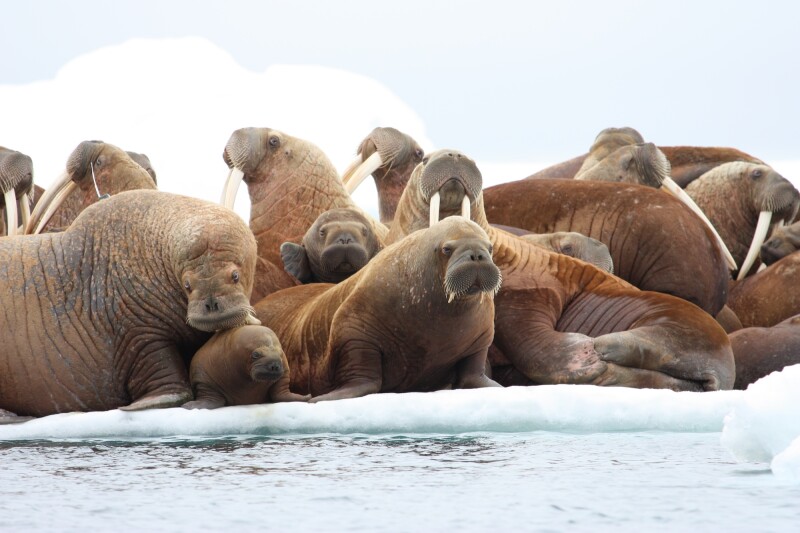
Managing the fisheries of the 900,000 square mile EEZ, or exclusive economic zone, surrounding the state effectively requires massive amounts of data that are often collected by different entities, public and private, using different methods. Harvesting the bounty safely and economically also relies on information about weather, waves, ice conditions, stock migration patterns, and more.
To gather and share the data being collected to support Alaska’s marine economic and subsistence activities, the Alaska Ocean Observing System (AOOS) was founded in 2003 and started operating in 2004 as one of the regional hubs under the National Oceanic and Atmospheric Administration (NOAA) national Integrated Ocean Observing System (IOOS). IOOS was formally established in 2007 and continues to expand in its role as an information portal on many fronts.
“It’s a lot to manage,” says AOOS’ executive director, Sheyna Wisdom. “If you look at California, for example, they have two regional hubs, and they're both on the Pacific. Ours are very spread out, and if you look at the Arctic, it doesn’t have the same information needs as Southeast.”
Besides marine traffic, water quality, and other projects, much of the AOOS budget of over $4 million goes into funding research that supports fisheries and coastal communities that depend on fisheries.
“What we do is collect information and make sure it is available to the people who need it,” says Wisdom. “With the Alaska Sea Grant, we co-host the bi-monthly Alaska Marine Policy Forum where the public gets updates on marine policy issues. We also facilitate several collaboration networks to connect people across Alaska, such as the Alaska Harmful Algal Bloom Network or the Alaska Ocean Acidification Network. We take our role as a connector very seriously.”
AOOS collects information from the numerous research projects it funds and makes that available on various portals on its website. Among those are the autonomous Slocum gliders that cruise the Bering Sea, Chukchi Sea, and Gulf of Alaska.
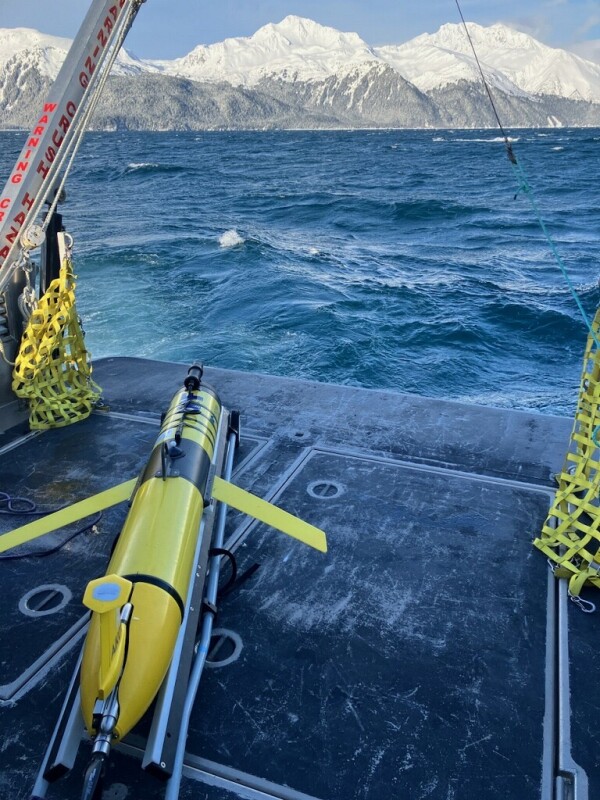
“We don’t own the gliders, for example,” says Wisdom. “The University of Alaska Fairbanks owns ten of them, of which AOOS has funded the purchase of two. The data they collect streams through AOOS. They collect information on sea temperature, salinity, and more. In addition, some of the gliders collect marine mammal vocalizations, while others detect if a tagged fish is in the area; it will pick up a signal, and when it surfaces, it transmits all that data to the university and to us.”
When researchers collect enough of these data points, they can create a picture of how certain fish species and marine mammals move and if there is a connection to oceanographic conditions. “A successful implementation of EAFM (Alaska’s Ecosystem Approach to Fisheries Management) is based on timely information that guides an informed approach to setting fisheries harvest levels in the context of environmental conditions,” says a note on the AOOS glider portal.
“Lack of timely ecosystem data is identified as a critical gap in the EAFM process. The purpose of this project is to apply gliders to the task of developing near-real-time indices of key physical and biological parameters that will inform the NPFMC (North Pacific Fishery Management Council) decision-making process, and other marine and fisheries management related research activities.”
The Prince William Sound Science Center (PWSSC), with AOOS as a partner, is conducting another monitoring program of tagged fish, using moored acoustic receivers. For the last ten years, the PWSSC has been surgically implanting Pacific herring, copper rockfish, lingcod, Pacific cod, and recently, walleye pollock with acoustic tags. So far, the PWSSC has deployed about 65 receivers. “These hydrophone arrays are the only series of arrays in Alaska and are providing us with new information on fish species ranging from salmon sharks to Pacific herring,” states the AOOS project page.
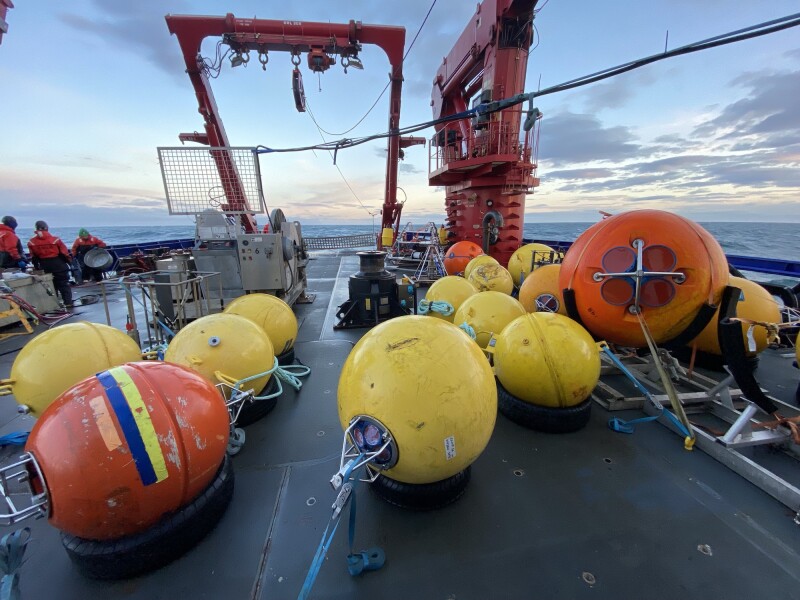
While the AOOS portal was originally intended to provide one-stop shopping for data, Wisdom points out that didn’t prove feasible. “We work with our partners such as the Marine Exchange of Alaska to provide them with data and help them design products that are useful to fishermen and rural communities,” she says. “But we don’t do the data visualization work. They do that. We also provide archives of many existing data sets.”
Among the products available to the public, Wisdom notes, is the Marine Exchange of Alaska weather page. “It’s a mobile-friendly, web-based page that provides real time weather data from several vessels and remote stations for all around Alaska,” she says. “This is vital for people trying to decide when to fish and where to fish. These data are also used by the National Weather Service for improved weather forecasts.”
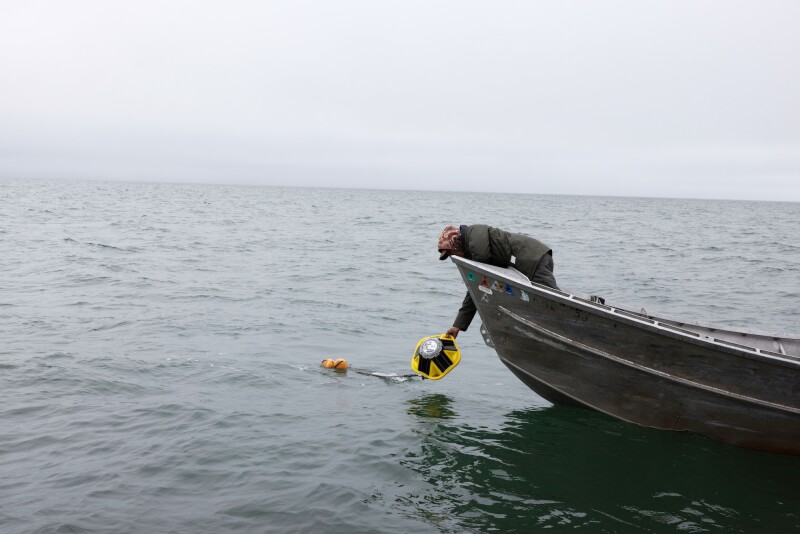
Besides commercial fisheries, the AOOS funds research and collects data important to subsistence hunters and fishermen. “Subsistence is extremely important for the food security of our rural populations,” says Wisdom. “We work with communities to collect data that is useful to them. For example, we’ll fund data buoys, but the communities decide what kind of buoy they need and what information they need it to collect.”
The AOOS provides support to the Alaska Department of Natural Resources and the Alaska Eskimo Whaling Commission for work that focuses on subsistence resources. For example, AOOS posts information on the Yukon River Chinook Run Timing project, aimed at predicting the timing and strength of the Yukon Chinook salmon run. “These forecasts are designed to help fishery managers, Yukon River community members, and other stakeholders anticipate when the Chinook run will reach the YK-Delta, and how it is likely to progress through June and July,” says the project description.
In Southeast Alaska and Kodiak, the AOOS is helping to fund several projects, including one where trollers are deploying small instruments that measure temperature, salinity, and pressure—with some also measuring chlorophyll—that will help establish a baseline for seasonal cycles of ocean mixing. “These processes affect how nutrients from the deep Pacific are brought to the surface and distributed around Southeast Alaska,” notes the project description.
While much of the AOOS-funded work focuses on the marine environment, one project currently on hold was intended to provide additional support to fisheries-dependent communities. Climate Planning for Fishing Communities, led by NOAA with regional marine and climate science, conservation, and fisheries organizations, would help Sitka, Cordova, and Kodiak cope with disruptions caused by climate change through workforce development, fisheries diversification, increasing energy efficiency, and other solutions.
“Unfortunately, that grant was terminated by the current administration,” says Wisdom. “But we’re leaving all the pieces in place in case funding gets restored.”
Wisdom has been leading AOOS for the last five years and did similar work in the region for the preceding 20 years, and in her own window of observation, she has seen some noteworthy changes. “Mostly the weather, and the changes to sea ice,” she says. “The harmful algal blooms are scary. We are seeing increasing blooms in different regions because of the changing conditions. Then there are the storms that have hit western Alaska and wiped out entire villages. They’re gone. And up north we could never get around Point Barrow until early August, and now it’s open in mid-July.”
Wisdom also reports high winds and large waves along the coast of the Chukchi Sea, where the Inuit are usually hunting bowhead whales this time of year. “Our buoys are reporting 12-foot seas,” she says. “That’s unusual, and there are 9-foot waves hitting the beach. They can’t get out to hunt in that kind of weather.”
The list of projects the AOOS funds is long and varied, and includes projects as diverse as ocean acidification monitoring, Cook Inlet particle trajectory analysis, and a walrus sea ice outlook. These projects are only the tip of the AOOS iceberg, and an exploration of the system’s website might be interesting to anyone, whether or not they fish in Alaska.