

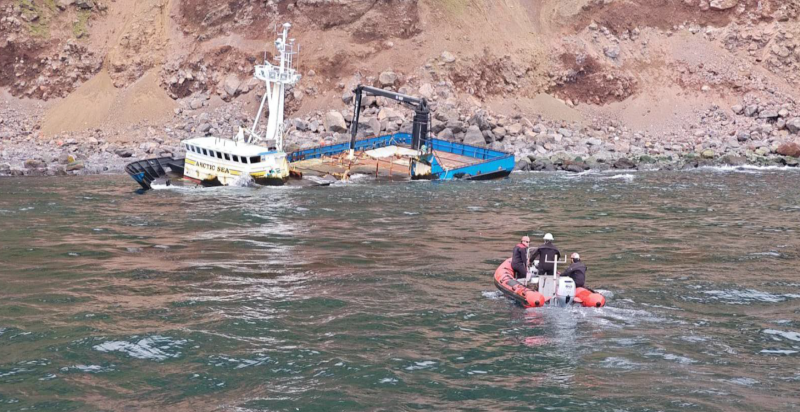
Wreck removal of the fishing vessel Arctic Sea is set to begin in early August, following a survey that found no signs of remaining diesel fuel or hydraulic oil aboard the wrecked crabber, according to the final situation report issued by the Alaska Department of Environmental Conservation (DEC) on July 21.
The 134-foot vessel reportedly lost power and ran hard aground on the northwest side of St. George Island in the Pribilofs on Jan. 5, releasing an estimated 45,000 gallons of diesel fuel and roughly 2,000 gallons of lube oil and hydraulic fluid from its 11 fuel tanks. All nine crew members were rescued by the Coast Guard at the time of the grounding, with no injuries reported.
The vessel was said to be carrying 11,000 pounds of Tanner crab at the time of the incident.
A June 1 pollution survey by Global Diving & Salvage Inc. had found one tank, the No. 2 starboard double-bottom tank, still holding about 5,800 gallons of diesel. That team plugged the tank's vent and standpipe to stop further leakage.
On June 20, a Resolve Marine team boarded the vessel to conduct a wreck removal survey and found that same tank full of seawater, with no sheen, emulsified product, or scent of diesel or hydraulic oil detected anywhere aboard. DEC said no further spill response or cleanup actions are required.
The Resolve Marine survey also documented significant deterioration of the hull, including cracks on both the port and starboard sides and sections of the port-side wave wall and bow that had broken free.
Resolve Marine has been contracted to remove the wreck, with work scheduled to wrap up before the onset of the Bering Sea winter season.
Shoreline and drone surveys conducted by Polaris Applied Sciences covered about 4 kilometers of coastline between the wreck site and the town of St. George. Heavy bird activity was observed along the surveyed cliffs, but no sheen or wildlife impacts were found. Polaris also collected mussel samples from three sites at varying distances from the wreck to establish baseline contamination levels ahead of the removal work.
The area lies within the Alaska Maritime National Wildlife Refuge and near sea lion and seal haul-outs, as well as nesting habitat for Steller's eiders and other seabirds, including one of Alaska's largest murre colonies. St. George Island is rat-free, and officials flagged that an accidental introduction of rodents during salvage work would pose a greater risk to wildlife than the spill itself; rodent-prevention kits have been positioned near the grounding site as a precaution.