


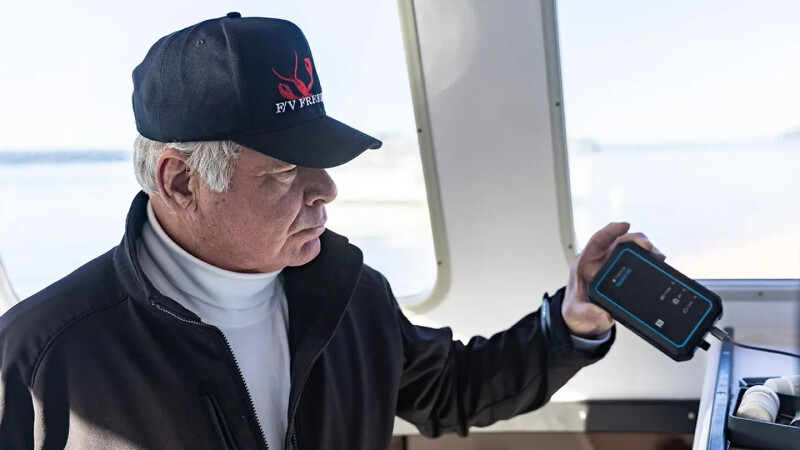
Vinalhaven lobsterman Frank Thompson says his fight against Maine’s vessel-tracking requirement is not over, despite the U.S. Supreme Court declining earlier this month to hear his Fourth Amendment challenge.
Thompson, a fifth-generation lobsterman who fishes from the island community of Vinalhaven, told Fox News that he intends to continue challenging a requirement that electronically tracks federally permitted lobster vessels, including when they are underway for personal use.
“I just told myself, I said, ‘Well, it ain’t over yet,’” Thompson told Fox after learning the Supreme Court had declined his petition.
As National Fisherman previously reported, the Supreme Court declined on Oct. 5 to review Thompson’s case, leaving intact a First Circuit Court of Appeals decision upholding the vessel-tracking requirement. Thompson had argued that requiring a GPS device aboard his privately owned vessel amounted to an unreasonable search in violation of the Fourth Amendment.
The case centered in part on the fact that tracking continues when a vessel is underway but is not being used for commercial fishing. That distinction is particularly important in Maine island communities, where fishing vessels can also serve as transportation to the mainland for errands, appointments, and other personal trips.
According to the Maine Department of Marine Resources (DMR), the devices collect a vessel’s location once per minute while it is moving and once every six hours while docked. Thompson said that knowing his location is being collected during personal trips gives him a “creepy feeling” about who has access to the information.
“This is totally against the Fourth Amendment, and somebody’s got to hear it one way or another,” Thompson said. “This black box that they’re putting aboard the boat is not legal, in my mind, and I’m not a criminal.”
Thompson and four other lobstermen filed suit after the tracking requirement took effect, arguing that fishermen were being subjected to warrantless surveillance. A federal district court dismissed the case, and the First Circuit upheld that decision, finding that the requirement fell under an exception to the Fourth Amendment for closely regulated industries.
Thompson’s attorney, Matthew Gilliam of Pacific Legal Foundation, maintains that fishermen do not surrender their constitutional privacy protections simply because they work in a regulated industry.
Gilliam told Fox News that fishermen must carry the devices “as a condition of earning a living and keeping their lobster license,” calling the requirement a warrantless search.
“Lobstermen and others have Fourth Amendment protections, and we’ll continue fighting against government overreach,” Gilliam said.
The dispute has also drawn attention outside the commercial fishing industry. The American Farm Bureau Federation supported Thompson’s Supreme Court appeal, arguing in an amicus brief that the lower court’s reasoning could weaken Fourth Amendment protections for farmers, ranchers and workers in other heavily regulated industries.
Maine fisheries officials have defended the tracking requirement as an important tool for fisheries science, enforcement and management. Following the Supreme Court’s decision, Maine DMR Commissioner Carl Wilson said the agency continues to view the data collection as “critically important to the long-term sustainability of the lobster fishery and resource.”
The Conservation Law Foundation (CLF), which supported the tracking regulations, also welcomed the Supreme Court’s decision. CLF has argued that vessel location data can help regulators manage the lobster resource and inform conservation efforts.
For Thompson, however, the issue remains one of privacy and what he sees as an erosion of the independence that has long defined commercial fishing. “People just don’t think before they react to it,” he told Fox. “All these rules and regulations and it’s taking away a lifestyle of generations of freedom.”
Thompson said he plans to continue working with his attorneys in an effort to challenge the tracking requirement, though no specific new legal action was identified.
“I’m fighting for everybody, not just myself,” Thompson said.