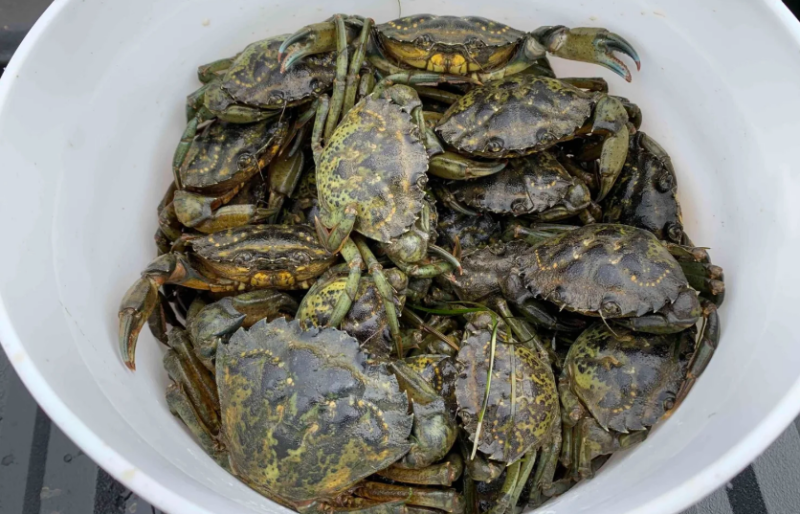
More than 2 million invasive European green crabs were captured along Washington state shorelines between July 2025 and June 2026, a record that underscores the growing threat the species poses to native shellfish and commercial fisheries.
According to KUOW, more green crabs were trapped during the 12-month period than in all previous years combined since the invasive species was first documented in Washington in 1998. The total was more than double the previous year's catch, according to the Washington Department of Fish and Wildlife's (WDFW) annual report on the state's emergency response.
“We've seen some pretty dramatic increases,” WDFW aquatic invasive species researcher Brian Turner told KUOW. “It's not good news.”
The vast majority of the crabs, roughly 1.9 million, were captured in Willapa Bay. Another 192,000 were caught in Grays Harbor and about 18,000 in North Puget Sound.
European green crabs pose a particular concern for Washington's shellfish industry. The invasive crustaceans prey on juvenile Dungeness crab, as well as oysters, mussels, and clams. They can also consume juvenile salmon and damage eelgrass and other nearshore habitat.
Former Washington Gov. Jay Inslee declared an emergency over the invasion in 2022. State and federal agencies spent at least $8 million combating green crabs during the 2025-26 fiscal year, with an estimated 500 professionals and volunteers involved in trapping efforts.
Despite the record removals, researchers do not know how many green crabs are actually living in Washington waters. Trapping provides only an indication of the broader population.
“This is not a species that we're going to 100% eradicate in our state in the near future,” Washington Sea Grant researcher Emily Grason told KUOW. “But slowing down the invasion and figuring out how to best protect resources is worth, I think, a lot.”
Researchers are also watching for another surge. Juvenile green crabs tend to thrive in warmer water, and higher-than-normal temperatures in Willapa Bay may have contributed to the recent increase.
Turner said managers are now watching for young crabs too small to be caught in standard traps, particularly as warm El Niño conditions could help fuel another wave of recruitment in Washington waters.
Efforts to create a commercial use for the invasive crabs have so far gained little traction. Green crabs are roughly 60 percent shell, making cost-effective meat processing difficult, and attempts to develop markets for their meat or shells have had limited success in Washington. For now, most of the crabs removed through trapping efforts are composted.