

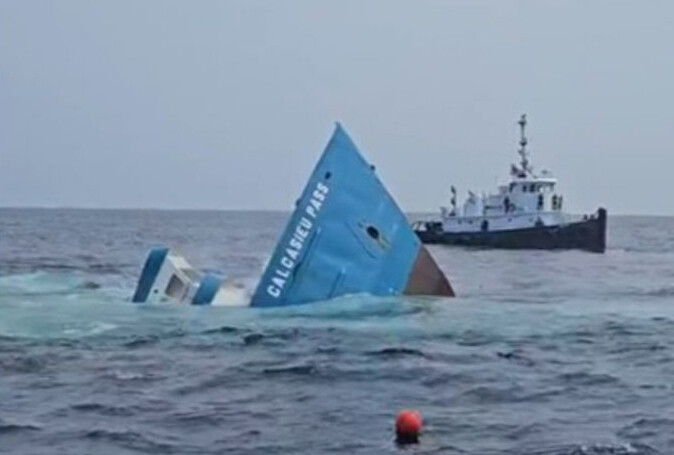
Delaware has sunk a retired 180-foot menhaden vessel on its flagship offshore artificial reef, the state Department of Natural Resources and Environmental Control announced Aug. 18.
The Calcasieu Pass, a former offshore oilfield supply boat that went on to spend more than 30 years in the Atlantic menhaden reduction fleet out of Reedville, Va., was placed on Reef Site 13, better known as the Del-Jersey-Land Reef. DNREC said the vessel went down after environmental remediation and approval by the U.S. Environmental Protection Agency and U.S. Coast Guard for environmental cleanliness and safety.
Ocean Harvesters, which operated the vessel, said in a separate announcement that the sinking took place Wednesday, Aug. 12, at a site roughly 26 miles off Indian River Inlet.
The boat measures 180 feet with a 40-foot beam. Built in 1982, it supported offshore oilfield work until 1989, when it was converted to an Atlantic menhaden fishing and processing vessel. Its name comes from Calcasieu Pass, a bend in the Calcasieu Ship Channel near Lake Charles, La., an area DNREC noted for liquefied natural gas production.
"The addition of this vessel to our reef system continues DNREC's commitment to improving marine habitat while giving retired maritime vessels a new purpose beneath the waves," DNREC Secretary Greg Patterson said. "The artificial reef system is a driver for Delaware's coastal and conservation economies, and carries out the Department's mission of conserving and sustaining our natural resources."
The DNREC Division of Fish and Wildlife, which runs the reef program, invested $285,000 in federal Sport Fish Restoration funds to buy and reef the vessel. The program, established under the Dingell-Johnson Act and expanded by the Wallop-Breaux amendments, distributes revenue from federal excise taxes on fishing tackle and motorboat fuel to state fish and wildlife agencies.
Norfolk, Va.-based marine contractor Coleen Marine handled the sinking. The company has carried out numerous deployments across Delaware's 14 permitted artificial reef sites.
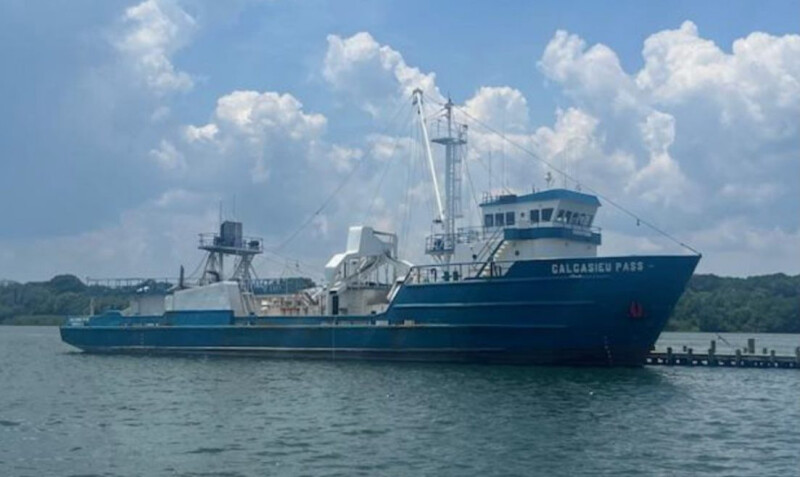
Ocean Harvesters said it transferred the Calcasieu Pass to Coleen Marine in 2024 for a nominal $1 purchase price, donating the boat for conversion into reef material. The company's chief executive, Monty Deihl, said retired working vessels can keep delivering value after their fishing days end, and that the firm welcomed the boat's new role as habitat for marine life and a destination for anglers and divers.
DNREC said the hull will provide complex underwater structure for reef-associated fish and invertebrates, with mussels, barnacles and corals colonizing the vessel over time.
Reef Site 13 sits in roughly 120 to 140 feet of water at a point about equidistant from ports in Delaware, New Jersey, and Maryland. Its best-known component is the 563-foot ex-USS Arthur W. Radford, sunk in 2011 in the first multistate reefing effort in the U.S. and the longest vessel reefed on the East Coast. Delaware's reef program dates to 1995 and its sites draw tautog, black sea bass, triggerfish, scup and spadefish.
Menhaden boats have been reefed before. The Reedville was sunk off Delaware in 2020, also by Coleen Marine, and the Mermentau and G.P. Chauvin were sunk off Mississippi in 2023.