

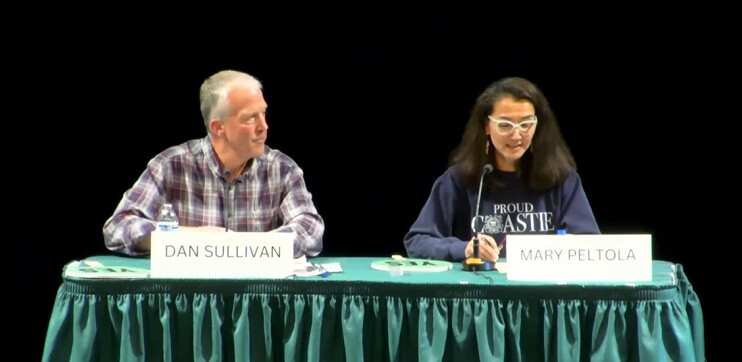
Bycatch, seafood markets, and the future of federal fisheries management took center stage as U.S. Sen. Dan Sullivan and former Rep. Mary Peltola faced off during a fisheries debate in Kodiak.
The two Senate candidates met Sept. 12 during the 2026 Congressional Candidates Fisheries Forum, hosted by the Kodiak Chamber of Commerce and KMXT Public Radio. Questions came from members of the public and the seafood industry and were vetted by representatives from Alaska's fishing sectors.
For commercial fishermen, the debate covered some of the biggest issues facing Alaska's fleet, including bycatch, fuel costs, foreign seafood competition, NOAA surveys, and Coast Guard resources.
Bycatch takes center stage
Peltola made trawl bycatch a focus from the start, distinguishing Alaska's smaller fishing operations from what she called "lower 48 factory trawlers."
"Our fight is not against small and mid-sized boats that keep communities like Kodiak strong," Peltola said. "It's against the out-of-state corporate greed that leads to wanton waste and damage to our seafloor."
When candidates were asked how they would reduce bycatch while balancing the interests of different fisheries and communities, Peltola called for changes to the Magnuson-Stevens Fishery Conservation and Management Act.
She said National Standards 4, 8, and 9 should be tightened and called for one or two Alaska Native seats on the North Pacific Fishery Management Council. Peltola also backed additional funding for monitoring and enforcement and federal investment in bycatch excluders and real-time monitoring.
"We have NOAA bycatch rules on the books now that are not being enforced," Peltola said. "Let's just start with enforcing the rules we have."
Sullivan pointed instead to work already underway, including federal bycatch research, action at the North Pacific council and legislation he has introduced.
He cited funding for NOAA's Bycatch Reduction Engineering Program and his support for the western Alaska chum salmon bycatch limit the council adopted. Sullivan also pointed to his Alaska Salmon Task Force, saying its work identified research gaps and helped lead to his Bycatch Reduction Act.
The legislation, introduced in June, was scheduled for a Senate Commerce Committee vote today, Sept. 16.
Sullivan said Alaska's salmon declines cannot be attributed to one factor, pointing to climate change and ocean acidification, ocean competition, Russian hatchery production, freshwater habitat, predators, and bycatch as issues examined through the task force.
The candidates did find common ground during a rapid-fire portion of the debate. Both said overharvest is a significant problem in North Pacific fisheries and supported maintaining or increasing federal fisheries and ecosystem survey funding.
Both also backed federal assistance for safer, more efficient fishing vessels, more domestic value-added seafood processing, and additional investment in Alaska seafood infrastructure.
Asked whether the North Pacific council and NOAA Fisheries adequately consider impacts on subsistence users, salmon migration, habitat, and Indigenous ways of life, both answered no.
Magnuson-Stevens could return to Congress
Peltola identified reauthorization of the Magnuson-Stevens Act as one of her top fisheries priorities, saying the law has not been reauthorized since 2006.
"So much has changed in our waters and in our industry," she said.
Sullivan also discussed the possibility of Magnuson-Stevens reauthorization and emphasized his position on the Senate Commerce Committee, which oversees fisheries policy. He said his seniority on the committee would be important if Congress takes up the law again.
Fuel costs and seafood markets
High operating costs and competition in seafood markets were another focus of the debate. Peltola put fuel prices among her top concerns, saying higher energy costs hit nearly every part of the seafood supply chain.
"This cost of energy affects everyone, both if you're on a factory trawler or the smallest fishing boat in the ocean, if you have a family-run operation processing fish or the biggest processing plant in the state," Peltola said.
She also called for stronger promotion of Alaska seafood and said federal programs should support smaller fishing businesses along with emerging shellfish and kelp operations. "We have the best fish in the world," Peltola said. "We should never be out marketed by farmed fish."
Sullivan focused heavily on competition from foreign seafood, particularly Russian and Chinese products. He pointed to restrictions on Russian seafood imports and said he wants those measures maintained while pursuing additional action against Chinese seafood. Sullivan argued that keeping Russian products out of U.S. markets has helped domestic fishermen compete.
Both candidates backed the new USDA Office of Seafood but emphasized different priorities.
Peltola said the office should focus on wild Alaska seafood and the needs of small and medium-sized fishing businesses. Sullivan highlighted his work on the office and said legislation to codify it is included in the Farm Bill.
NOAA surveys and Coast Guard resources
Federal fisheries science also drew attention. Peltola criticized reductions to the federal workforce and said Alaska's fisheries depend on consistent NOAA research, surveys and monitoring.
"We are flying blind without the surveys and the research that NOAA does," she said.
Sullivan said surveys are also a priority for him, pointing to what he described as a $10 million increase for NOAA surveys and funding for ocean acidification work. He also cited work involving the Oscar Dyson and the Fairweather, a NOAA vessel homeported in Ketchikan.
Both candidates said they would continue supporting Coast Guard resources in Alaska. Sullivan pointed to a $25 billion Coast Guard recapitalization package and said Kodiak would benefit from two icebreakers, two fast response cutters and new aircraft.
Peltola highlighted her previous work on the House Transportation and Infrastructure Committee and its Coast Guard subcommittee and said she would continue supporting vessels, aircraft and personnel in Alaska.
With Alaska fishermen facing pressure from weak markets, operating costs, salmon declines, and changing federal fisheries policy, much of the Kodiak debate stayed where the moderators intended it to: on fish.