After a January 2025 tragedy in which Chester and Aaron Barrett of Addison, Maine, disappeared not far offshore while transiting from Lubec to their home port, the Maine Marine Patrol located the vessel in 160 feet of water using a remotely operated vehicle (ROV) that was damaged in the operation. With the obvious need to have an operational ROV to perform search and recovery operations, the Marine Patrol sought a new machine and chose the Oceanoptics SR-X.
According to Oceanoptics spokesperson Mira Nagle, the SR-X is a popular choice among many of the company's customers. "The SR-X can go to 600 meters," said Nagle. "It has options for a two- or three-jaw grabber, a 6,000-lumen light, Oculus 2D sonar, GPS, and a Doppler velocity log (DVL), which is an acoustic sensor that measures the vehicle's speed and direction relative to the seafloor."
The Maine Marine Patrol chose the Oceanoptics ROV for these and other reasons. According to the agency's purchase order, the SR-X was determined to be easier to deploy and tear down. In addition, it runs on battery power as opposed to a generator, and it is more maneuverable than other ROVs. The Marine Patrol purchase order also notes that the SR-X has "Ability to Pitch the ROV to grab objects and search; 24/7 customer service; free onsite training."
"We work very closely with our customers," said Nagle. We go to the site, and meet with their team, usually five or six people, and we do one day of classroom training and one day in the field."
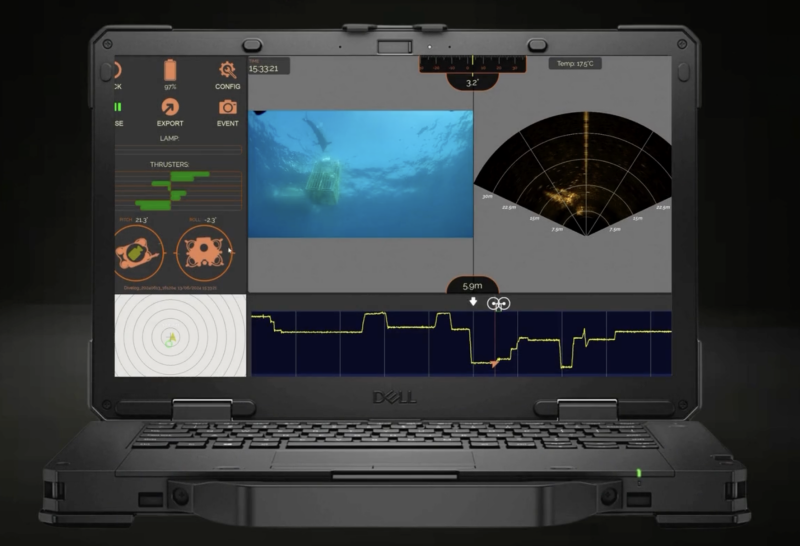
Ease of use is a major selling point for Oceanbotics. "With our system, you put the ROV in the water and attach the tether to the computer. You open our SubNav software, and that gives you a camera and sonar view and navigation with the DVL or GPS, or you can use the camera," said Nagle. "Our ROVs use an Xbox controller that most people are familiar with, and with that, you can control the lights, the grabbers, and the ROV, and you're ready to go."
According to Nagle, Oceanoptics customers include fisheries managers, conservation organizations, and aquaculture companies. "We sell a lot to NOAA [National Oceanic and Atmospheric Administration]," she said. "They use them for surveying coral reefs and other areas.
Besides search and rescue, the Maine DMR can use its new Oceanbotics ROV to conduct surveys under and around salmon pens, as well as locate ghost gear if it chooses.
"There are a lot of things we haven't done yet," said Nagle. "Just because we haven't been asked. But we're ready."