


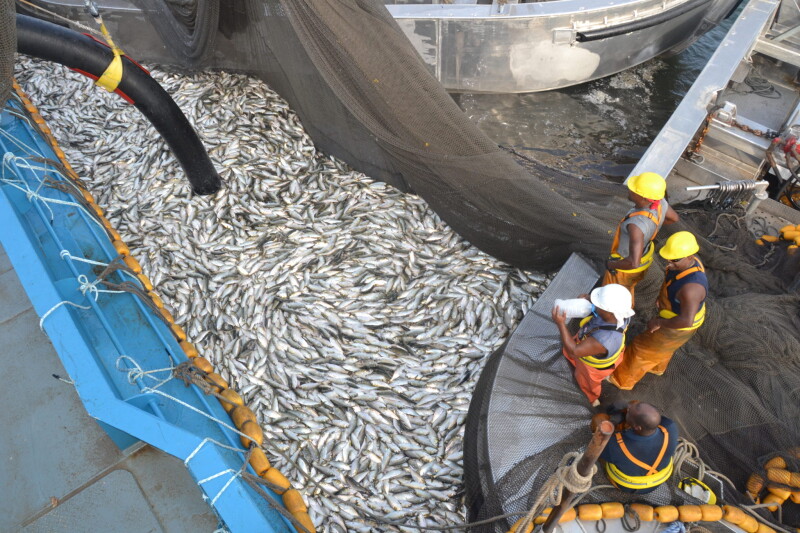
Ocean Harvesters has released a detailed response to a July 6 commentary by osprey researcher Dr. Bryan Watts, arguing that his recent scientific work does not establish a causal link between declining Chesapeake Bay osprey reproduction and Virginia's commercial menhaden fishery.
The response follows an ongoing debate sparked by the publication of Widespread Reproductive Deficits in Chesapeake Bay Ospreys in Frontiers in Marine Science. As National Fisherman previously reported, the study suggested reduced availability of Atlantic menhaden may be contributing to poor osprey nesting success in parts of the Chesapeake Bay, while Ocean Harvesters maintained the research did not prove commercial fishing caused the problem.
In its latest statement, Ocean Harvesters said Watts' own public comments reinforce that position.
"We wholeheartedly agree, as Dr. Watts said in his response, that repeating misinformation should not happen," the company wrote. "But repeating misinformation is precisely what Dr. Watts and others have done."
According to Ocean Harvesters, Watts acknowledged that his paper "does not link poor osprey reproduction to menhaden harvest," while the company argues advocacy groups have nevertheless cited the research as justification for restricting the Chesapeake Bay reduction fishery.
The company also disputed claims that its purse seine fleet operates an "intercept fishery," preventing menhaden from reaching the upper Chesapeake Bay. Ocean Harvesters cited analyses submitted to the Atlantic States Marine Fisheries Commission that it said found no evidence supporting the so-called "gauntlet" theory, arguing that catch rates and seasonal fishing patterns do not support the claim that the reduction fleet blocks fish from moving farther into the Bay.
Ocean Harvesters further contended that food stress observed in osprey nests should not automatically be attributed to commercial menhaden harvest.
While acknowledging the ecological importance of both menhaden and osprey, the company argued that ospreys rely on a broader prey base that includes striped bass, weakfish, catfish and gizzard shad. It also pointed to environmental factors such as water quality, salinity, temperature, prey distribution and other ecological conditions that could influence prey availability and reproductive success.
The response also emphasized that Atlantic menhaden continue to be managed under the Atlantic States Marine Fisheries Commission's coastwide stock assessment, which currently finds the stock is not overfished and that overfishing is not occurring. While acknowledging that Bay-specific questions remain, Ocean Harvesters argued that localized management decisions should be supported by localized scientific evidence rather than inference.
The company highlighted recent efforts to address those data gaps, including industry-supported research initiatives and Virginia's approval of $2 million in funding for Chesapeake Bay menhaden research through the Virginia Institute of Marine Science in collaboration with the Virginia Marine Resources Commission. Ocean Harvesters said the research is intended to improve understanding of adult menhaden abundance, movement, predator-prey relationships and other ecological factors that could inform future management decisions.
Ocean Harvesters concluded that questions surrounding Chesapeake Bay osprey reproduction warrant further investigation but maintained that current evidence does not demonstrate commercial menhaden harvest is responsible for the observed declines.
"The right path is Bay-specific science, not Bay-specific blame," the company wrote, adding that future management decisions should be guided by additional research rather than assumptions about the relationship between the fishery and osprey reproductive success.