

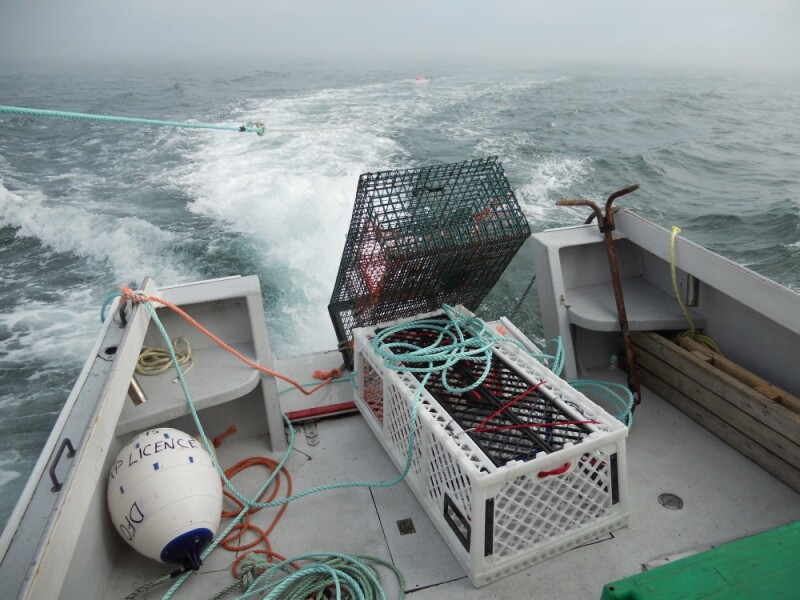
The half-round wooden lobster traps hauled from dories, and Friendship sloops gave way to wire traps and fiberglass boats, and Scott Dauphinee is taking the next step in the evolution of the lobster trap. Dauphinee owns the Lobster Trap Company in Yarmouth, Nova Scotia, which offers a polyethylene composite modular trap that he believes is better than wire.
According to the Lobster Trap Company’s PR agent, Troy Doyle, Dauphinee started experimenting with the plastic traps in 2017 and has been field testing the latest version with several Nova Scotia lobstermen. “So far they are saying that our traps catch as good or better than their wire traps,” says Doyle. “The orders we’ve been getting have been for a few hundred at a time.”
Doyle believes the price of the Lobster Trap Company’s traps is competitive. “It’s really about value,” he says. “The great thing about Scott’s traps is that they are durable. We believe they’re going to last 10 years, and this is the good part. They’re modular. So, if you damage one part you can replace it without having to buy a whole new trap.”
According to Doyle, the durable trap is a work in progress. “Scott started with a business incubator in 2017, and they asked him to take the idea to engineers and refine it, and line up manufacturers to produce the first mold. He had initial success but moved on to other projects during the pandemic. Now we’re back at it.”
The Lobster Trap Company is now offering traps in a variety of colors and sizes, and Doyle notes that Dauphinee is taking suggestions from customers. “Yes, Scott realizes that some guys like to fish certain color traps, and we make sizes for all around the Maritimes.”
Doyle notes that the traps are normally weighted with steel ingots weighing 6 lbs each. “If a fisherman wants concrete as a weight, that could be an option, but they normally install the concrete themselves. In the initial research, we found that steel tends to have more negative buoyancy than concrete – in most cases, steel is 3 times as dense as concrete. Somebody fishing North Umberland Strait is not going to need the same weight as someone fishing Southwest Nova Scotia and dealing with the Fundy tide.”
As far as refining the design, Doyle adds that customers take the traps, use them, and come back with suggestions. “Scott listens,” he says. “That’s the key to customer satisfaction.”
At present, the Lobster Trap Company standard trap weighs about 40 pounds. “That’s without weight or anything,” says Doyle. “All kitted out it weighs about 95 pounds. And on the green side of things, we’re looking at shifting over to making it out of recycled plastic.”
After almost 10 years of development, Doyle believes it’s time for Dauphinee’s traps to tap bigger markets. “We’d like to get into the U.S., and we’re building traps for other fisheries,” he says.