

Pop-up gear has been promoted as the best way to protect whales from entanglement, but there are other options.
For Dustin Delano, a former lobsterman from Friendship, Maine, and current executive director of the New England Fishermen’s Stewardship Association (NEFSA), the idea of using pop-up buoys, also known as ropeless or on-demand gear, is a complete non-starter. “I won’t test it,” Delano said. “I’m not going to get involved in something that’s just going to allow a few fishermen to fish. And then there’s the safety issue. If somebody gets tangled in ropeless gear and goes overboard, you’re not going to get them back.”
Delano’s message is echoed on the NEFSA Instagram account, with four recent posts on the safety issue. “That’s our biggest concern,” said Delano. “Everyone knows of somebody who got hauled overboard, and we got them back because we had an endline.”
In addition to the safety of fishermen, Delano is also concerned about the workability of ropeless gear that would require fishermen to determine the position of other gear based on acoustic signals that the gear would send. “For that to work, the accuracy would have to be a small fraction of a mile,” he said. “And our plotters are not perfect. This will require very high-tech equipment that we don’t have yet.”
When the weather becomes an issue, Delano pointed out that many fishermen will be going out at the same time when there’s a good day, and with everyone hauling and shifting gear, the chances of setting over each other increase. Hauling up tangled 25-trap trawls presents yet another safety issue. “Ropeless gear is not going to work with the number of fishermen we have now,” he said. “They’re going to have to eliminate people from the fishery. A lot of fishermen won’t survive this.”
Many researchers and innovators genuinely believe that ropeless gear is a viable option that will give fishermen a chance to fish areas that might otherwise be closed. NEFSA contends that fishermen facing economic strain are accepting grant money to help test ropeless gear and creating division in communities. “The MLA [Maine Lobstermen’s Association] doesn’t want to throw up its hands and say this won’t work, because then it looks like the industry doesn’t want to cooperate,” said Delano. “But how long can we cooperate if we lose and lose?”
While Delano stands firmly against the push for ropeless gear, he noted that fishermen want to keep whales from getting tangled in lobster gear. “I just don’t think we need to put all our eggs in one basket,” he said. “There’s a lot of money out there for research that we can be using to explore options other than ropeless gear. We as fishermen have made changes—like weak links, increasing trawl size, and other things—that have hurt. I don’t want to see us going in that direction. I think we need to look at non-invasive tagging and dynamic management.”
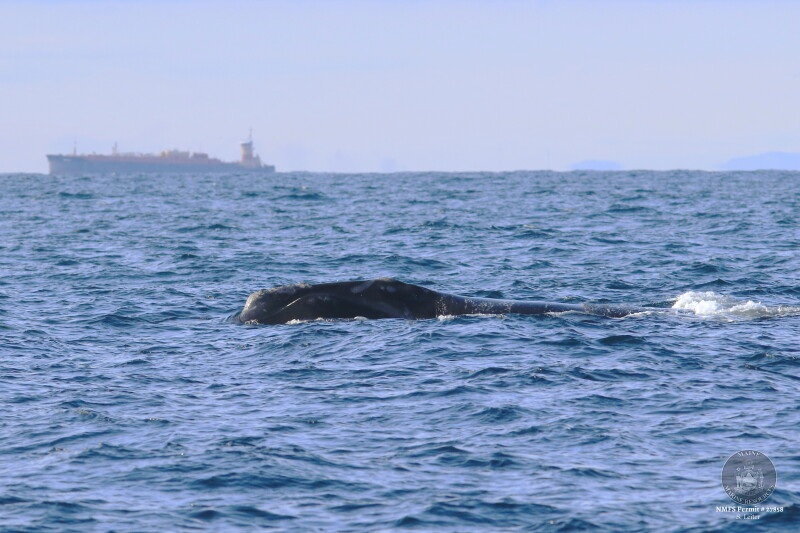
According to Sarah Leiter, a former lobsterman and now Acting Lead of the Maine Department of Marine Resources (DMR) Division of Marine Mammal Research, in early 2025, the industry proved that it is ready and willing to cooperate. “In January 2025, we had an aggregation of around 100 North Atlantic right whales around Jeffrey’s Ledge, about 35 miles east of Portsmouth, New Hampshire,” said Leiter. “DMR facilitated a meeting of Maine fishermen with gear near the whales from Zone F & G, and the fishermen suggested using only one endline on their trawls.”
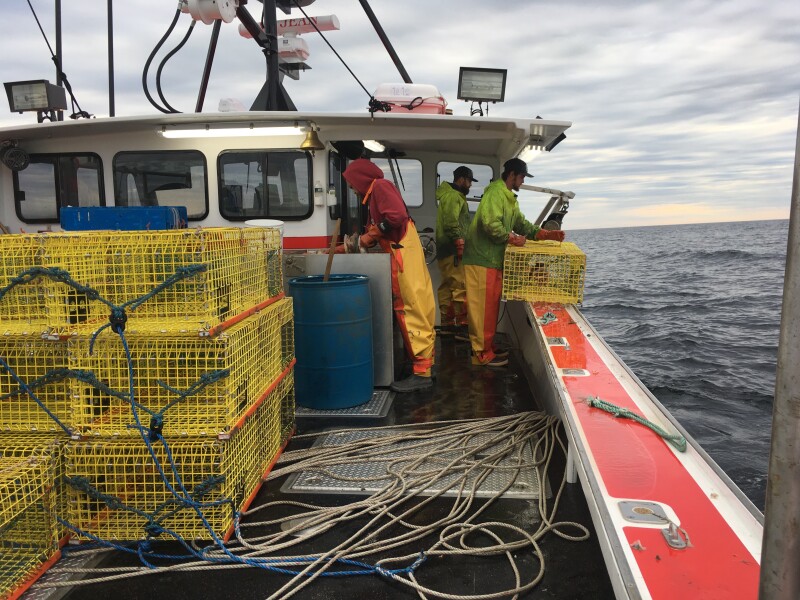
Leiter, who has spent years lobster fishing, noted that fishermen were fishing trawls of anywhere from 10 to 25 traps tied along a groundline with an endline and buoy on each end. By eliminating one of those endlines, they cut the number of vertical lines in the water in an effort to reduce the risk to whales. “It’s been over a year, and we haven’t had any reports of whales entangled in Maine gear,” she said. “So, optimistically, it appears to have worked.”
While the Maine DMR is testing several types of alternative gear types — including on-demand gear such as lift bag and stowed rope acoustic release systems, as well as timed and spring release gear, and a gear beacon — Leiter noted that the department is not necessarily promoting it. “We’re interested in learning about and providing tools that can keep fishermen fishing and maintain access to fishing grounds. Where, or how, on-demand gear might fit into that, if at all, is not clear at this time,” she said. “We’re doing research in partnership with the Maine fishing industry to understand more about if and how it could work for them, and document their experiences with the gear.” Fishermen can try any of the gear through the DMR’s Innovative Gear Library.
The Division’s research is also focused on learning about right whale behavior and looking at how to facilitate more targeted or dynamic management that will protect whales while still allowing fishermen to fish.
“In 2023, the Consolidated Appropriations Act allocated a significant amount of money for whale research, and Erin Summers, who is now the Acting Director of DMR’s Bureau of Marine Science, started the Division of Marine Mammal Research,” said Leiter. “There are three monitoring components to our research: passive acoustic monitoring, visual monitoring, and plankton surveys.”
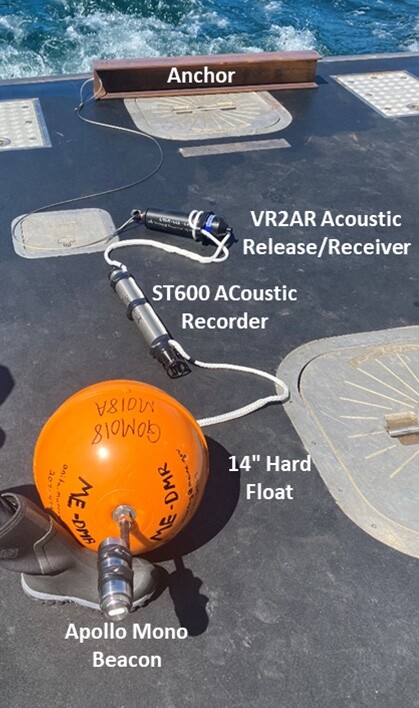
The visual monitoring takes place using an airplane and boats, and at present, the Passive Acoustic Monitoring (PAM) utilizes an array of 26 acoustic recorders spread throughout Maine’s portion of Lobster Management Area 1 and into Area 3, ranging from 60 miles off the border with New Hampshire to the narrow area between Cutler and Canadian waters. All of these stations have been listening around the clock since November of 2023. Each station is mounted near the sea floor and has a ST600 acoustic recorder and a VR2AR acoustic release receiver suspended between a buoy and an anchor, and can collect whale vocalizations from an average of about six miles away, though those detection distances vary by location.
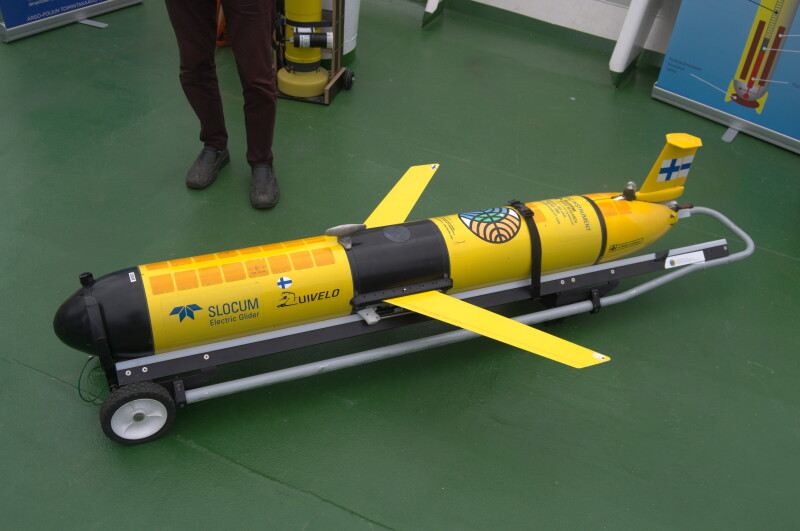
Leiter noted that the department swaps out the recorders every four months and reviews the data to get an idea of when and where right whales occur off the coast. “They’ve collected data our analysts are reviewing to determine whether it’s a right whale or something else,” said Leiter. “We are also implementing real-time PAM, which is currently in the form of a glider in the water that surfaces periodically to transmit data by satellite, and again, our analysts review it. We had it out on Jeffrey’s this past December through mid-April, and we have another deployment planned for this spring so that we’ll have an early warning if the whales show up again.”
The glider can be preprogrammed to follow a prescribed course, and Leiter notes that the glider was deployed in cooperation with the Woods Hole Oceanographic Institution. “The whales didn’t come back this year,” she says. “But that leads to another part of our research, looking at plankton populations, because the whales are likely to be where their food is.”
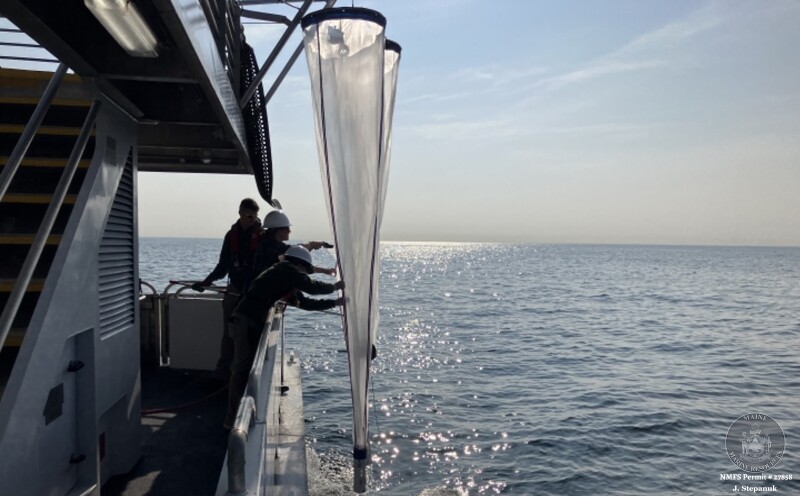
The plankton research takes place at a number of stations off the coast of Maine. “It just started in July of 2025,” said Leiter. “We do a CTD cast for chlorophyll, and then a vertical net tow, from the bottom to the surface, looking for a type of plankton called Calanus finmarchicus, which is just visible to the naked eye and is the primary food of the right whale. We look at abundance and lipid content among other things.” The survey also collects info on pH, temperature, dissolved oxygen, salinity, and other environmental conditions, Leiter notes.
“We’re also using an acoustic sounder to look for Calanus,” said Leiter. “We have a Simrad EK80 echosounders (manufactured by Kongsberg) at two frequencies, 120 and 200 kHz, which let us measure vertical layers of zooplankton in the water column.”
Leiter’s colleagues at Bigelow Laboratory for Ocean Science are providing the Simrad machines and analyzing the imagery. “We've certainly seen plenty of cool layers out there,” said Hannah Blair, of Bigelow. “It's hard to say more than that yet, since I'm just beginning analysis, but I'm very excited to dig into the data!”
“Thick red patches are what we’re looking for,” said Leiter. “There are many different species of plankton, so when we see it, we have to look closer to see if it’s Calanus. Right whales will eat other types of plankton, but Calanus is what they are looking for.” She adds that their limited diet is possibly one of the problems the endangered right whales face. “We wish they were more generalists. It would make it easier for them to survive.”
Many people, including Dustin Delano, wonder why the right whales can’t be tagged and tracked, making it easier for fishermen and ships that often run the whales over to avoid entanglements and ship strikes. “The trouble is that right whales don’t have a dorsal fin to attach a tag to,” said Leiter. “So you have to penetrate through the blubber to get a tag to stay on the whale, and that’s risky for the whale. It could lead to infection.”
Leiter added that some experiments are being done with the more abundant species of southern right whale (Eubalaena australis) of the Southern Hemisphere, but that, for now, tagging in the North Atlantic is limited to short-term tags. “We’re working with fishermen to figure a lot of this out,” she said. “Give fishermen a problem, and they’ll figure out a way to solve it. Our goal is to help fishermen continue to do what they do, while reducing risks to the whales.”