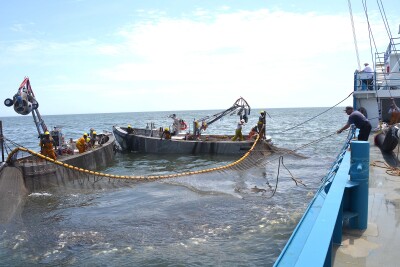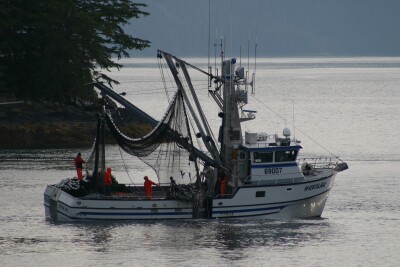

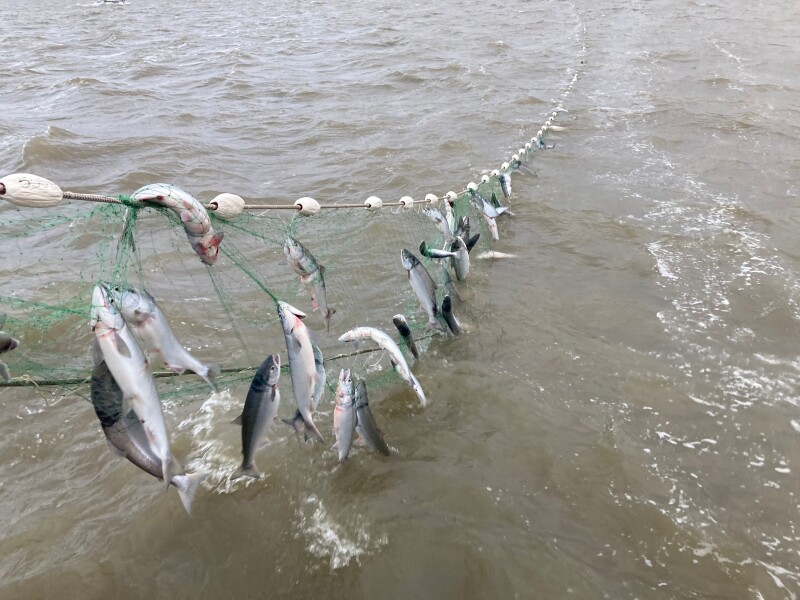
This summer’s Bristol Bay sockeye season concluded with a total catch of 29.3 million to 29.4 million fish as reported at press time, short of the government’s allowable harvest of 32.26 million. The total run reached 44.7 million fish, exceeding the forecast of 44.05 million; although this was 7 million fish above the seasonal average dating back to1963, it was well below the averages for the last decade and especially the record-run filled last five years.
Within these overall numbers, great variation in forecast and harvest results were evident among the reporting districts.
The two “Ns”, Nushagak and Naknek, were well down from the heady highs of recent years. Nushagak’s late opening (June 27) was set to allow a better upriver escapement of Nushagak king salmon, as the Nushagak kings were listed as a “stock of concern” in 2022 owing to declines. But as luck would have it, the sockeye run started early this year; Nushagak’s peak (mid-point) was July 1, meaning many fish came through before the fishery started. And this late opening no doubt played a role in the total catch (a bit over 9 million fish) falling well below the harvest forecast of 14 million. Naknek, meanwhile, saw its smallest run since 1998. However, other districts fared much better.
And at least some fishermen felt the lower catch this year was anticipated, and then higher prices saved the day.
“I was happy with this season’s catch, given the low return,” noted Peter Oswald, skipper of the Williwa, fishing Nushagak and then the Naknek-Kvichak. “A lot of guys were disappointed with their catches, but the lower catch allowed us to focus on catching the highest-quality fish, and the crew did well.
“Prices started out really strong and then got even stronger with the midseason price adjustment,” Oswald added.
As preparations for this season were underway, many fishermen were optimistic. The pre-season price offering of $1.60 per pound was 30 cents higher than 2025, and a whopping 80 cents more than in 2024. Prices rose further by mid-July, with Silver Bay and Trident Seafoods offering $2 per pound for chilled, bled, and floated product. Subsequently, even slightly higher prices were being reported. This season’s mid-point price rise was a rare event in the history of the fishery.
Chad Sorenson, skipper of Two Boys fishing Egegik, noted that “the top tier fishermen, those that positioned themselves to do well, are looking at a number of things to promote the longevity of their careers. They are looking at either upgrading their existing equipment or building new vessels with the most modern equipment available. I’m not only looking for myself, but for the future of the upcoming generation, as in my own family, whether they are set-netters or drift-netters.”
In the Seattle area, traditional suppliers of fishing equipment have also heard about newbuild projects and sensed the shift. “The phone has practically wrung off the hook since mid-July,” notes James Davis, owner and president of Kinematics Marine, located in Arlington, Wash., about an hour north of Seattle.
Kinematics builds rollers, gillnet drums, power blocks, and other equipment for Bristol Bay fishermen. “We’re enjoying our best year for orders in the last five,” he noted, adding, “We’re also hearing about plans to build new gillnetters for the 2027 season.”
SOCKEYE SEASON IN PERSPECTIVE
Among a number of commercial fisheries that Alaska has, sockeye has long stood out as one of the most important, providing livelihoods to a wide range of people, including both full-time fishermen and marine suppliers, along with people who have regular but seasonal employment in other fields, such as teachers and construction personnel. College students (as from the University of Washington, including this author) were formerly plentiful in the Bristol Bay effort, attracted by pay well exceeding summer jobs “on the beach” down in Seattle.
Though the sockeye season is historically short (mid-June to late July), it is legendary for its intensity. The July 4 peak is especially famous, with some participants foregoing sleep that day, regardless of whether aboard a boat, in a cannery, or set-netting from shore, so as to not miss a single second of the peak opportunity. For hourly workers, as in the canneries, this historically equated to plentiful overtime pay at time-and-a-half, offering the prospect of weekly wages sometimes exponentially greater than regular jobs down in Seattle.
CHALLENGES OLD AND NEW
Yet the industry has, especially in the last five years, been buffeted by a variety of challenges. The Covid-19 pandemic hit all the fisheries of the North Pacific very hard, Bristol Bay included. Mandatory quarantines brought costly delays in transporting workers and fishermen, along with unplanned costs for fulfilling quarantine protocols, difficulties delivering products to international buyers, and other hardships.
Large processors’ prices have at times been so low as to render fishing untenable, when coupled with high fuel and other costs. Diesel (the most common fuel on the fleet) has averaged above $5 to $6 per gallon.
Consolidation among processors is also a concern; several times in the history of the fishery, fishermen went on strike in response to low price offerings.
Yet other less obvious threats exist. For one, farmed fish, especially from Norway and Chile, compete with Alaskan fish. Then, although embargoes have sealed off much of Russia’s seafood exports, there is a sockeye run at the north end of the Kamchatka Peninsula, although it averages significantly smaller than Bristol Bay. Ironically, when the USSR collapsed in 1991, Americans arrived in Kamchatka specifically to undertake this and other fisheries, and they brought the first processing equipment necessary to undertake shore-based processing.
Sockeye fishermen are also mindful of the Pebble Creek Mine, widely seen as a significant threat to the Bristol Bay effort; although blocked by an EPA ruling in 2023, mining interests continue to litigate in federal courts to bring the project back to life. Finally, the “graying out” of the fishing fleet, with average ages of workers aboard rising very significantly in the last two decades, presents a unique challenge.
LOOKING AHEAD
Yet following this sockeye season, optimism is clearly evident about 2027, especially after first forecasts were published last week.