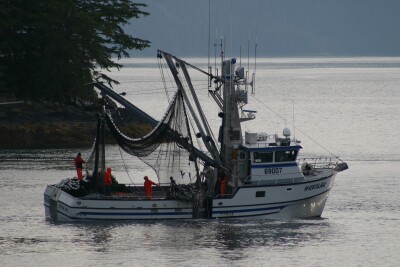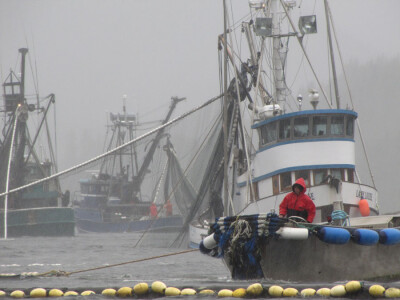
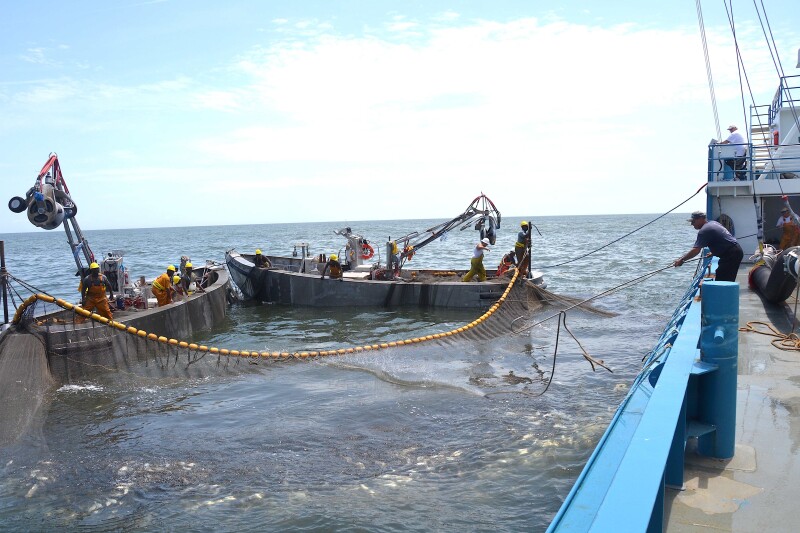
The debate over menhaden’s role in coastal ecosystems and fishing communities continues, as an industry group pushes back on claims linking commercial harvest to predator declines and questions arguments about the fishery’s economic value.
The American Small Pelagics Network (ASPN), which represents fishermen, processors, suppliers, and communities connected to fisheries including menhaden, responded to a Sept. 22 Washington Examiner op-ed by Forage Fish Campaign executive director Whit Fosburgh. In its response, ASPN challenged several of Fosburgh’s arguments surrounding menhaden management, predator needs, commercial fishing jobs, and the ownership of Omega Protein.
The response comes as menhaden management remains under scrutiny on both the Atlantic and Gulf coasts and as new research into Chesapeake Bay osprey reproduction has added another layer to the debate.
Earlier this month, the Center for Conservation Biology at William & Mary reported historically low osprey reproduction in higher-salinity portions of the Chesapeake Bay, where the birds rely heavily on menhaden. Researchers identified food stress as a major factor in nesting failures, but the study did not establish commercial menhaden harvest as the cause.
ASPN highlighted that distinction, noting that lead researcher Bryan Watts has said the study did not attempt to connect poor osprey reproduction directly to commercial menhaden harvest. The group also pointed to reports of osprey reproductive problems elsewhere along the East Coast and in the Pacific Northwest.
The Chesapeake findings have become part of a broader discussion as the Atlantic States Marine Fisheries Commission (ASMFC) considers changes to the Bay’s reduction fishery cap through Draft Addendum II to the Atlantic Menhaden Fishery Management Plan.
The current cap is 51,000 metric tons, with options under consideration that could reduce it by as much as 50 percent. At a Sept. 19 public hearing in Northumberland County, Va., hundreds of residents, fishermen and fishing families urged commissioners to wait for several ongoing studies before imposing additional restrictions.
ASPN also pushed back on arguments that current menhaden harvest levels are leaving too little forage for predators such as striped bass.
Atlantic menhaden are managed using ecological reference points intended to account for predator needs while allowing commercial harvest. According to ASPN, the 2025 Atlantic menhaden stock assessment found the stock was not overfished, and overfishing was not occurring. The group also cited ASMFC modeling indicating that the 2026 catch level had a modeled zero-percent probability of exceeding the ecological overfishing threshold.
ASPN argued that the relationship between menhaden abundance and striped bass recovery is more complicated than harvest alone. The group pointed to ASMFC modeling indicating that eliminating menhaden fishing by itself would not rebuild striped bass to its biomass target. It also cited recreational harvest and release mortality as accounting for 89 percent of striped bass removals in 2022 and 2023.
Economic arguments have also become a major part of the menhaden debate. ASPN disputed the idea that menhaden are necessarily worth more economically when left in the ecosystem than when commercially harvested. The group argued that harvested menhaden generate value through fishing and processing jobs, suppliers, aquaculture, fish oil, nutrition products, and bait used by recreational and commercial fishermen.
The organization also challenged criticism centered on the Canadian ownership of Omega Protein. Omega’s parent company, Cooke Seafood, is headquartered in Canada, but ASPN noted that Atlantic menhaden vessels are operated by Ocean Harvesters, a U.S. company whose fishermen are represented by UFCW Local 400. The Reedville menhaden industry dates to the 1870s and remains an important employer in Virginia’s Northern Neck.
According to figures provided by ASPN, Omega reported that 70 percent of its marine ingredient sales in 2025 went to U.S. customers, while 83 percent remained within the United States, Canada, and Mexico. The group said 85 percent of menhaden harvested for bait is sold to U.S. recreational and commercial customers, with the remaining 15 percent primarily going to Canadian lobster harvesters.
The back-and-forth comes as managers face increasing pressure from different sides of the menhaden debate.
Conservation and recreational fishing groups have raised concerns about whether enough menhaden are remaining in the water for predators, while commercial fishing families and industry representatives argue that current management already accounts for predator needs and that additional restrictions should wait for Bay-specific research now underway.
More than $4.5 million is expected to support three studies examining the Chesapeake Bay menhaden population, commercial harvest, management approaches and predator needs.
For ASPN, those studies and the existing stock assessment process should guide future decisions. The group said Atlantic and Gulf menhaden should continue to be managed through stock assessments, state and interstate regulations, targeted research and economic analysis.
With ASMFC weighing changes to the Chesapeake Bay cap and new research continuing to examine menhaden’s place in the Bay ecosystem, the disagreement over how much weight managers should give predator concerns, commercial fishing impacts and emerging science is unlikely to disappear anytime soon.