

An autonomous acoustic surveillance system spent 18 days in the Gulf of Maine detecting, classifying, and tracking vessels as part of a federal demonstration aimed at cracking down on illegal fishing.
The operation was sponsored by NOAA's National Marine Fisheries Service Office of Law Enforcement to test whether uncrewed technology could fill persistent surveillance gaps in marine protected areas and the U.S. Exclusive Economic Zone, stretches of water where consistent monitoring has been constrained by the cost and availability of patrol vessels and aircraft.
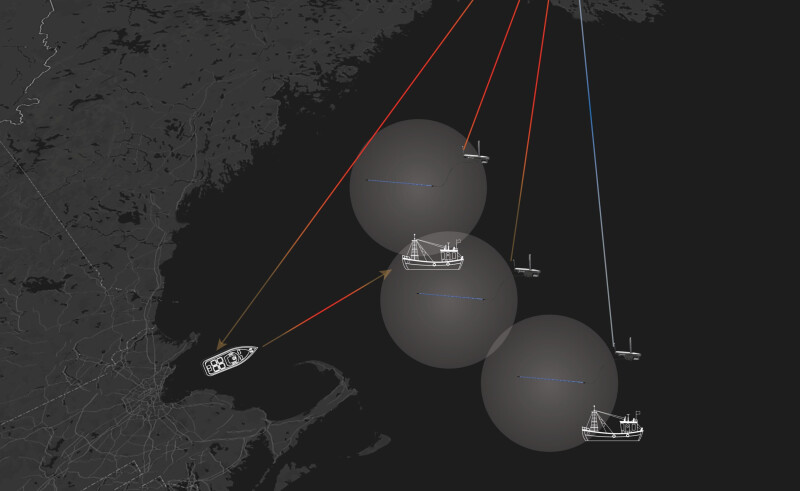
The technology was supplied by ThayerMahan, a Groton, Conn.-based maritime surveillance company. Its mobile Outpost acoustic sensing platforms, equipped with linear arrays and onboard classification systems, ran continuously through high winds, heavy seas, and extended cloud cover without a single crewed vessel or aircraft in the loop.
The systems picked up contacts beyond visual range, including boats not transmitting via the Automatic Identification System (AIS), and identified vessel activity patterns consistent with trawling and loitering. All detections were fed in near-real time into the U.S. Naval Research Laboratory's PROTEUS maritime domain awareness system, where NOAA analysts could watch the data as it came in and use it to inform live enforcement decisions.
The results validated the full detect-to-intercept workflow NOAA was looking for, and company officials say they demonstrate a fundamentally new approach to fisheries monitoring.
"This demonstration is important for our maritime national security and the preservation of U.S. marine resources," said Greg Sabra, vice president of offshore programs at ThayerMahan and retired Coast Guard officer. "We've proven to NOAA, the Coast Guard, and their partners that ThayerMahan's advanced sensing and data flows give them a dependable, scalable, and repeatable way to observe protected waters and areas of interest, around the clock, with no crewed vessels or aircraft in the loop. This is how the United States can combat illicit actors at operational scale."
The company says the system's ability to acoustically characterize vessel behavior is a key step beyond what traditional monitoring has offered.
"Autonomous systems can fundamentally change how we observe activity at sea," said Dr. Kevin Lopes, vice president of marketing and sales at ThayerMahan and a retired Coast Guard captain. "The ability to detect beyond visual range, characterize behavior acoustically, and corroborate those observations provides a level of situational awareness not previously achievable at this scale. This kind of persistent, data-driven monitoring strengthens the ability to protect marine resources, understand activity in managed areas, and support enforcement decisions."
ThayerMahan president of offshore operations Chris Glander, also a retired Coast Guard captain, said the Gulf of Maine results point toward routine integration of uncrewed systems into federal fisheries enforcement. "From fisheries enforcement and marine sanctuary protection, to coastal and border security, to countering trafficking and grey-zone tactics, ThayerMahan is ready to deploy now," Glander said. "We've proven that full-stack autonomous operations are viable, and we've proven that our technology is highly capable."
IUU fishing — illegal, unreported, and unregulated — costs the global economy an estimated $10 billion to $23 billion annually, according to the UN Food and Agriculture Organization, and accounts for as much as one in every five fish caught worldwide.
ThayerMahan said the architecture demonstrated in the Gulf of Maine can be adapted to other regions and enforcement applications.