

Groundwater discharge plays a critical role in salmon-rich rivers of Southcentral Alaska and managing this limited resource,
These groundwaters also support increasing demands of people living
Groundwater is traditionally defined as water stored and transmitted within the saturated zone but commonly includes the continuum of water stored and transmitted in both the unsaturated and saturated zones.
Southcentral Alaska is well known for its abundant Pacific salmon fisheries, which annually attract thousands of people engaged in the commercial, sport and subsistence harvest of these fish, generating hundreds of millions of dollars to the area economy. The region is a primary contributor to the state's overall economy, often producing over 100 million fish annually, according to data compiled by the Alaska Department of Fish and Game.
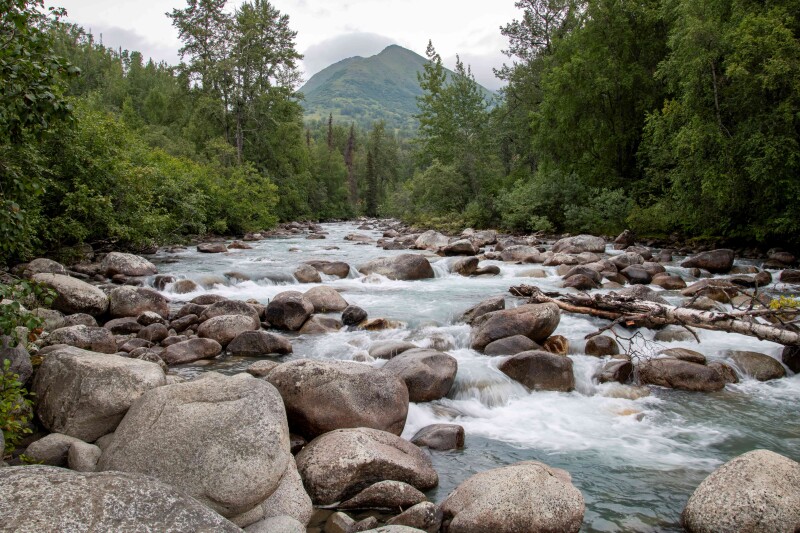
Researchers from the University of South Florida (USF) in Tampa and the Kachemak Bay National Estuarine Research Reserve (KBNERR) in Homer, Alaska, studied seasonal and regional variability of groundwater contributions to six area non-glacial mainstem salmon-bearing rivers.
USF and KBNERR have an established multi-year research partnership focused on hydrology, watershed management and climate change impacts on Alaska's coastal ecosystems. Key collaborations involve groundwater modeling and graduate-level studies funded by NOAA fellowships.
This research team found that groundwater discharge is the dominant source of streamflow, with an annual relative contribution of 70 percent. Groundwater contribution to streamflow varies seasonally, ranging from about 50-70 percent during peak flow to 70-80 percent during low flow. All rivers in the study area followed similar trends, with higher groundwater contributions in summer and winter and lower contributions in spring and fall, their report said.
In streams groundwater augments streamflow, delivers land-derived nutrients to streams and modulates stream temperatures, keeping water warmer in winter and cooler in summer. This is increasingly important for warming salmonid-streams under a changing climate. Meanwhile, as populations grow, groundwater resources face increasing pressure from extraction and expanding land use, as well as the broader drying climatic trend.
Groundwater levels worldwide are in decline due to both anthropogenic and climatic issues, including increasing agricultural, domestic and industrial demands. Changing land use and land cover meanwhile affect the quantity and quality of groundwater resources. These pressures are compounded by changes in regional precipitation and evapo-transpiration patterns as extreme weather events become more common, the study noted.
In areas where groundwater withdrawals exceed sustainable recharge rates, streamflow is expected to diminish below minimum flow thresholds in 50 percent
Groundwater withdrawal in Alaska remains largely unregulated, though some protections do exist to maintain natural streamflow, including reservations of water and the Alaska Anadromous Waters Catalog. Together they apply to only a small number of the state's streams, with some 3,200 miles of streams having reservations of water and 79,768 miles of streams in the Alaska Anadromous Waters Catalog, a conservative estimate as new streams are added to the catalog annually. In total these protections cover only about 5 percent of all stream miles mapped in the National Hydrography Dataset for Alaska.
But in Southcentral Alaska, there is growing interest in expanding protections beyond streams to include groundwater source areas through land acquisition and conservation. The research reserve's administrative specialist, Nannette Pierson, said this study is continuing research, now including research on carbon stores inside the wetlands.