Federal financing proposals, shipyard investments, and growing cooperation with Japan could help accelerate the long-delayed modernization of the North Pacific fishing fleet, industry leaders said at the Pacific Marine Expo in Seattle.
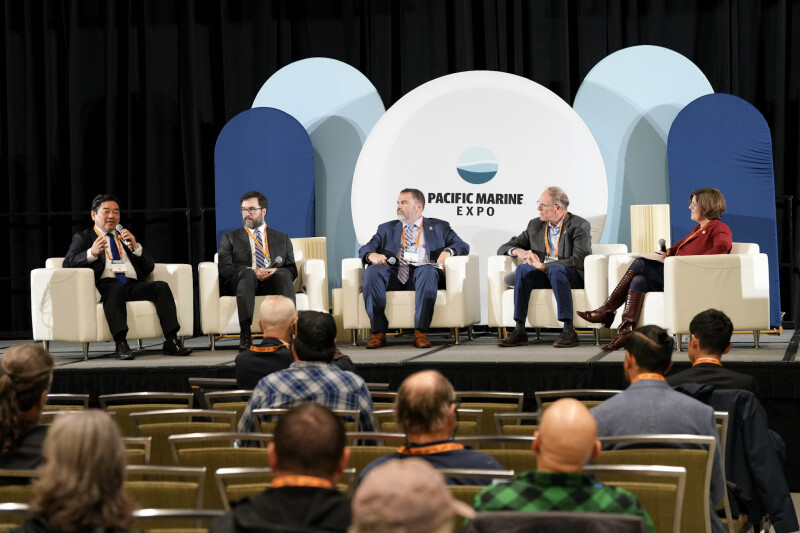
The panel, moderated by Stephanie Jones Stebbins, managing director of maritime at the Port of Seattle, brought together fishing industry, shipbuilding, and government representatives to examine the obstacles to replacing aging vessels. Jones Stebbins said commercial fishing generates approximately $1.2 billion in regional economic impact.
Chad See, executive director of the Freezer Longline Coalition, Seattle, said vessels in his sector average about 40 years old, with three exceeding 80 years. Replacing them remains costly, with new fishing vessels running $50 million to $70 million and larger catcher-processors potentially exceeding $200 million.
"The challenge here for us has been the cost to recapitalize, first and foremost," See said.
Beyond construction costs, See cited limited domestic shipyard capacity and a shortage of financing options as major barriers to fleet renewal.
Frank Wells, director of shipyards, marine engineering, and new shipbuilding at the U.S. Maritime Administration (Marad), highlighted proposed legislative changes that could expand the agency's Title XI financing authority to include fishing vessels.
Currently, fishing vessel financing falls under NOAA's authority. Wells said changes under consideration in Congress could allow Marad to provide financing through its Title XI program, which offers up to 87.5% financing over periods of up to 25 years.
"Hopefully the legislative changes are in there to allow us to service the fishing fleet, which would be groundbreaking," Wells said.
Wells also pointed to Marad's Small Shipyard Grant Program as a means of strengthening domestic construction and repair capacity. He said the agency received 172 applications requesting approximately $165 million in funding this year, far exceeding the $35 million available.
"Although the Small Shipyard Grant Program is great, and we see a lot of success with it, and we certainly don't want it to go away, it can get better," Wells said.
Hobie Stebbins (no relation to Jones Stebbins), president and CEO of Lake Union Drydock Co., Seattle, described how Marad-supported improvements have increased productivity at his Seattle facility. A newly constructed access tunnel allows workers and equipment to move directly into the drydock, reducing time spent moving between work areas.
Stebbins said the improvement increased drydock productivity by 10%. He also emphasized that sustained demand is essential to workforce development.
"We can train up people within two to three years where they become fully functional craftspeople," Stebbins said. "But that ramp, we need to be able to promise them that there's work to support it."
International cooperation could provide another avenue for strengthening domestic shipbuilding.
Shin Imai, deputy director general for engineering affairs at Japan's Ministry of Land, Infrastructure, Transport and Tourism, spoke of opportunities for Japanese shipbuilders and equipment manufacturers to collaborate with U.S. yards.
A Japanese delegation of more than 30 representatives was visiting West Coast shipyards as part of efforts to develop partnerships involving technology, workforce training, and production efficiency. Imai highlighted Japanese research into robotics, artificial intelligence, and virtual reality applications that could improve shipbuilding processes.
"This is just the beginning," Imai said. "We wish to have broader cooperation with the United States shipyards and manufacturers, so that we can work together."
For fishing vessel operators, See said the industry is eager to move forward after years of uncertainty.
"We're ready to build. We want to build. We want to invest and reinvest in our vessels to recapitalize and modernize our fleets," he said.