

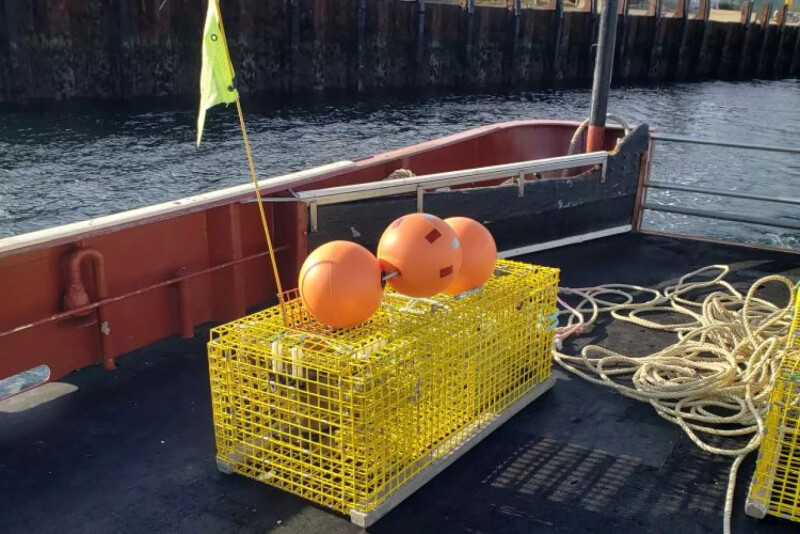
Consumers are willing to pay a premium for lobster harvested with ropeless fishing technology designed to reduce whale entanglement risks, according to new research from the University of Maine.
The study, led by Qiujie "Angie" Zheng, associate professor of business analytics at UMaine's Maine Business School, found that consumers would pay an average of $3.42 more for a lobster roll when informed that the lobster was caught using ropeless gear — particularly when messaging emphasized animal welfare.
Zheng was careful to frame the findings in context. "These findings do not suggest that Maine's lobster industry needs to change its current practices," she said. "Rather, they provide insight into how consumers might respond if ropeless technology were adopted."
The study lands amid an ongoing and contentious debate over whether the gear is safe or practical for working fishermen. Many in Maine's lobster fleet — which supplies roughly 90 percent of the nation's lobster — remain firmly opposed to ropeless gear due to safety, cost, and practicality concerns.
Dustin Delano, a former lobsterman and executive director of the New England Fishermen's Stewardship Association, has called ropeless gear a complete non-starter. "If somebody gets tangled in ropeless gear and goes overboard, you're not going to get them back," Delano told National Fisherman, noting that traditional endlines are often the only thing that saves a fisherman who goes overboard.
Beyond the man-overboard concern, Delano has also questioned the operational feasibility of ropeless systems, which rely on acoustic signals to locate submerged gear. "For that to work, the accuracy would have to be a small fraction of a mile," he said. "And our plotters are not perfect."
Those concerns have drawn attention at the federal level as well. Maine Sens. Susan Collins and Angus King pushed back on federal efforts to make ropeless gear the centerpiece of right whale conservation earlier this year, warning in a letter to the National Marine Fisheries Service that forcing an unproven technology on the lobster fleet could devastate the fishery.
"A single, uniform solution, particularly one that mandates technology that is not yet proven at scale, is not the right path forward for this fishery or for the conservation goals we share," the senators wrote in April in a letter to Eugenio Piñero Soler, assistant administrator for fisheries at the National Marine Fisheries Service.
The Maine Lobstermen's Association has estimated that industry-wide transition costs alone would reach at least $45 million, and has warned that mandatory ropeless gear could create pressure for consolidation — a direct threat to Maine's owner-operator model. Operational concerns also include the time it takes to haul on-demand gear and the lack of interoperability among the more than a dozen manufacturers currently developing ropeless systems.
Maine's lobster industry has already implemented significant whale-protection measures over the years, including weak links, sinking lines, and reduced vertical line requirements. The fishery operates under ongoing pressure related to the North Atlantic right whale, one of the world's most endangered large whale species, with an estimated population of 356 individuals and fewer than 100 reproductive-age females.
The UMaine study examined how different types of consumer messaging shaped willingness to pay for ropeless-harvested lobster. Information focused on whale welfare and entanglement impacts proved most effective at building consumer support, though responses varied based on individuals' environmental attitudes, prior knowledge of right whale issues, and familiarity with ropeless gear.
Zheng emphasized that consumers themselves are one part of a broader conservation equation. "Right whale conservation is a collective effort. In addition to the fishermen, regulators, and scientists, consumers play a role, so we hope this research helps understand consumer preferences and evaluations," she said.
She also stressed that the research is intended to inform, not prescribe. "We are providing a base for the community to assess the overall economic feasibility," she said. "I'm always trying to learn from fishermen and the fishing community because they make their living from a very complicated natural system, and they know it so well."
Zheng collaborated with Kanae Tokunaga of the Gulf of Maine Research Institute and Rodolfo Nayga and Wei Yang of Texas A&M University. The findings were published in the journal Marine Resource Economics.