

My first engine was a Johnson Seahorse 3 (horsepower) outboard. It didn’t have a reverse, but standing over it in the stern I could spin it 180 degrees if I wanted to brake or go astern like the lobster boats did. I was 10 or 11 at the time. Nowadays that would probably be considered too young for a boy to have a boat. In fact, the skiff I mounted it on was my second one.
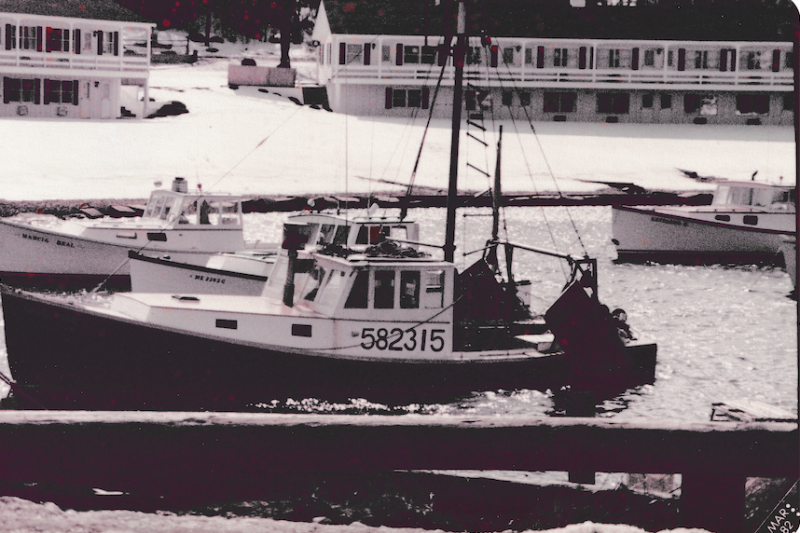
The first was a square-ended wooden punt I rowed standing up with a single oar — “Armstrong power.” It was heavy and somewhat difficult to propel unless you were proficient at sculling. I was not. Once I was nearly blown out to sea when I bit off more of the channel at Perkins Cove, Maine, than I could chew during a stiff offshore breeze. I was saved by Teddy Johnson, the young lobsterman who had sold me the boat for $10. He saw my plight, ran out onto the remains of an old bridge, and jumped down. He sculled us back into the harbor as I paid close attention.
Later that summer, or perhaps the next one, a lobsterman named Earl Miller came upon an empty skiff while hauling traps. Earl wore sunglasses that shaded the sides of his eyes as well as the front and was gruff if you didn’t know him. He was admired for his skill at catching halibut in the spring, which he did not undertake until the apple blossoms came out, and renowned for the expression, “We thank you Lord for the little ones, and for the bigger ones in proportion,” which you may still hear uttered at the Cove today, if you can find a place to park.
I was on the dock as Earl towed the skiff in and he hollered if I wanted it. It sorely needed paint, but it was conventional with a pointed bow and square stern and a set of oarlocks. Heck yes! A set of oars later and I was in business. This put me in the company of the other boys at the cove, although at least a couple of them had Amesbury skiffs, known for their lapstrake planking and graceful lines. These were working skiffs nonetheless, no varnish or stainless oarlocks. We rowed around and went fishing.
The next year the kids graduated to outboards, and so did I, after some pleading with my mother, who was not especially comfortable around the ocean and was always saying, “You can drown in a teacup.”
By now, though, she and my father had gone their separate ways, and I think she made up her mind that a little rough and tumble for her only son was worth the risk.
The other boys had 5½-hp engines, which came with motorcycle-style throttles, shift levers for reverse, and six-gallon tanks with bulbs to pump the fuel up to the engine on first start. By contrast my Seahorse 3 had a small, built-in tank. It could run for an hour or so. I had a 2½-gallon gas can so I could top it off “at sea.” The man who sold it to me said, “Make sure you don’t spill gas on the powerhead.”
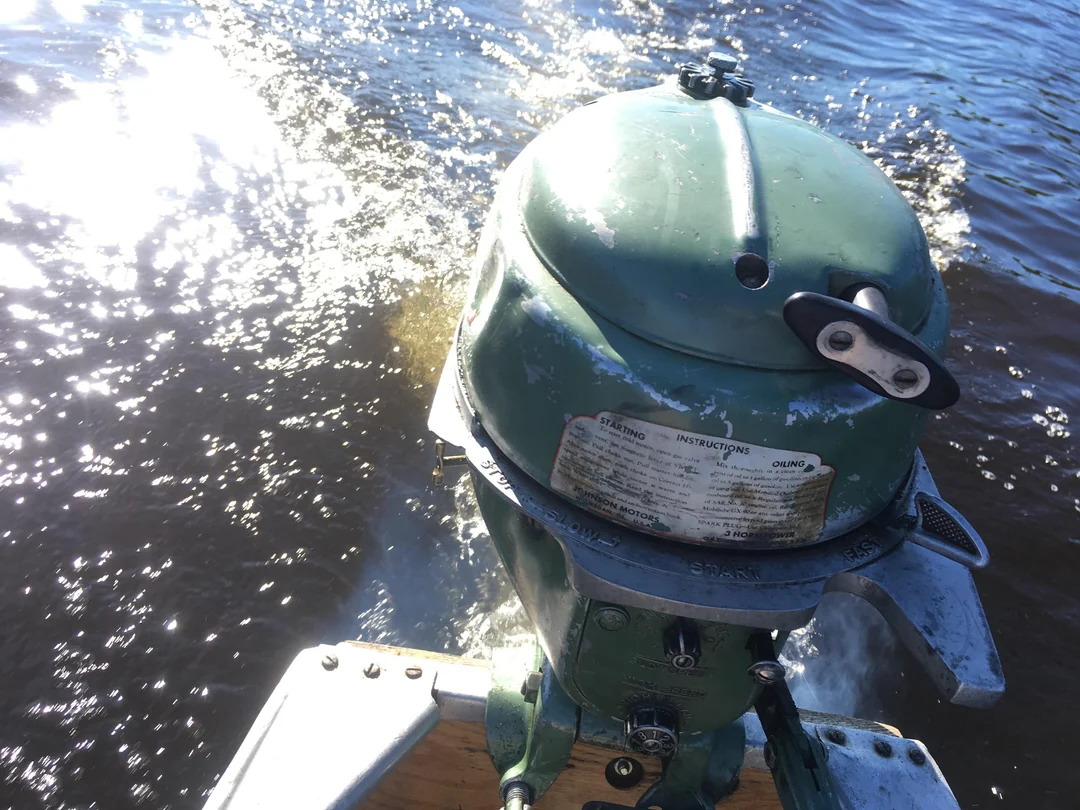
The Seahorse, like all outboards of the era, was two-cycle, so I’d mix oil with the gas and off I’d go. Though I couldn’t keep up with the other boats, I learned that if it was just me in the skiff and I moved forward to the middle seat (reaching back to the tiller), the boat would get “on step” and pick up speed — such as it was.
Nothing is indestructible, but those old outboards came close. I don’t remember anyone breaking down. Their only vulnerability was the shear pin connecting the propeller to the driveshaft. Most of us acquired experience with shear pins, typically after tangling with a mooring line or lobster trap warp. They were easy to replace; the trick was to have a spare pin and not resort to a trap nail, which would turn the prop but wouldn’t shear, resulting in extensive damage to your outboard’s lower unit the next time you fouled the propeller or struck bottom.
The only way to destroy those old outboards was to dunk them, which we very nearly did to our friend Peter during a water fight. We’d had occasional water fights during our rowing days, using oars to splash one another. A guy could easily get soaked. We still carried oars in our motorboats, and one day we got into it in the back of the cove. Somehow Peter found himself at the center of a throng of the boat with boats splashing water in every direction, and before anyone knew it, he was sinking. He quickly undid the transom clamps, lifted the engine off, and passed it to one of the other kids, saving the day.
Saltwater is a great platform but it’s no engine’s idea of a high colonic.
I sustained my carbon-burning lifestyle baiting lobster traps aboard the Mi Stephanie, a 34-foot, Novi (Nova Scotia-built) lobster boat . Like many of the old lobster boats, she was powered by a six-cylinder Chevy attached to a marine bellhousing. Mechanical, as opposed to hydraulic reverse gears were still common. As a result, propeller shafts tended to turn slowly, even in neutral. This could cause problems if rope got under the stern — not unheard of in the lobstering business. Often these engines came from junked cars. When they died, the fisherman would go back to the junkyard to find one that would mate up to whatever bell housing he had.
Cooling was fresh water circulated through keel pipes. There was no engine room or even an engine box aboard the Mi-Stephanie. The engine sat in the fo’c’stle adorned only by the bare necessities of wires and linkages. The exhaust was dry, with a stack that went up through the overhead. It was loud, but in the winter, Red said, its heat would warm the virgin-wool mittens his wife knitted. The engine had a couple of belt drives so it would not have done to fall into it.
One of the belts drove the winch head. There was no clutch, so Red wouldn’t put the v-belt on until we were ready to haul traps. In its day the winch head was a tremendous innovation, but it was not something to be used mindlessly. If the fairlead wasn’t right, the line coming onto the winch could get pinched by the turn just hauled. The winch would then wind on line from both ends. If you tried to pull the line free, it would wind you on as well.
Lobstermen often plugged the brown bottles of yesteryear and tied them onto their trap lines as submerged floats to keep slack line from hanging up on the bottom. These were known as toggle buoys and on more than one occasion we had a wind-up in which a bottle would get hauled up into the snatch block and shatter before Red could shut the engine down.
It’s probably just as well that the hydraulic hauler, which used a sheave rather than a winch head to take line and was controlled by a handle at the hauling station, came into existence before the Occupational Health and Safety Administration did.
Forward of the engine was a wooden v-berth I laid down on when I was feeling queasy, and the warmth and oil smell and sound of the engine would lull me to sleep.
Baiting traps involved reaching down into a barrel of salted redfish decomposing in their own juice and putting three or four racks on a stringer. Red would then hang them in the trap. He paid me $1 a day and willingly shared his lunch with me, as mine was usually gone before 9 o’clock. Today’s wage-and-hour police would be aghast, but my mother, who in her Depression-era youth had picked blueberries for less money, thought it would do me good. She was right. I got more out of the bargain than Red did. It was experience I’ll remain grateful for forever. And I had enough money for gasoline and oil, to boot.
It is easy to think that life aboard a fishing boat takes place on deck or in the wheelhouse, but the fisherman knows that the engine room is the beating heart of the boat. This notion crystallized for me on the Hard Times, a 37-foot Jonesport-built lobster boat rigged for dragging that was my introduction to the world of owner-operator.
The Hard Times was powered by a naturally aspirated 6V-53 Detroit Diesel. We had an Allison 2:1 reverse gear and the power takeoff was by Klutchmaster (as opposed to Clutch Master) and ran the hydraulics that powered the winch.
This was in the late 1970s, when hydraulics were still viewed with skepticism by many in the dragging fleet. But their day was coming. Mechanically driven winches derived power through chains or shafts, which imposed limits on where they were placed on deck. As a result, you could wind up with trawl wires running zigzagging through deck blocks. Hydraulics cleared the way for so-called split winches with trawl wires running directly aft to the port and starboard gallows, reducing wear all around. Hydraulics also sped the introduction of net reels.
To look at the Klutch Master, which as I remember it was not much bigger than an alternator, it was not imposing. But it stood up to the considerable abuse we gave it. So did the engine. Make no mistake, the old GM diesels had their detractors. These two-cycle beasts were less fuel efficient than their four-cycle cousins and prone to leaking oil into the bilge. And they were loud: not for nothing were they known as screaming jimmies. But they had a well-deserved reputation as “the poor man’s diesel,” which was what I needed as I embarked on my fishing career.
And for sure, the 6-53 was the beating heart of the Hard Times. It ran and ran and ran. It sat there in the fo’c’stle just like Red’s six-cylinder Chevy, only larger, and sometimes when I went down forward for something I would pause for a second or two and just marvel at it as it roared. Whatever else it was, it was a comfort.
Rigged for dragging, the Hard Times presented an element of risk in that there was little freeboard. She was a lobster boat weighed down by the ironmongery of trawling, to say nothing of a net and a pair of trawl doors. The cockpit was just above the water line. By way of freeing ports, she had two scuppers in the stern threaded with PVC, and such was our freeboard that I kept the end caps close at hand, though I never actually used them. If we took green water over the side, we could drain it by steaming ahead. But if the engine quit some night rough enough that water came in over the side, we knew we could lose the boat, followed in short order by our own backsides. But the 6-53 never skipped a beat.
Two-cycle engines are virtuous in that there is a little that can go wrong. One potential 6-53 gotcha was that occasionally the spline of the blower shaft drive would strip. The engine would belch black smoke up the stack and stop. If you had a few minutes you could end for end the shaft and get going. But God forbid the shaft let go at the wrong time — negotiating the entrance to the cove in an onshore breeze, for example. You could find yourself on the rocks even as you looked at the lights of home. Of course, we never experienced this, nor did we dwell on it. Stripped blower shaft drives were a notion in the ether.
We focused on weather and the price of fish, and we went fishing.