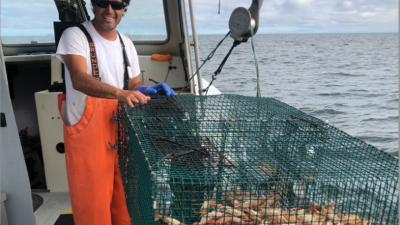
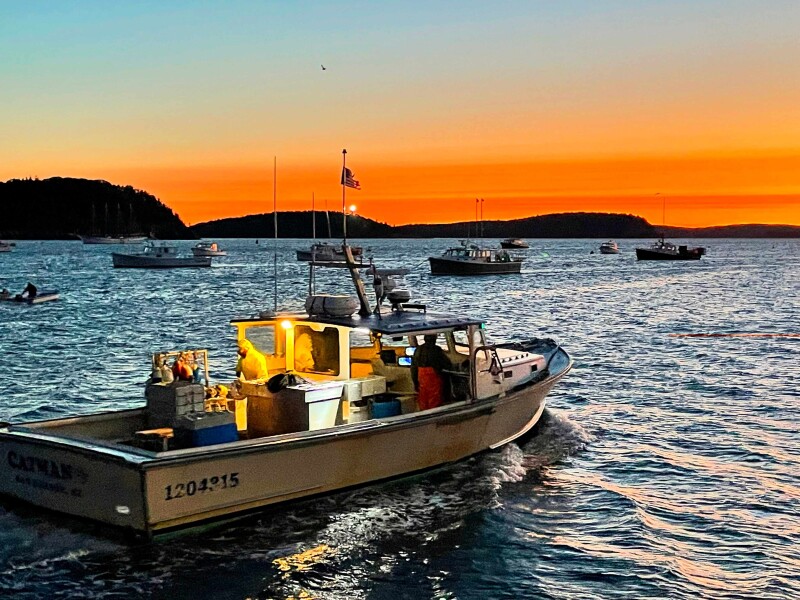
Over the past decade, the conversation around fishermen's wellness has grown. Once upon a time, if you googled "fishermen and mental health," the only articles that came up were about how fly fishing was good for your mental health. If you googled "farmers and mental health," on the other hand, you got thousands of articles about how the wellbeing of farmers was being supported or considered when new rules were adopted or the price of milk bottomed out. Thankfully, that has changed. The conversation around mental health and fishermen has finally humanized the role of commercial fishermen in the fishing industry, acknowledging that it is hard work that takes a real toll, and that the people doing it deserve resources built around the specific demands of that work.
Suicide rates in fishing and agriculture are among the highest of any occupation, the physical toll of the work is well documented, and we have learned that the independence that draws people to commercial fishing, the thing they say they love most about it, can also be one of its greatest risks. The same traits that make a fisherman good at their job, self-reliance, stoicism, and the ability to work through pain, weather, and uncertainty, are the same traits that make it hard to ask for help when something goes wrong.
That's not a character flaw. It's a deeply conditioned response, and research on men's health confirms it. (The number of women in commercial fishing is growing, but the business of fishing remains predominantly male, and the culture around it reflects that.) Studies consistently find that adherence to traditional masculine norms, emotional stoicism, self-reliance, the expectation that a man should be strong and in control, significantly reduces the likelihood that a man will reach out when he is struggling. Asking for help feels like it conflicts with the identity a fisherman has spent a lifetime building. And so men mask it, push through it, handle it themselves, or don't handle it at all. Psychologists call this suppressed help-seeking behavior, and it has less to do with not feeling things than with having learned that showing those feelings comes at a cost to how you see yourself and how others see you.
In commercial fishing, this tends to run even deeper. Fishing is not just a job. For most of the men who do it, it is who they are. You are a fisherman from the moment you get your student license, if not before. You are a fisherman at the hardware store, at your kid's school, out to dinner. The work and the self are the same thing, and that fusion is part of what sustains people through the hardest parts of the job. If fishing weren't so intrinsically tied to a fisherman's identity, a lot of them might have given up by now, and honestly, who could blame them? It is a demanding, uncertain industry with thin margins and little control over what you earn. But when you cannot imagine being anything other than a fisherman, you will do whatever it takes to protect that part of who you are.
Sport psychologists have studied this exact dynamic in elite athletes, and what they have found translates well. When identity is built entirely around a single role, the loss of that role, or even the threat of losing it, produces something that looks a lot like grief. Researchers define this as athletic identity foreclosure: the athletic identity has been so dominant that a broader personal identity never fully developed alongside it. When the career ends, what's left? The identity research on retiring athletes shows mental health symptoms peaking in the first three months post-retirement, with depression and anxiety both elevated in athletes who had the strongest identification with their sport. Retirement from sport can be one of the most difficult transitions for athletes who must cope with the loss of athlete identity in redefining their purpose outside of sports. And athletes who resisted preparing for that transition, who tried not to think about it, fared worst of all.
Now apply that to a fisherman in his sixties or seventies. A fisherman who has been hauling since he was old enough to band a lobster. A fisherman whose father fished, whose grandfather fished, who has lived inside this identity for fifty-plus years. For him, retirement is not a milestone. It is an existential threat. And when you ask him about it, he will probably tell you he is not going to retire. He is going to fish until he dies.
He is not being dramatic. He is being honest about what stopping would mean.
This is why so many older fishermen keep buying their lobster license long after they have stopped actively hauling. The license is not really about fishing anymore. It is a ritual, and rituals matter because they affirm continuity of self. As long as you have your license, you are still a lobsterman. You still belong to the thing that has defined you for most of your life. Giving up the license is giving up the identity, and that is a much harder thing to do than people who have never had this kind of work-based identity can fully appreciate.
Research on retirees with strong occupational identities finds that those most strongly tied to their work roles are more prone to diminished mental well-being after retiring. The same research finds that people who resist adopting a retiree identity often pursue what's called bridge employment, part-time or informal work that keeps them connected to the role they've spent their lives building. For fishermen, that might look like helping a younger fisherman with his boat, doing odd jobs on the water, or simply keeping the boat fueled up and the gear in order even when there's no particular reason to. The doing keeps the being intact.
What this means practically for wellness programs that serve fishing communities is that help-seeking, and the identity questions that surround aging and leaving the work, are not separate conversations. A fisherman who won't ask for help when his back gives out is operating on the same psychology as a fisherman who won't think about what life looks like when he can no longer haul. The thing at risk, in both cases, is the self.
Research points to a useful insight here: men often don't make deliberate, planned decisions to seek help. Instead, they act on spontaneous willingness, a moment when the conditions feel right. That means the most effective approach is not to lecture fishermen about the importance of asking for help. It is to reduce the friction around it. It is to be present, consistent, and there, so that when the moment of willingness arrives, there is somewhere to go. This is why resources developed for the industry need to be both culturally competent and accessible in the ways fishermen actually seek support, which looks different from how most access to care systems are designed.
The fishermen who tell us they will die before they retire are not being stubborn. They are telling us something true about the relationship between this work and the people who do it. Fishing is not something you grow out of. For people who work with fishermen, like family members, caregivers, health practitioners, and even policy makers, our job is to understand what that means, and to make sure that the people who have given their lives to this work have somewhere to land, at any age, or when the time comes for them to disembark from the boat for the very last time.
There is a condition called mal de débarquement, which translates literally as the sickness of going ashore. After extended time on the ocean, the brain adapts so completely to the motion of the water that solid ground no longer feels solid. For example, you might find yourself swaying in the shower after a choppy day on the water or feel a little wobbly on the wharf after a few days out fishing. It is a neurological condition, but it is also, for many fishermen, something closer to a metaphor. A fisherman who has spent their life calibrated to the rhythms of the water, tides, seasons, the boat, does not simply step ashore and find their footing. The work gets into you at a level that does not just go away. Understanding that is where good support has to start.