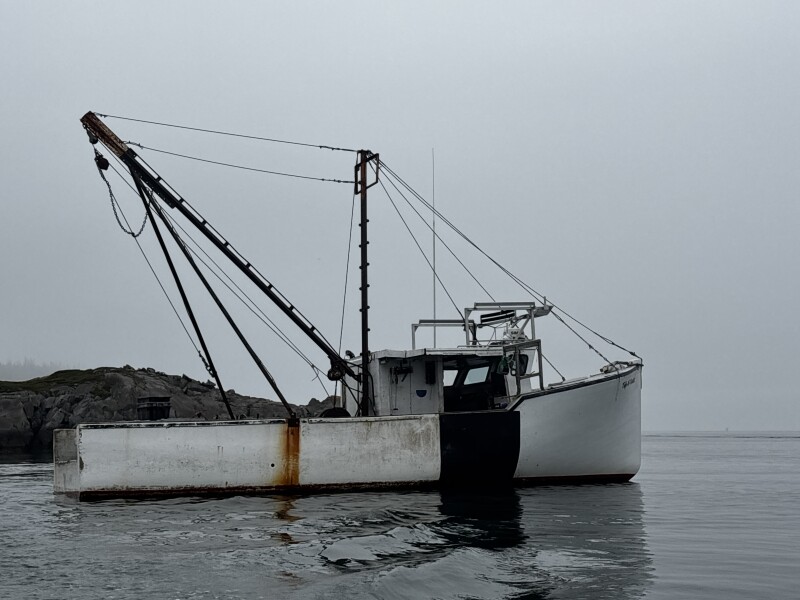
Some boats are not beauties or particularly innovative. In Lubec, Maine, a lot of boats are simple workhorses – rough boats for a rough environment – and whatever they’re running for systems have earned their place aboard.
Lubec is a community with many families descended from Irish immigrants who arrived in the mid-1800s from Rathlin Island. Some, it is said, were simply dropped off on fog shrouded beaches, such as Bailey’s Mistake, and told they were now in America. Greg McConnell comes from that tough and resourceful crowd, and his boat is one of the rough workhorses.
A 42-foot Novi of unknown origin, the Tide-N-Knots has a 15-foot beam and draws just shy of 4 feet. Whether it’s dragging scallops or sea urchins, hauling lobster gear, or longlining halibut, she gets the job done. “When I bought the boat almost 18 years ago, it had a 3208 Cat in it,” McConnell says. He ran that old 320-hp, 10.4-liter V-8 mechanical engine for five years until it met its end. “It blew up at the middle of lobster season, so I bought a used 370-horsepower Volvo just to get going again. I ran that for a few years, until it blew up about eight years ago.”
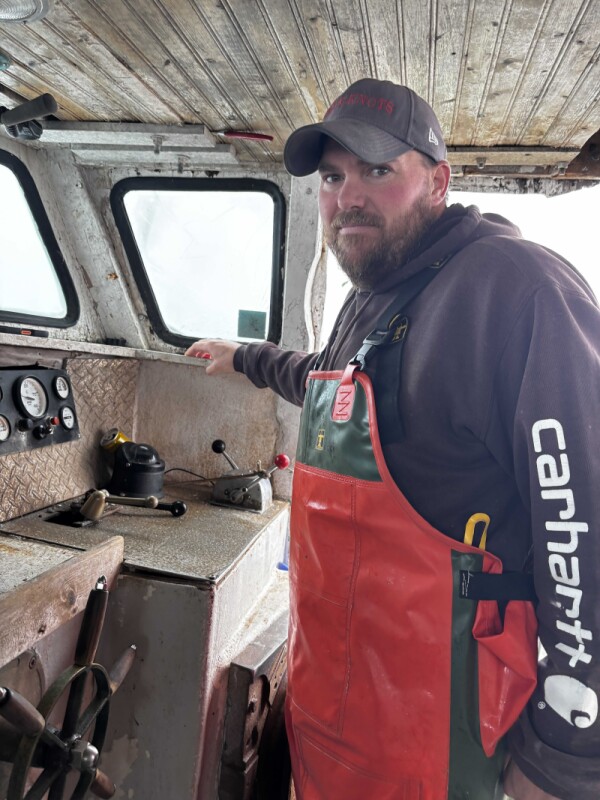
McConnell then opted for a John Deere, and it seems his luck has changed, but it took some work. “I bought a 300-horsepower John Deere rebuilt by a guy in Canada, up in northern New Brunswick or Quebec. He shipped it, so I never actually met him. They’d rebuilt it, but didn’t pressure test the head, and I guess it had a little stress fracture in it. After a couple of years, I started to notice it would run hot and overheat if I ran it at top speed, but I didn’t think much of it.”
In Lubec, at the mouth of the Bay of Fundy, tides can run 27 feet, and fishermen do a lot of work on their boats on the low tide. Over the course of two tides, McConnell let the Tide-N-Knots lie down on one side and then the other, so he could scrape and paint the bottom. “I have a wet exhaust, and when the tide came in and refloated her, she got water in there that got back into the engine. That’s when I called Tim Toppins. He came down to look at that and found I had bigger problems, so we took it out and sent it down to his shop to rebuild it again.”
At Toppins Diesel and Marine, they had put in new rings and sleeves when they decided to test the head. That’s when they discovered the crack and let McConnell know he needed a new head.
“I hadn’t been counting on that,” he says. “I ended up paying almost twice as much for the rebuild as I had paid for the engine.”
“It was a 6076AFM, a 7.6-liter inline 6 with 300 horsepower,” says Toppins, pulling the details from three years earlier from his memory. “It has a 507 Twin Disc. I used to sell a combination like that for $12,200 new. I just rebuilt one, and with all new parts, it cost $26,000.” With a gear ratio of 2.5:1, Toppins recalled that it turns a 2 and a quarter inch shaft and a 28x28 square propeller.
McConnell confirms that. “And she’s running good now,” he says, noting that he burns a little over 2 gallons an hour when longlining.
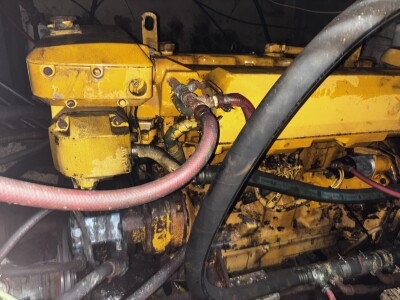
With his power problems vanquished, McConnell plans to put his attention on the rest of the boat, particularly the deck and deck gear. Which he admits she deserves after almost 18 years of service. “I bought the boat in Nova Scotia,” he says. “I went over there to look at a specific boat, and another guy from here ended up buying it, and he brought it over and blew the engine after a couple of days. Then I made a couple more trips over there looking –there’s a few brokers over there – I found this one in Hulls Harbor, and she was right for me.”
After bringing the boat over to the U.S. side, McConnell did a major overhaul on the hull. “I built up the rails about two feet and raised the deck up to the level of the wheelhouse deck, and about eight inches in the stern,” he says. McConnel also moved the 350-gallon fuel tank to the stern, replaced all the bulkheads, and put down a new deck.
“I used Avantec and glassed over it,” he says, referring to a composite plywood used in home construction. “It’s good in the wheelhouse, looks like the day I put it in, but out on deck, it’s all soft under the fiberglass. Now that my son has his student lobster license and is interested in fishing, I think I’ll fish another scallop season with her and then fix her up again.”
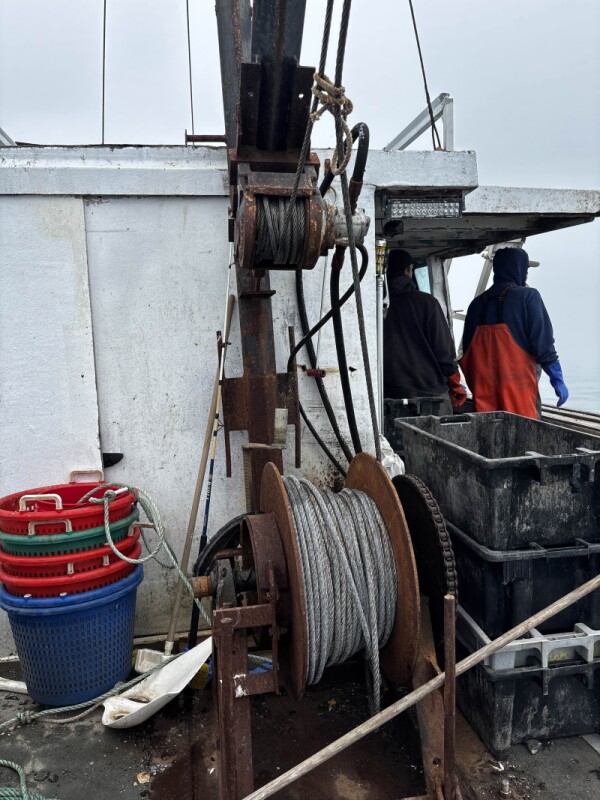
The boat suffers from what marine architects call “weight creep.” Over the years, gear and tools are brought aboard and end up finding a home down in the fo’c’sle. “What she needs is to get hauled out, put alongside a dumpster, and emptied out,” says McConnell. “Then I’m going to tear up this deck and put down some marine plywood this time.
The deck gear on the Tide-N-Knots consists of a 14-inch Hydro-Slave hauler for lobstering and longlining, a homemade winch for scallop and urchin dragging, and a Pullmaster number boom winch for dumping the scallop and urchin dredges. “The hydraulics run off a jack shaft with an electric clutch,” says McConnell. “I just flip a switch on the panel here.”
The hauler is working fine, and so is the Pullmaster, but the homemade winch has problems. “I had just put on new wire,” says McConnell. “And I was back there, paying attention to the drag – couldn’t see the winch – and the wire jumped over the flange on the drum and tightened up and crushed the bearing. I’ll have to take it home and put a new pillow block on it.”
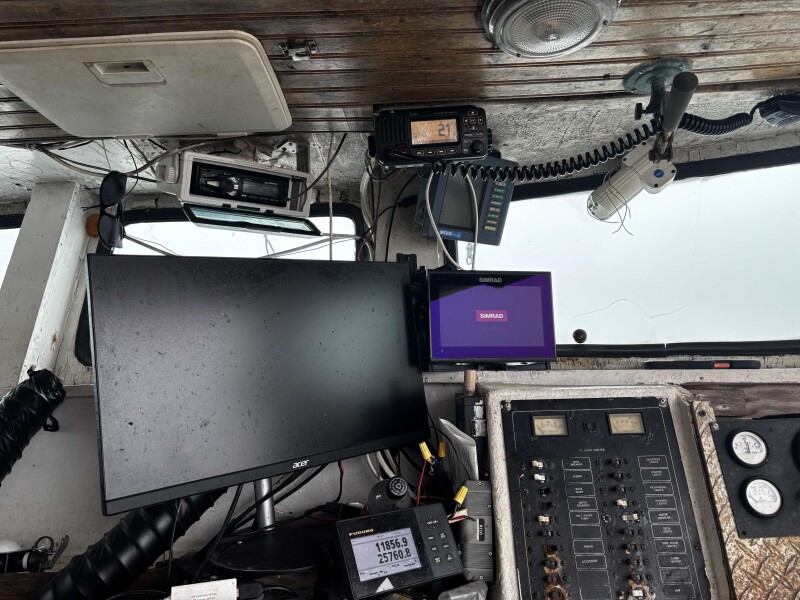
McConnell's electronics suite is minimal. It consists of a Simrad plotter, radar, depth sounder, a computer running a basic Time Zero program, A Si-Tex 106L fishfinder, a Furuno GPS, and a couple of VHFs.
Like a lot of Downeast fishermen, the primary yard McConnell takes the boat to is his front yard, and that’s where he plans to get the Tide-N-Knots back in shape. “Last year, my son and I hauled ten traps by hand from the skiff,” he says. “This year he can haul 50, so we’ll use the boat.”
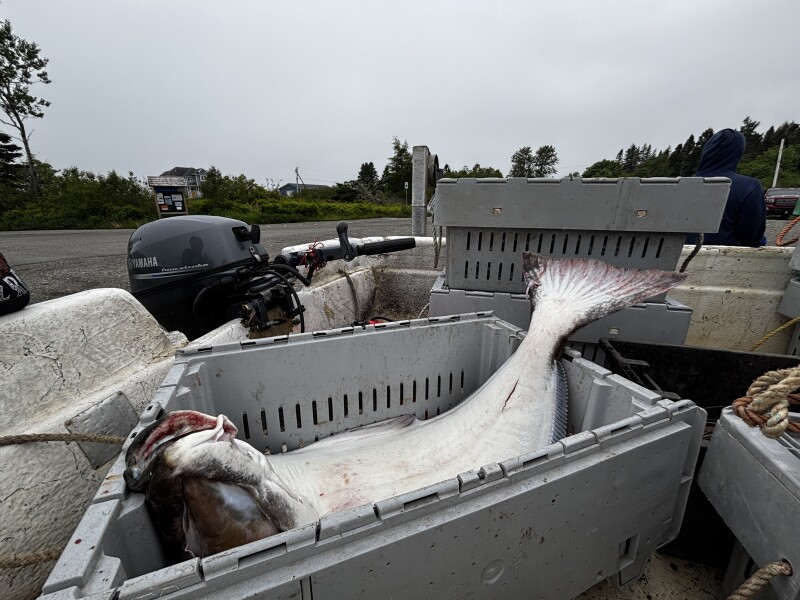
On June 13, while we talk about his boat, McConnell and his son Kallen, along with Chris Tripp and Alex Matthews, are hauling halibut trawls in thick fog a mile or two off the coast. After hauling a 54-inch fish aboard, he and the crew head back to their mooring in Bailey’s Mistake, named for a captain who ran his boat aground there. It’s the last fish of the season, 54 inches long and McConnell estimates its weight at 65 pounds.
“That’s our 21st fish,” he says. “We get 25 tags, and we almost tagged out.”
Spec Box
Name of Boat: Tide-N-Knots
Home Port: Lubec, Maine
Owner: Greg McConnell
Builder: Built in Nova Scotia in 1979
Hull material: fiberglass
Year built: 1979
Fishery: Scallop, urchin, lobster, halibut
Length: 42 feet
Beam: 15 feet
Draft: 4 feet
Main Engine: 320-hp John Deere 6076 AFM
Power Train: Twin Disc MG507 at 2.57:1, 2.25-inch diameter shaft, 28x28 propeller
Hydraulics: Jack shaft off main, electric clutch
Fuel Capacity: 400-gallon port tank, 250-gallon starboard tank
Water Capacity: 400 gallons
Electronics: Panasonic Toughbook running TimeZero, Si-Tex fish finder, Simrad GO9 plotter/radar/sounder, Furuno GPS, two VHFs