




When Evening Star Fisheries lengthened and sponsoned the Bering Sea trawler Progress at Fred Wahl Marine Construction (FWMC) in 2019, the company prepared for a future repowering project.
“We knew the gear was approaching the end of its life, and that the engine, a 1,200-horsepower Cat 3512 A series, was not going to be enough to push that much steel through the water,” said Hunter Berns, general manager of what is now Bering North LLC.
“The company was formed when Evening Star Fisheries was purchased in 2022 by a partnership that includes Coastal Villages Region Fund and Norton Sound Economic Development Corporation, and CDQ groups from Western Alaska, Berns said.
“During the capacity expansion project, we opted to prepare the shafting and exhaust systems for 2,000 horsepower,” Berns said. “And in 2023, we started working with Mike Fourtner at Cummins to find the right engine.”
Bering North chose a 2,000-hp Cummins QSK60 to replace the Cat. “Curry Marine supplied the engine, and we were able to go with Tier III because we were replacing basically a Tier 0,” Berns said. “Karl Senner supplied the gear; it’s a Reintjes WAF 763 at 5.91:1.”
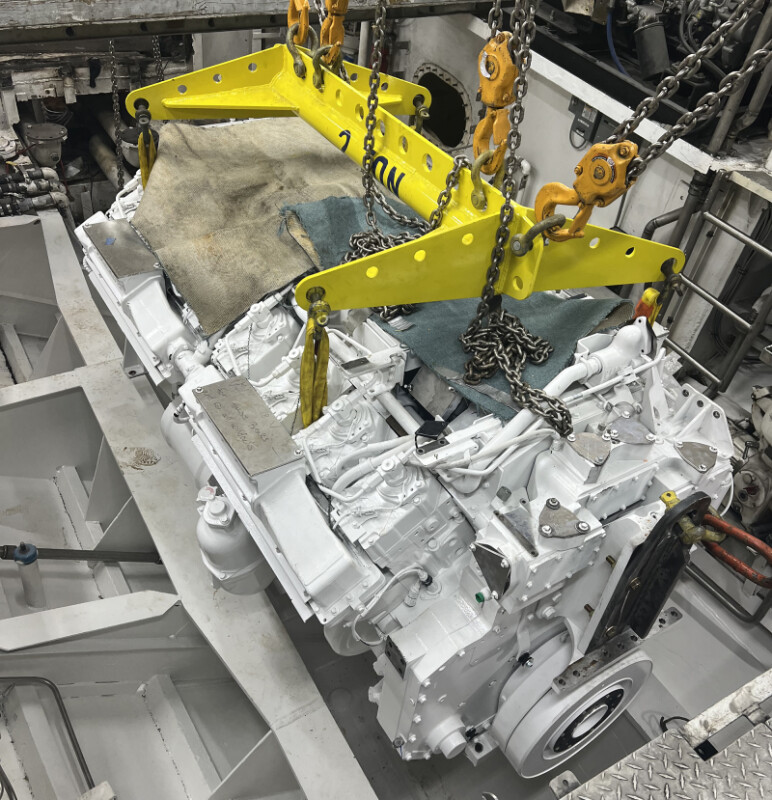
With the big decisions made, Bering North sent Progress back to Fred Wahl’s yard in Reedsport, Ore. “They know the boat, and they have the facilities to do the job,” Berns said. “We put her in the shed where they have an overhead crane that can lift the engines.”
Bering North had the Hockema Group, naval architects and engineers, scan the engine room and provide a plan to install new engine rails for the Cummins QSK60. “They cut a hole in the bulkhead between the forward fish hold and the engine room and took out the old engine in six hours,” Berns said. “Then they put in the bedrails for the Cummins and the reduction gear and did the same process in reverse.”
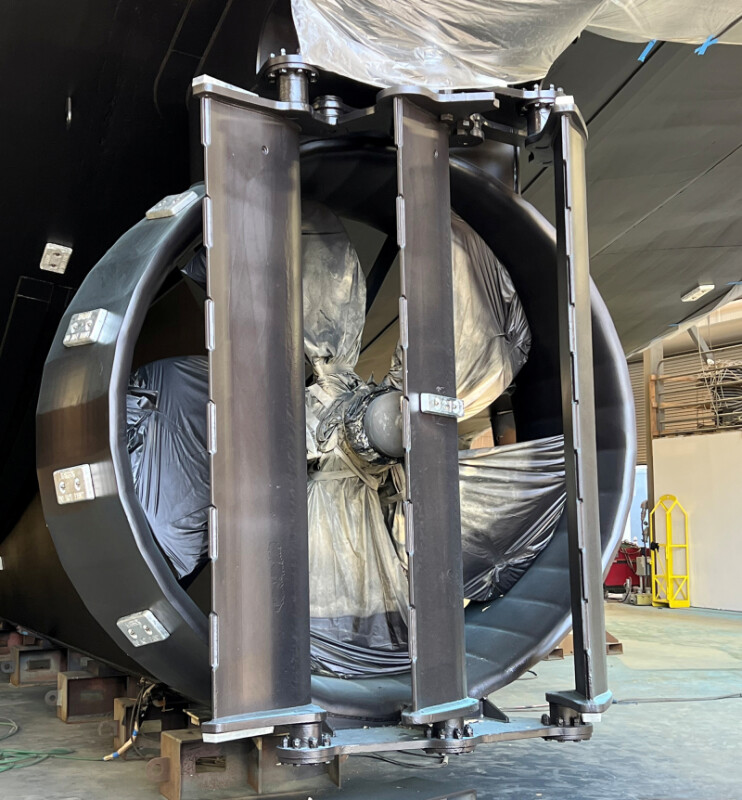
With the new engine in place, the crew at FWMC installed the new gear and an integrated propulsion unit supplied by Nautican. “The shaft is seven inches,” Berns said. "Nautican supplied an 88x91 propeller, nozzle, and a triple rudder system.”
The triple rudder system, Berns said, helps capture all the available bollard pull and helps the boat track better when steaming, thus improving fuel efficiency.
In terms of fishing operations, Berns sees a big improvement.
“It can cruise at 10 knots, and the top speed I’ve seen is 13.5. The power it has now gives the Progress a lot more versatility,” he said. “It’s especially important during the B seasons in the summer when fishing can get a lot scratchier. With the QSK60 they can fish a lot deeper and still pull the net at 3 or 4 knots. With the old engine we couldn’t have done that without sacrificing catch per unit of effort. And it helps us avoid bycatch by fishing around the depths where chum salmon tend to swim in the summer.”
According to Berns, working with professionals at FWMC and Hockema Group, two companies familiar with the vessel, made the entire process smooth and seamless.
“We did a lot of pre-planning,” he said. “That makes all the difference.”

.png.small.400x400.png)
