

The 2026 Bay-wide Blue Crab Winter Dredge Survey show a 46 percent increase in the abundance of blue crabs in Chesapeake Bay, for a total population of 349 million crabs.
“This increase comes despite another cold winter, which increased the overwintering mortality of crabs throughout the bay and caused cold-stun events in several finfish species throughout Virginia. Overall, the results suggest improved conditions for the 2026 crab fishery,” stated a news release from Virginia Marine Resources Commission (VMRC).
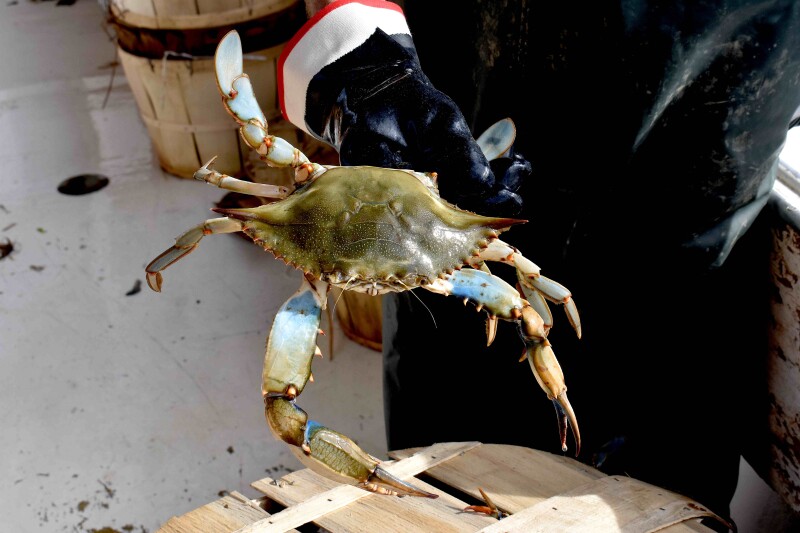
The annual Winter Dredge Survey found the total estimated population of blue crabs in Chesapeake Bay increased from 238 million crabs in the winter of 2024-2025 to 349 million crabs in the winter of 2025-2026. This was driven mainly by an increase of 120 percent in juvenile blue crabs, up to 228 million juveniles. Adult male crab abundance also increased, from 26 million to 37 million crabs. The adult female population, however, declined to 81 million. Although, the 349 million is encouraging, historically 1993 survey numbers of 852 million is a bar that has not been reached again since the dredge survey started.
The increase in juvenile crabs is showing up in Virginia crab pots. Joey William of Remlik, Va. fishes hard crab and peeler pots in the Rappahannock and Piankatank rivers. “I am seeing an abundance of juvenile crabs, the size of a thumbnail, in every pot that I pull,” says Williams. “If these crabs survive, we should have a good year next year.
"This spring we are not seeing the soft-shell and adult crabs that we usually see this time of the year,” says Williams. “I think it is most likely due to the cold winter and extended low water temperatures into May. Usually in May the (peeler) crab runs start and we are shedding 150 to 200 dozen (soft-shell crabs) a night. The best we have done this May so far is 40 dozen a night.”
The annual Winter Dredge Survey is the primary assessment of the Bay’s blue crab population and has been done annually by the Virginia Institute of Marine Science (VIMS) and Maryland Department of Natural Resources (DNR) since 1990. The survey employs crab dredges to sample blue crabs at 1,500 sites throughout the Chesapeake Bay from December through March. Sampling during winter when blue crabs are usually buried in the mud and stationary, allows scientists to develop, with good precision, estimates of the the number of crabs present in the Bay, stated the VMRC report.
Since 1990, blue crab fishery managers in Virginia, Maryland, and the Potomac River Fisheries Commission have used the annual Winter Dredge Survey estimates to help inform management for the coming fishing season. Additional information on the blue crab population is also anticipated through the completion of a bay-wide benchmark stock assessment. Managers will review that information alongside other ongoing monitoring efforts as it becomes available.
The Chesapeake Bay Stock Assessment Committee (CBSAC), an advisory group under the Chesapeake Bay Program, met on May 13 to discuss the results from the 2025-26 Winter Dredge Survey and the upcoming release of the benchmark stock assessment. Their analysis of the Winter Dredge Survey will be published in the full CBSAC Annual Report this June and presented to the Crab Management Advisory Committee in a public meeting later in May.
President of the Virginia Watermen’s Association, J. C. Hudgins of Mathews County, Va., said that unusually low water temperatures from the cold 2025-26 winter have really hurt crabbers who work in the sanctuary waters of the Chesapeake Bay.
These areas are closed to commercial and recreational crabbing from June 1-Sept. 15 and are designed to protect mature females crabs during the summer spawning migration. “This year when the water temperatures get high enough for crabs to start potting, the deep water grounds are already going to be closed to crab pots,” he says. “The sanctuaries cover nearly half of the best crab grounds in Virginia waters.
“It is great that the survey is showing more crabs but it won’t necessarily help area watermen right away,” says Hudgins.