


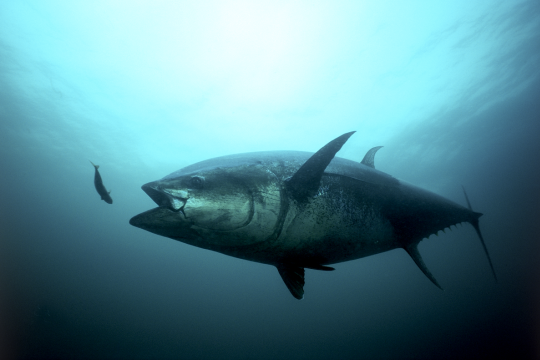
Commercial fishermen from New England to the Southeast are seeing a mixed picture across Atlantic highly migratory species, with several major tuna and swordfish stocks remaining in relatively strong conditions while some shark stocks continue to face rebuilding challenges.
NOAA Fisheries released its 2024- 2025 Stock Assessment and Fishery Evaluation Report for Atlantic Highly Migratory Species on Sept. 4, providing an updated look at tunas, swordfish, billfish, and sharks managed along the East Coast, Gulf, and Caribbean.
For fishermen, the report offers more than a snapshot of stock health. It also shows where commercial landings and revenues are moving, including a notable decline in overall highly migratory species revenue in 2024.
Tuna stocks show some of the stronger signs
Among the major commercial species, North Atlantic albacore remained well above its biomass target and was not considered overfished or subject to overfishing. Atlantic yellowfin and western Atlantic skipjack were also classified as not overfished, with overfishing not occurring.
The picture is less straightforward for bluefin.
NOAA Fisheries does not currently list a biomass-based overfished status for western Atlantic bluefin because scientists have been unable to establish the necessary biomass reference points. However, the report shows that overfishing is not occurring.
Commercial bluefin landings increased in 2024. Commercial rod-and-reel landings in the Northwest Atlantic reached 902.8 metric tons, up from 835.9 metric tons in 2023. Longline landings and estimated dead discards also increased from 125.7 metric tons to 172.3 metric tons, while harpoon landings remained nearly unchanged at 79.9 metric tons.
That increase translated into higher bluefin revenue. NOAA estimated the fishery generated about $12.2 million in 2024, up from $11.7 million in 2023, even as the average ex-vessel price slipped slightly from $6.19 to $6.12 per pound dressed weight.
Bigeye tuna presented a different picture. The stock is classified as overfished, although NOAA reported that overfishing is not occurring. U.S. bigeye landings also dropped sharply in 2024, particularly in the Northwest and North Central Atlantic longline fishery, where landings fell from 680.4 metric tons in 2023 to 228.6 metric tons in 2024.
The decline contributed to a steep drop in bigeye revenue, from roughly $8.4 million in 2023 to $2.9 million in 2024.
Swordfish remains healthy in the North Atlantic
For swordfish fishermen working from the Northeast through the Mid-Atlantic and Southeast, the North Atlantic stock remains one of the brighter spots in the report.
NOAA lists North Atlantic swordfish as not overfished, with overfishing not occurring.
Landings, however, continue to decline. Northwest Atlantic longline swordfish landings fell from 539.8 metric tons in 2023 to 510.7 metric tons in 2024, while handgear landings declined from 159.5 to 149.8 metric tons.
Gulf longline landings also declined, from 217.1 metric tons in 2023 to 190.7 metric tons in 2024.
Across the fishery, swordfish revenue slipped from about $7.27 million in 2023 to $7.18 million in 2024. Average ex-vessel price fell more substantially, from $5.15 to $4.48 per pound dressed weight.
Shark fisheries remain a mixed bag
The report shows some Atlantic shark stocks in relatively strong condition, while others remain overfished or subject to overfishing.
Atlantic blacktip sharks are not overfished and are not experiencing overfishing. The Gulf blacktip stock is also not overfished and is not experiencing overfishing.
Atlantic sharpnose sharks are similarly classified as not overfished, with overfishing not occurring, and the Atlantic smooth dogfish remains above its biomass threshold with overfishing not occurring.
Several other shark stocks remain under considerably more pressure.
Northwest Atlantic porbeagle remains classified as overfished, although overfishing is not likely occurring. North Atlantic shortfin mako is both overfished and experiencing overfishing, with its rebuilding period extending to 2070.
Sandbar shark remains overfished, though overfishing is not occurring, while dusky shark is both overfished and experiencing overfishing. Atlantic blacknose shark is also classified as overfished and experiencing overfishing.
Those biological constraints coincide with weaker overall shark revenues. NOAA estimated Atlantic shark fisheries generated just under $2 million in 2024, down from approximately $2.49 million in 2023.
Large coastal shark revenue declined from about $1.12 million to $856,000, while smoothhound revenue dropped from roughly $927,000 to $657,000.
Total revenue fell across the board
Perhaps one of the clearest takeaways for commercial fishermen is economic.
NOAA estimated total ex-vessel revenue from Atlantic highly migratory species at approximately $31.6 million in 2024, down from $36.9 million in 2023 and more than $41 million in 2022.
Tuna accounted for most of that decline. Total tuna revenue fell from approximately $27.2 million in 2023 to $22.4 million in 2024, driven largely by the drop in bigeye.
The report also shows how important different gear sectors remain to the fishery. Pelagic longline vessels accounted for approximately 52 percent of total 2024 highly migratory species ex-vessel revenue, while commercial rod-and-reel vessels accounted for 36 percent. Buoy gear contributed another 4 percent, harpoon vessels 2.8 percent, and bottom longline vessels 2 percent.
Taken together, the latest numbers show an Atlantic highly migratory species fisheries where biological and economic conditions do not always move together. Several major stocks supporting commercial fisheries, including North Atlantic swordfish, yellowfin, albacore, and some coastal sharks, remain above overfished thresholds, but fishermen face declining revenues, changing landings, and continued restrictions tied to stocks still rebuilding.