

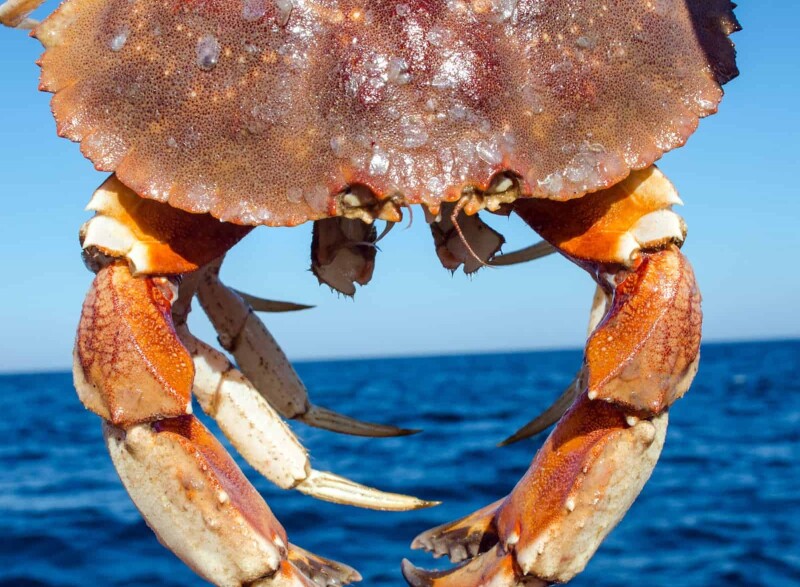
Researchers at the University of Rhode Island (URI) are studying whether offshore wind turbines are changing the movement and feeding behavior of Jonah crabs, work they say could have implications for fisheries management and future offshore wind development.
According to ecoRI, first-year URI Ph.D. student Emmanuel Oyewole is using isotopic analysis to determine whether Jonah crabs found around offshore wind turbines are migrating from traditional fishing grounds or spending their entire lives at turbine sites. The research is being conducted with Kelton McMahon, an associate professor of oceanography at URI.
"It's really, really important for understanding the impact of these wind farms on biodiversity, on ecosystem structure and function, and on fisheries production," McMahon told ecoRI.
The study builds on years of research showing that offshore wind turbine foundations can act as artificial reefs, supporting algae, coral and other marine life that create habitat for a range of species.
Jonah crabs have become increasingly important to Rhode Island's commercial fishing industry as lobster populations have declined due to warming waters and overfishing. Oyewole said the species has grown in market value, with an estimated 70 percent to 85 percent of Jonah crab stock coming from the Rhode Island area.
Researchers are comparing isotopic signatures preserved in a crab's shell with those found in its muscle tissue to determine whether individual crabs have moved between habitats or remained near the turbines throughout their lives.
"If [the turbines] are aggregating different biomasses from different areas, that means that you're having a lot of stock like Jonah crab stock coming from fishable areas to that particular area, which is less fishable," Oyewole told ecoRI.
The team is also analyzing the crabs' diets to better understand what attracts them to turbine sites. Similar research is also being conducted on black sea bass, which have become more common in Southern New England waters as ocean temperatures have warmed.
Oyewole said the goal of the research is not to determine whether offshore wind is inherently beneficial or harmful.
"Everyone when they see me asks about my research. They ask, 'Is it good or bad?' I'm just trying to understand what is happening so people can know," he told ecoRI.
The findings could help guide future marine spatial planning and fisheries management. If the study shows turbines are drawing Jonah crabs away from productive fishing grounds, researchers said future offshore wind projects could be sited farther from those areas. If the crabs are instead reproducing around turbine foundations, the increased populations could eventually spill over into nearby fishing grounds.