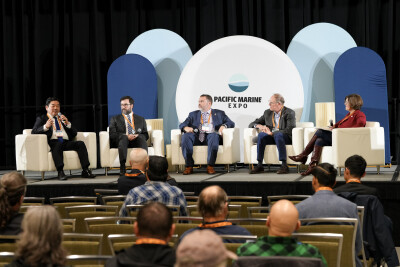
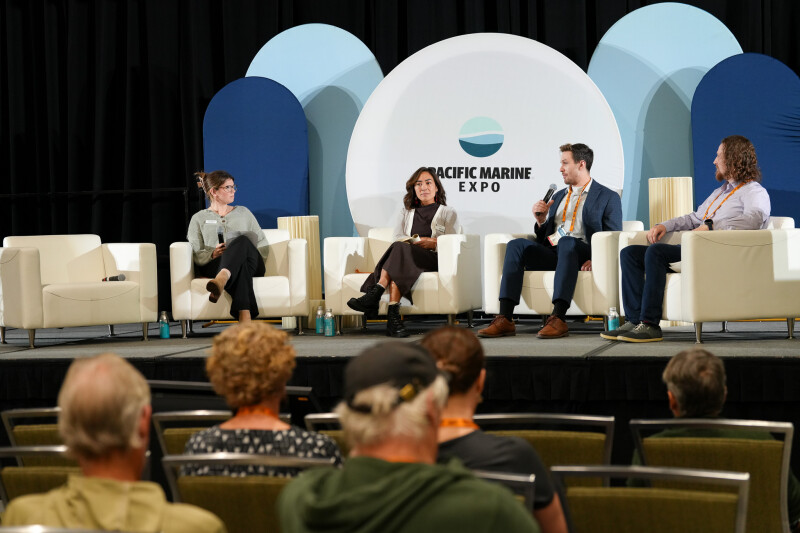
Alaskan fisheries face a number of challenges, and people all around the industry are looking for ways to improve the economic outlook for the future. Simon Marks of the McKinley Research Group—an Alaskan consulting firm that collects and analyzes the numbers relating to the state’s fisheries—opened a panel discussion, Alaska Seafood Outlook: Market Data, Trends, and What’s Shaping the Industry, at the 2026 Pacific Marine Expo with an overview of past and recent statistics.
“Sixty percent of the wild harvested seafood in the U.S. comes from Alaska,” Marks said. “But we are very small in the global context. Only 2.5 percent of the global wild harvest comes from Alaska, and only 1 percent of the overall seafood supply.” Marks noted that prices were trending upward for Alaskan seafood in general, and the groundfish harvest was steady overall with a small reduction in the pollock quota.
On the downside, however, Marks showed a slide indicating a reduction in employment in Alaska’s fishing industry. “The biggest drop we saw was in the number of active permit holders. That’s down 20 percent since 2015,” he said, adding that consequently, the number of crew is also down; only in processing was the decline minimal.
The key number in Marks’s presentation was the overall value of the industry. “The ex-vessel price of all Alaskan seafood is currently $2.01 billion for 2026,” he said. “And that is expected to increase by 10 to 15 percent.” The McKinley Group’s economic impact analysis, Marks noted, is a tool for the industry to explain and advocate for itself.
What the industry needs to advocate for, according to panelist John Burrows of the Alaska Seafood Marketing Institute, is upgrades to infrastructure. “The airport in Dutch Harbor needs to be expanded,” he said. “In fact, it’s hard to think of an airport in Alaska that doesn’t need improvement. Sitka just did some work on theirs, but most others need to be able to handle bigger planes and more fish. And I hear a lot about a lack of cold storage, and improving transportation.”
Lilani Dunn, executive director of the Bristol Bay Regional Seafood Development Association, agreed with Burrows and added that quality has to be a priority. “Price gets you into the store,” Dunn said. “But quality keeps you there.” Dunn noted that besides a Saltonstall-Kennedy Grant aimed at funding value-added projects for Alaskan seafood, there was also SK funding to get Alaska salmon into the food service industry. “We’re in discussions with distributors about what they’re looking for in terms of things like portion size.”
Like all the panelists, Dunn expressed optimism for the future. “We have a strong forecast for 2027 sockeye returns,” she said. “And we have new products from mariculture, like kelp and oysters, and personally I’d like to see herring come back, but we need markets and we need to be able to get products to those markets.”
The panelists also raised a number of critical issues, including tariffs and fuel prices that are impacting already slim profit margins in export markets, which have been important to Alaska fisheries. These factors are driving a push to develop more domestic markets and deliver Alaskan seafood to Americans.