



There are two programs that I get to run at the Maine Coast Fishermen's Association: working waterfront and fishermen wellness. And while it seems like one doesn't have anything to do with the other, they actually have a pretty significant overlap in their Venn diagram.
There are a couple of reasons for this.
In the wellness industry, there is a term called "the third place." The third place is somewhere that a person visits regularly that is neither their job nor their home. And while a working waterfront is definitely a part of a fisherman's job, it also tends to be a space where fishermen get the opportunity to check in and commiserate — as does the general store, which, if we are being honest, is also vulnerable to many of the changes happening in our coastal communities.
Third places matter because they are where people find belonging outside of work and family. They are where community gets built and maintained, where people feel seen and known, and where the informal networks that hold a place together actually function. When those spaces disappear, people lose something that is hard to name — but it can leave lingering emotions.
And when these places are lost, it leads to feelings of grief and sadness. Which seems strange, because we usually think of grief when a loved one or a pet dies. But it turns out you can grieve the loss of a place too.
More specifically, this is called solastalgia.
The term was coined by philosopher Glenn Albrecht to describe the grief, anxiety, and sense of loss people experience when the place they live in changes around them in ways they did not choose and cannot control. Albrecht developed the concept to articulate what communities feel in the aftermath of environmental disasters — like what happened to people in Louisiana after Katrina.
It is the homesickness you feel when you are already home.
Gentrification is a concept that has been well studied in urban communities, but it has not been as well developed in rural coastal communities, because it is far more subtle. In urban areas, you can see your community gentrify as new coffee shops pop up and long-term residents are priced out. On the Maine coast, it moves more quietly. When a coastal community gentrifies, the visible physical changes are things like rising property values, multiplying seasonal homes, and disappearing long-term rentals. Young fishing families who cannot afford to stay in the communities they fish out of move further and further inland, commuting longer and longer distances to a wharf that used to be a short drive down the road.
But something else happens too — something that takes longer to name and is harder to see. The composition of planning boards shifts, and the people making decisions about zoning, waterfront access, and land use are increasingly people who arrived recently, who love the coast for what it looks like rather than what it produces, and who may not have any direct experience with what commercial fishing actually requires. The institutional knowledge that used to live in those rooms slowly starts to fade: the harbormaster who knew every boat, the selectman whose grandfather fished, the neighbor who understood what a working wharf required. The people who replace them are starting from scratch with a very different set of assumptions about what the waterfront is for.
This is the civic dimension of solastalgia, and it is often absent from conversations about working waterfront protection. We talk about property values and zoning and infrastructure, but we rarely talk about the fact that the people making decisions about fishing communities are increasingly people who do not fish, who did not grow up in these towns, and who are applying a different set of values to the questions in front of them.
And that disconnect can have real mental health consequences.
There is a concept in the gentrification literature called the social preservationist. It describes a particular kind of newcomer — not a developer or someone who wants to change everything, but someone who genuinely loves the community they have moved into and wants to protect what they see as its authentic character. So they go to the planning board meetings and they advocate for preservation.
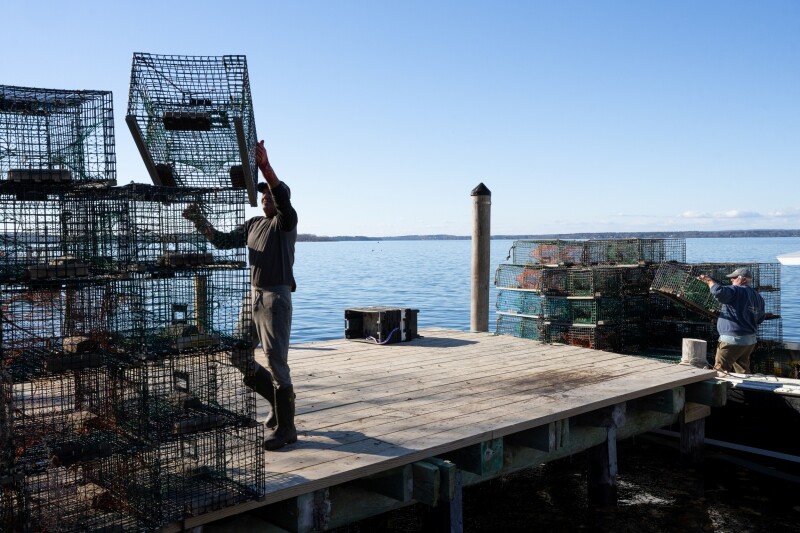
The problem, as gentrification research has noted, is that what the social preservationist wants to preserve is a version of the community that they have defined. They are drawn to the picturesque: the weathered wharf, the stacked traps, the lobster boat at dawn, the buoys hanging from mailboxes. They want to enshrine that specific image. What they are less interested in — often without realizing it — is the messy, industrial, sometimes smelly, often loud reality of what makes that image possible: the bait shed, forklifts beeping, airboats, the smell of diesel exhaust, gear piled on a wharf.
So what happens in practice is that the social preservationist ends up working at cross-purposes with the fishing community they are trying to protect. They support conservation language that restricts the very activities that sustain commercial fishing. They object to the infrastructure that fishing families need to actually do the job. They vote against the affordable housing that would allow the next generation of fishing families to stay in the community. And they do all of this while genuinely believing they are on the side of the fishermen. This is one of the most insidious forms of displacement precisely because it does not look like displacement from the outside. It looks like stewardship.
Fishing families feel these changes in their hearts and see them in the world around them every day. We try to communicate these stresses and concerns to people outside the industry, but it doesn't always feel like anyone is listening — and some of the solutions that get created in response don't actually match the concerns of the fishing community. That gap between what fishing families are experiencing and what gets addressed has its own name in psychology: moral injury. The term comes originally from military psychology, developed to describe the distress soldiers experience when they witness or participate in things that violate their deeply held values, or when they feel betrayed by the people and institutions that were supposed to have their backs. It has since been applied more broadly to describe the particular kind of distress that comes from watching the wrong problem get solved, or from feeling like your experience is being managed rather than heard.
We talk about the feeling of being misunderstood in our own towns — of going to a selectboard meeting and feeling like a guest in a room that used to belong to us, of watching arguments about gear storage and bait shed permits and wharf noise that would have seemed completely absurd a generation ago become serious ordinance questions. We are watching school enrollment shrink because there are simply not enough kids left when the families who have historically lived here year-round are getting squeezed out.
This is also why, when fishermen are accused of breaking child labor laws, it generates outrage in fishing communities that can seem disproportionate to outsiders. To be clear, it is not because fishing families are opposed to protecting children. It is because those cases feel like one more instance of an outside value system being applied to our way of life by people who do not understand it — and one more signal that the community we knew is being replaced by something that feels pretty exclusionary.
This, too, is solastalgia, and it compounds over time. Every planning board decision that prioritizes "peace and quiet" over access adds to the weight. Every conservation argument that restricts a working wharf without consulting the people who depend on it adds more.
So what does this mean for fishermen wellness?
Because of the fishermen wellness program, I think about solastalgia not just as a community health issue but as an individual one. The research on solastalgia consistently connects it to anxiety, depression, and a diminished sense of purpose and identity. For fishermen, whose work is intimately tied to a specific place, a specific community, and a specific set of relationships that have often been passed down through generations, the psychological cost of watching all of that change is significant. And when the third places disappear too — the places where fishermen have always gone to decompress, to belong, to feel like themselves — there is nowhere left to put that weight down.
We can intuitively understand the physical toll of the work: the chronic pain, the overuse injuries, the demands of an occupation that truly has no off-season and no HR department. But the mental load is real too, and it is not just the stress of an unpredictable industry, the regulatory burden, or the financial uncertainty. It is the weight of watching the community you built your life around become something you do not quite recognize.
What makes this particularly hard to address is that these feelings tend to get buried under everything else. There is always something more immediate to deal with: the price of bait, the weather window, the boat that needs fixing. The grief that comes from watching your community change is not the kind of thing that gets scheduled into a conversation. It sits underneath all the other things and quietly drains reserves. A fisherman carrying that kind of loss — in the way that fishing families tend to carry things — has less capacity to absorb the next hard thing, less margin for the stresses that are more visible and easier to name, and may be more likely to reach for something that offers temporary relief from a depletion that does not have an obvious source.
This is why working waterfront and fishermen wellness are not truly two separate programs.
Naming something actually matters. Having the terminology and the words to describe an experience is important because it helps people who are less familiar begin to understand what fishing families are going through.
Solastalgia gives us language for something real that has been happening without a name for a long time.
But naming is not enough. What fishing communities need is for the policy conversations about working waterfront protection to expand beyond the physical and into the civic and the cultural. The conversation needs to include who is in the room when decisions get made, whose values are shaping the outcome, and what we are actually trying to preserve when we say we want to protect the working waterfront.
The coastline is being gentrified — but so is the culture of fishing communities. The grief that fishing families feel about both deserves to be taken seriously, not just as a public health issue, but as a fundamental question about what these communities are for and who gets to decide.
.jpg.small.400x400.jpg)
